Table of Contents >> Show >> Hide
- Are Squats Safe During Pregnancy?
- Benefits of Squats During Pregnancy
- When You Should Ask Your Provider Before Doing Squats
- How to Perform Squats Safely During Pregnancy
- Common Mistakes to Avoid
- Trimester-by-Trimester Squat Tips
- When to Stop Squats Immediately
- Smart Modifications If Regular Squats Do Not Feel Great
- Real-World Experiences: What Squats During Pregnancy Often Feel Like
- Conclusion
- SEO Tags
Pregnancy changes a lot of things, including your balance, your breathing, your energy, and your relationship with chairs. One minute you are cruising through your day, and the next you are lowering yourself onto the couch like it is a precision landing. That is exactly why squats get so much attention during pregnancy. Done well, they can help maintain lower-body strength, support daily movement, and prepare you for the physical demands of labor, delivery, and postpartum life.
But let’s be honest: the word squat can sound either empowering or mildly threatening, depending on how your hips, knees, and pelvic floor are behaving that day. The good news is that prenatal squats are often safe and useful when they are adjusted to your body, your trimester, and your provider’s advice. The goal is not to perform gym-hero reps while dramatically staring into the distance. The goal is to move well, stay stable, and avoid turning a healthy exercise into an unnecessary struggle.
This guide breaks down the benefits of squats during pregnancy, who should be cautious, how to perform them safely, and how to modify them as your belly grows and your center of gravity starts making executive decisions of its own.
Are Squats Safe During Pregnancy?
For many people with uncomplicated pregnancies, squats can be a safe part of a prenatal fitness routine. In fact, strength-focused movement is often encouraged during pregnancy because it supports muscle tone, endurance, posture, balance, and everyday function. A well-executed squat trains the muscles you rely on constantly: glutes, quads, hamstrings, core, back, and pelvic floor.
That said, “safe” does not mean “same as before pregnancy.” Your joints may feel looser, your posture changes, and balance becomes more unpredictable as pregnancy progresses. A squat that felt effortless before pregnancy may suddenly require a wider stance, slower tempo, extra support, or fewer repetitions. That is not failure. That is smart programming.
If you were already exercising before pregnancy, you can often continue with appropriate modifications. If you are new to exercise, squats can still be introduced gradually. Think of pregnancy fitness less like training camp and more like intelligent maintenance. Your mission is to stay strong, mobile, and comfortable, not set a personal record while assembling nursery furniture.
Benefits of Squats During Pregnancy
1. They strengthen the muscles you actually use every day
Pregnancy is full of functional movement: standing up, sitting down, picking things up, climbing stairs, getting out of bed, and later lifting a baby, car seat, diaper bag, and approximately fourteen tiny but somehow heavy items. Squats build strength in the lower body and trunk, which makes these movements easier and safer.
2. They can support posture and reduce strain
As your abdomen grows, posture shifts. Many pregnant people lean back more, arch the lower back, and feel extra tension through the hips and spine. A properly performed squat encourages better alignment, glute activation, and more controlled movement through the hips. That can reduce some of the mechanical stress that shows up as “Why does my back feel 97 years old today?”
3. They may help prepare you for labor positions
Supported squatting can be useful because squatting is also a labor position. It may help open the pelvis and can make the position feel less foreign if you choose to use it later during labor. Practicing the movement during pregnancy does not guarantee you will want to squat in labor, but it gives you another option in your movement toolbox.
4. They can encourage pelvic floor awareness
Squats involve the pelvic floor, but this is where nuance matters. Some people benefit from learning how to relax and lengthen those muscles during a supported squat. Others need more strengthening and coordination. And some people with pelvic pain, prolapse symptoms, or a very tense pelvic floor may need individualized guidance. In other words, the pelvic floor is not a one-button machine.
5. They can improve confidence in movement
One underrated benefit of prenatal squats is psychological. When you move well, you often feel better. When you feel better, you tend to trust your body more. And during pregnancy, that trust matters. Safe, repeatable movement can help you feel capable instead of fragile, which is a pretty great trade.
When You Should Ask Your Provider Before Doing Squats
Squats are not automatically right for every pregnant person. Before adding or continuing them, check with your OB-GYN, midwife, or physical therapist if you have a high-risk pregnancy, vaginal bleeding, regular contractions, preeclampsia, severe anemia, heart or lung conditions, severe pain, or any provider-directed exercise restrictions.
You should also pause and ask for guidance if you have:
- Pelvic girdle pain or symphysis pubis dysfunction
- Sharp pubic bone pain or groin pain
- A sense of pelvic heaviness or prolapse symptoms
- Urine leakage that worsens with exercise
- Persistent low back pain that increases with squatting
- Dizziness, faintness, or unusual shortness of breath
Needing modifications is common. Needing professional guidance is smart. Needing both is basically pregnancy in one sentence.
How to Perform Squats Safely During Pregnancy
Option 1: Supported Bodyweight Squat
This is one of the best starting points because it gives you strength work without demanding circus-level balance.
- Stand with your feet about hip-width to shoulder-width apart. As pregnancy progresses, a slightly wider stance often feels better.
- Point your toes forward or slightly outward, whichever allows your knees to track comfortably.
- Hold onto a sturdy surface such as a countertop, chair back, wall rail, or suspension strap.
- Inhale as you bend at your hips and knees, lowering slowly like you are sitting back into a chair.
- Keep your chest lifted, spine neutral, and heels grounded.
- Only go as low as you can without pain, instability, breath-holding, or pelvic pressure that feels wrong.
- Exhale as you return to standing, pressing through your feet in a smooth, controlled motion.
Start with 6 to 10 repetitions. If that feels good, do 1 to 3 sets with rest in between. Slow and steady wins the prenatal race.
Option 2: Wall Squat With a Fitness Ball
This variation can feel more stable for some pregnant people.
- Place a fitness ball between your lower back and a wall.
- Stand with your feet about shoulder-width apart and slightly in front of you.
- Slide down the wall slowly, aiming for a comfortable depth.
- Keep your heels flat and your knees aligned over your feet.
- Return to standing in a controlled way.
You do not need to chase a perfect 90-degree knee bend if your body says, “Absolutely not.” Range of motion can be smaller and still effective.
Breathing Matters More Than Most People Think
Try not to hold your breath during squats. A simple pattern works well: inhale on the way down, exhale on the way up. This helps with control, reduces unnecessary pressure, and encourages better coordination through the core and pelvic floor.
If you notice yourself clenching everything from your jaw to your eyebrows, reset. Pregnancy workouts should feel intentional, not like you are trying to win an underground strength tournament.
Common Mistakes to Avoid
Going too deep just because you used to
Depth is not a gold medal event. If a deep squat feels smooth and pain-free, fine. If it causes pressure, pinching, instability, or pain, reduce the depth. Partial squats count. Supported squats count. Sit-to-stands from a chair definitely count.
Letting the knees cave inward
Your knees should generally track in the same direction as your toes. If they collapse inward, widen your stance slightly, reduce your depth, or hold onto support.
Lifting more than you can control
Pregnancy is usually not the time to suddenly become very interested in heavy barbell squats. Even if strength training remains part of your routine, control and stability matter more than ego. There is no trophy for “most determined squat while mildly off-balance.”
Ignoring pain or warning signs
Discomfort from effort is one thing. Pain, pressure, leaking, dizziness, contractions, or feeling unsteady is another. Your body is not being dramatic. It is providing feedback. Listen to it.
Trimester-by-Trimester Squat Tips
First Trimester
Many people can continue their usual squat pattern early in pregnancy, especially if they were already active. Fatigue and nausea may be the bigger issue than mechanics. Keep workouts short if needed, hydrate well, and remember that “today I only did one set” still counts as movement.
Second Trimester
This is often when balance changes become more noticeable. A wider stance, slower descent, and supported setup can make a huge difference. Avoid long periods lying flat on your back during workouts, and pay attention to how your pelvis feels during and after exercise.
Third Trimester
Now the squat often becomes less about performance and more about comfort, mobility, and function. Supported squats, box squats, sit-to-stands, and gentle deep supported holds may work better than repeated low squats. You may also need longer rest periods and more room for your belly. That is normal. The assignment here is not elegance. It is safe movement with good control.
When to Stop Squats Immediately
Stop exercising and contact your healthcare provider if you notice any of the following:
- Vaginal bleeding
- Fluid leaking or gushing
- Dizziness or faintness
- Chest pain
- Shortness of breath before exercise or symptoms that feel unusual
- Regular contractions
- Calf pain or swelling
- Trouble walking or sudden weakness
- Decreased fetal movement
- Severe pelvic pain, intense pubic pain, or pain that makes weight-bearing hard
That last point matters. If squats make it painful to walk, climb stairs, roll in bed, or get out of the car, do not power through. Pelvic girdle pain and symphysis pubis dysfunction deserve proper evaluation and treatment.
Smart Modifications If Regular Squats Do Not Feel Great
- Chair squat: Lower to a chair and stand back up.
- Counter-supported squat: Hold a kitchen counter for balance.
- Wall squat with ball: Add back support and control.
- Mini squat: Use a smaller range of motion.
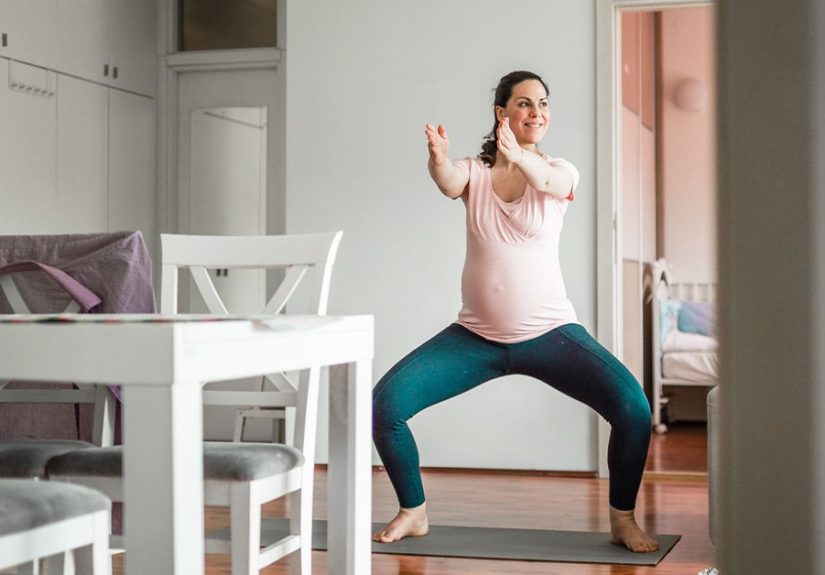
- Sumo-style stance: A wider stance can create more belly room.
- Physical therapy referral: Best for pelvic pain, prolapse symptoms, or uncertainty about technique.
The best prenatal squat is the one your body tolerates well and that you can repeat consistently without symptoms.
Real-World Experiences: What Squats During Pregnancy Often Feel Like
One of the most helpful things to know about squats during pregnancy is that the experience can change from week to week. Early on, some people feel almost normal and wonder what all the fuss is about. Then one morning they go to squat and realize their balance has quietly packed up and moved to another zip code. Suddenly, they want a wall, a chair, a countertop, a spotter, and maybe emotional support from a nearby houseplant. That shift is common, and it does not mean something is wrong.
Many pregnant people describe supported squats as surprisingly reassuring. Instead of feeling like a hard workout, they feel like a way to reconnect with the lower body. The movement can make the hips feel less stiff, the legs feel more awake, and the body feel more capable. That matters during a season when physical changes can feel relentless. There is something grounding about practicing a basic movement and realizing, “Okay, I still know how to do this. I just do it differently now.”
Some people notice that squats feel best in the middle of the day, after they have moved around a bit, rather than first thing in the morning when everything feels tight and vaguely offended. Others feel stronger in the morning and more wobbly later. This is why rigid fitness rules often fail during pregnancy. The body’s needs can be annoyingly specific. You may love squats on Tuesday and reject them on Thursday. Both responses can be completely valid.
It is also common to discover that what used to feel like a leg exercise now feels more like a full-body negotiation. Breathing becomes part of the work. Posture matters more. Foot placement matters more. Recovery matters more. Even getting into position becomes an event. But that is not a bad thing. In many ways, pregnancy improves movement awareness because it forces you to stop rushing and start noticing.
People who keep squats in their prenatal routine often say the biggest benefit is not aesthetic. It is practical. They feel more prepared for daily life. Getting off the couch is easier. Climbing stairs feels less dramatic. Carrying groceries feels more controlled. Some say they feel better prepared for labor positions because supported squatting no longer feels strange. Others simply like the confidence boost of staying active in a body that is changing fast.
On the flip side, some experiences are a clear sign to modify. A feeling of heaviness in the pelvis, sharp pubic pain, leaking that gets worse, or pressure that lingers after the workout usually means it is time to scale back and ask for professional guidance. That is not giving up. That is course correction. A pelvic floor physical therapist can often turn a frustrating exercise into a manageable one by adjusting stance, breathing, depth, tempo, or support.
Perhaps the most universal experience is this: pregnancy rewards flexibility. Not yoga flexibility, though that can be nice. Mental flexibility. The willingness to say, “Today I am doing counter squats instead of deep squats, and that is still a win.” That mindset tends to make prenatal exercise safer, more sustainable, and far less annoying.
Conclusion
Squats during pregnancy can be safe, effective, and genuinely useful when you approach them with good form, smart modifications, and realistic expectations. They can strengthen your legs and glutes, support posture, encourage pelvic awareness, and help you stay functional through pregnancy and beyond. The key is to prioritize control over depth, support over pride, and feedback over force.
If your pregnancy is uncomplicated and squats feel good, keep them in your routine with the adjustments your body needs. If they feel wrong, painful, or unstable, step back and get guidance. Pregnancy fitness is not about proving toughness. It is about building strength that still feels respectful to the body doing the extraordinary work of growing a human.