Table of Contents >> Show >> Hide
- What Stretchable Traces Really Are
- Why Ordinary Traces Fail Under Motion
- The Materials Behind Stretchable and Flexible Traces
- The Main Design Strategies That Make Traces Stretch
- Design Rules That Keep Stretchable Traces Alive
- Manufacturing Approaches Used Today
- Where Stretchable Traces Matter Most
- A Practical Example
- Conclusion
- Hands-On Experiences With Stretchable Traces For Flexible Circuits
Flexible electronics used to sound like science fiction. Now they show up in wearables, medical patches, foldable gadgets, smart textiles, automotive interiors, and sensors that need to wrap around curved surfaces without throwing a tantrum. At the center of all this engineering drama is one deceptively simple question: how do you make an electrical trace move with the product instead of cracking the first time it bends, twists, or stretches?
That is where stretchable traces for flexible circuits come in. These traces are not just “regular PCB lines on a bad day.” They are carefully designed conductive pathways built to survive mechanical motion while still carrying signals, power, or both. Sometimes that means traditional flex-circuit design using polyimide and copper. Sometimes it means stepping into the more adventurous world of serpentine geometries, conductive inks, elastomers, silver nanowires, or hybrid structures that combine rigid islands with stretchy interconnects.
If you are designing electronics that need to conform to motion instead of fighting it, understanding stretchable traces is not optional. It is the whole ball game. Below is a practical guide to what stretchable traces are, how engineers build them, where they fail, and what design choices actually improve reliability in the real world.
What Stretchable Traces Really Are
A stretchable trace is an electrically conductive path designed to maintain continuity while the substrate changes shape. The important word here is stretchable, not merely flexible. Flexible circuits are built to bend. Stretchable circuits are built to tolerate in-plane strain, repeated deformation, and more complex motion such as twisting, folding, or skin-like stretching.
That distinction matters. A traditional flexible circuit can wrap around a hinge or fold into a small enclosure beautifully. Ask it to stretch like a gym band, though, and it may respond by cracking, delaminating, or silently becoming an expensive orange bookmark. Copper is excellent at conducting electricity, but it is not famous for behaving like a rubber band.
Because of that, the smartest stretchable-trace designs rarely depend on material choice alone. They use geometry, stackup design, mechanical strain management, and process control to keep the conductive path alive. In other words, good stretchability is usually designed in, not wished into existence.
Why Ordinary Traces Fail Under Motion
Standard traces fail for very predictable reasons. Mechanical strain concentrates at weak points: sharp corners, pad transitions, plated through-holes in bend zones, stacked conductors, abrupt material changes, and areas where the trace is forced to stretch directly instead of being allowed to distribute strain. When those stress risers build up, microcracks begin. Then resistance drifts. Then the circuit acts haunted. Then it stops working.
Even in classic flex design, thickness matters. The tighter the bend radius relative to the overall circuit thickness, the greater the risk of conductor fracture or coverlay damage. That is why experienced designers obsess over bend areas. They are not being dramatic. They are trying to avoid field failures, warranty claims, and the famous engineering phrase, “It worked on the bench.”
Stretchable circuits raise the stakes further because the conductor may see repeated cycles of strain rather than one controlled installation bend. That means fatigue becomes a real design constraint. Reliability is no longer only about conductivity on day one. It is about conductivity after hundreds, thousands, or even millions of movements.
The Materials Behind Stretchable and Flexible Traces
Traditional Flex Stackups
Many flexible circuits still start with a familiar recipe: polyimide film, rolled-annealed copper, adhesive systems, and a protective coverlay. This combination works well because polyimide offers thermal stability and mechanical flexibility, while rolled-annealed copper generally performs better in bending than copper foils more common in rigid boards. For products that need bending rather than aggressive stretching, this is still the workhorse approach.
These materials are especially useful when the circuit needs stable electrical performance, tight routing density, and compatibility with conventional fabrication and assembly methods. If your design only needs to fold once during assembly or flex around a fixed contour, a well-designed flex stack may be the simplest and most reliable answer.
Stretch-Ready Materials
Once the design needs real elongation, engineers usually expand the toolbox. Elastomeric substrates such as silicone or TPU enter the conversation. Conductive materials may shift from etched copper to printed silver inks, silver nanowire networks, conductive coatings, composite traces, or hybrid structures that blend metal conductors with soft binders. These materials trade some of the “classic PCB” mindset for greater compliance under strain.
High-elongation conductive inks are especially useful for wearables, smart textiles, flexible heaters, and soft human-machine interfaces. They can be screen printed or otherwise deposited on flexible films and fabrics, making them attractive when low-profile manufacturing, roll-to-roll production, or non-planar surfaces are part of the design brief.
The Main Design Strategies That Make Traces Stretch
Serpentine Traces
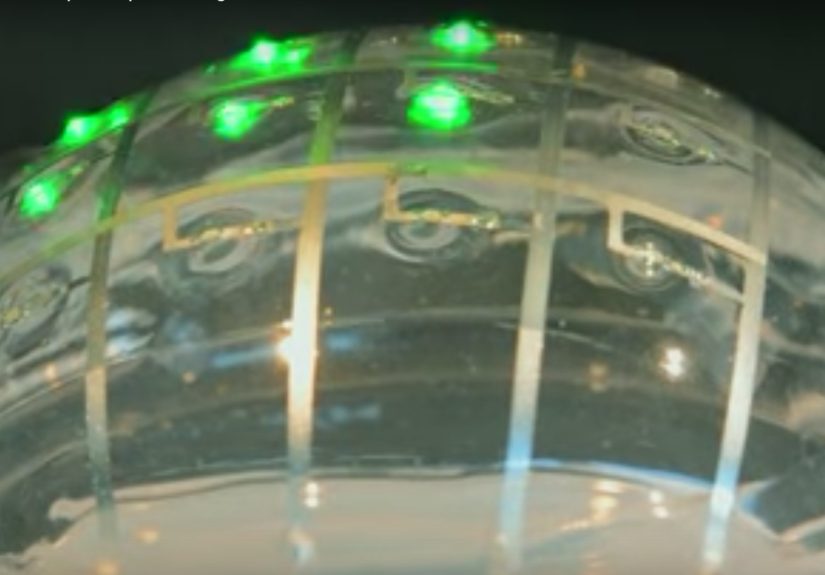
The most famous stretchability trick is the serpentine trace. Instead of running a straight line from point A to point B, the conductor follows a wavy, horseshoe, or self-similar pattern. That geometry behaves like a spring. When the substrate stretches, the trace can uncoil, rotate, and redistribute strain instead of taking the full force directly along its length.
This is why serpentine interconnects show up so often in wearable electronics research and advanced prototypes. They offer exceptional stretchability while allowing designers to keep higher-performance conductive materials in the system. Put simply, the trace does not become stretchy because the metal suddenly discovered yoga. It becomes stretchy because the layout does the mechanical work.
Island-Bridge Layouts
Another popular architecture uses rigid or semi-rigid islands connected by soft bridges. The “islands” hold chips, sensors, or other components that do not enjoy being stretched. The “bridges” carry the motion. This layout is elegant because it lets each region do what it does best: hard components stay protected, while interconnects absorb mechanical strain.
For many medical patches and body-worn devices, this is the sweet spot. You preserve electrical functionality where precision matters and allow stretch only where motion is unavoidable.
Printed Conductive Networks
Printing is another powerful route. Instead of etching copper from a laminated stack, manufacturers deposit conductive material directly onto a flexible or stretchable substrate. Depending on the process, that may involve screen printing, inkjet printing, direct-write printing, aerosol jet printing, or electrohydrodynamic methods. This opens the door to conductive polymers, silver inks, silver nanowires, and other formulations that can survive deformation better than a rigid metal film alone.
Printed traces are particularly attractive when the design needs low cost, large-area coverage, textile integration, fast iteration, or compatibility with soft substrates. They are not automatically superior to etched copper, but they are often better matched to products that move like people instead of like circuit boards.
Design Rules That Keep Stretchable Traces Alive
Start With the Motion Profile
Before choosing a conductor, define what the circuit must survive. Is the motion static, where the part bends once during installation? Is it dynamic, where the part flexes continuously in use? Does it stretch one direction, two directions, or twist? A trace that survives a one-time bend may fail quickly in a dynamic wearable. If you do not know the strain profile, you are not really designing yet. You are guessing in CAD.
Respect Bend Radius
In conventional flex design, common rules of thumb place single-layer circuits at a gentler radius-to-thickness target than many people expect, and multilayer circuits require even more caution. Dynamic applications usually demand larger radii and more conservative layouts than simple bend-to-install parts. The practical lesson is clear: a bend that looks fine on a screen can still be brutally sharp in real hardware.
For flexible copper circuits, controlled forming is better than creasing. A curve is your friend. A fold line is a future failure report.
Route for Mechanics, Not Just Electronics
In bend areas, traces should cross as close to perpendicular to the bend axis as practical, maintain consistent width, and avoid unnecessary thickness buildup. Multilayer conductors should be staggered rather than stacked directly over one another. Plated through-holes should stay out of bend regions. Pad transitions benefit from fillets and smooth geometry instead of acute angles. Ground or shield areas often work better as cross-hatched patterns than as big solid slabs of copper.
These details sound small until you realize most failures begin at exactly these kinds of details.
Protect Termination Zones
Connectors, pads, solder joints, and transition points tend to be mechanically vulnerable. Stiffeners and strain-relief features can dramatically improve durability by moving stress away from termination points. When a flex circuit must connect to a rigid board, bonding technologies such as anisotropic conductive film may also play a role in creating compact, controlled interconnects.
Manufacturing Approaches Used Today
The best manufacturing method depends on the application. Traditional etched flex circuits remain excellent for dense routing, repeatable geometry, and mature production control. Additive printing methods are appealing for soft sensors, low-profile wearables, disposable medical devices, or textile-based systems. Direct printing of metal or nanomaterial networks can also simplify prototyping when the design calls for unusual substrates or custom shapes.
Screen printing remains a favorite for many conductive inks because it balances throughput and cost. Inkjet printing helps when fine pattern control and digital process flexibility matter. Direct-write approaches are useful in research and advanced manufacturing. None of these methods is universally best. The right question is not, “What is the coolest process?” It is, “What process gives this product the conductivity, elongation, adhesion, throughput, and reliability it actually needs?”
Where Stretchable Traces Matter Most
Wearables and Medical Patches
Body-worn electronics live on curved, moving, sweaty surfaces that are famously inconsiderate to rigid hardware. Stretchable traces help temperature sensors, strain sensors, electrophysiology patches, and bio-signal devices conform to skin and maintain function during daily motion.
Smart Textiles
Textiles bend, fold, wrinkle, wash, and generally refuse to sit still. Conductive traces for e-textiles must tolerate that environment while remaining lightweight and comfortable. Printed conductive materials and stretchable silver-based systems are especially promising here.
Automotive Interiors and Flexible Heaters
Modern interiors increasingly integrate electronics into curved panels, seating, touch surfaces, and decorative trim. Stretchable or high-flex traces make it easier to embed sensors and heaters without forcing every surface to become a rigid assembly.
Aerospace and Advanced Sensors
Flexible and stretchable electronics also matter in aerospace, where lightweight, conformal sensing systems can mount on curved structures or wearable platforms. In these environments, designers care about both compactness and reliability under motion, temperature swings, and demanding use conditions.
A Practical Example
Imagine you are building an elbow-mounted motion sensor. Version one uses straight copper traces on a simple flex substrate. On the bench, it works. On the arm, it bends with each movement, strain concentrates near the pad transitions, and the signal becomes unreliable after repeated use. Version two uses component islands, serpentine interconnects, strain relief near the terminations, and a printed conductive section where the highest elongation occurs. Suddenly the device behaves less like a fragile lab sample and more like something a real person could wear.
That is the heart of stretchable-trace design. You do not win by making the whole circuit equally soft. You win by putting flexibility and stretchability where the mechanics demand them, while preserving electrical integrity everywhere else.
Conclusion
Stretchable traces for flexible circuits sit at the intersection of materials science, electrical design, and mechanical common sense. Traditional flex materials such as polyimide and rolled-annealed copper remain essential when the job is bending with reliability. But when the application must tolerate real stretching, engineers turn to smarter geometries, softer substrates, conductive inks, nanomaterial networks, and hybrid architectures that let motion happen without sacrificing electrical performance.
The best designs are rarely the flashiest. They are the ones that honestly match the conductor, substrate, geometry, and manufacturing process to the way the product will move in real life. That means respecting bend radius, reducing strain concentrations, protecting terminations, and treating stretchability as a system problem rather than a single-material miracle. Do that well, and your traces keep conducting while everything around them bends, twists, and stretches like it is no big deal.
Hands-On Experiences With Stretchable Traces For Flexible Circuits
One of the most common real-world experiences engineers report with stretchable traces is that the first prototype usually teaches more than the first spreadsheet. On paper, a design may look perfect: the resistance is low, the routing is neat, and the package fits beautifully. Then the prototype gets wrapped around a wrist, folded into a garment seam, or pressed into a curved housing, and suddenly the “good enough” trace geometry reveals its personality. Usually that personality is “I crack under pressure.”
In early prototypes, teams often discover that straight traces in high-motion areas are an invitation to failure. A wearable patch may survive ten flexes on the bench and then fail after a few hours of natural movement on a person. That is why many developers shift quickly to serpentine layouts, softer interconnect regions, or hybrid constructions with rigid component islands. The biggest lesson is that motion in the field is more chaotic than motion in a lab fixture. People twist, pull, sweat, sit, stand, and forget the device is even there. Your traces still have to cope.
Another frequent experience involves the termination area. Designers may focus heavily on the stretchable section and overlook the connection between the soft circuit and the harder world around it. But in practice, pads, connectors, solder joints, and board transitions are where many failures begin. Adding a stiffener, softening the stress gradient, or moving the bend zone away from the termination can make a dramatic difference. It is not glamorous engineering, but it saves products.
Teams working with printed conductive materials also learn that adhesion and process control are every bit as important as conductivity. A conductive ink can look fantastic right after printing and curing, then lose performance after repeated flexing if the substrate surface preparation was poor or the curing profile was not well tuned. On textiles, the challenge gets even more interesting because the substrate itself is uneven, porous, and constantly moving. Success often comes from treating the substrate, selecting the right binder system, and accepting that mechanical durability is part of the electrical design.
There is also a useful mindset shift that comes with experience: not every application needs extreme stretchability. Some products only need controlled flexing with long life. Others need small amounts of repeated elongation in one localized area. Chasing the highest possible stretch number can add cost and complexity without improving the actual product. Experienced teams define the real strain budget early, then optimize around that target instead of building a superhero trace for a job that only requires a reliable professional.
Perhaps the most valuable lesson of all is this: stretchable traces succeed when electrical, mechanical, and manufacturing teams work together from the start. If each group solves only its own problem, the product gets awkward compromises. But when they design together, the result is a circuit that fits the shape, survives the motion, and still performs electrically. That is when stretchable traces stop being a cool concept and become a genuinely dependable technology.