Table of Contents >> Show >> Hide
- What Do We Mean by “Ancient” Black Holes?
- Why These Black Holes “Shouldn’t” Exist (According to the Usual Rules)
- Meet the “Impossible” Elders: Early Supermassive Black Holes We’ve Actually Seen
- How Astronomers Find Ancient Black Holes Without a Time Machine
- JWST Changed the Story: Early Black Holes Might Be Everywhere (Just Hiding)
- So… How Did They Grow So Fast? The Leading Explanations
- What These Ancient Black Holes Teach Us About the First Galaxies
- FAQ: Quick Answers About “Impossible” Early Black Holes
- What’s Next: How We’ll Test These Ideas
- Conclusion: The Universe Was Busy Before It Was Cool
- The Experience: What It Feels Like to Chase the Universe’s Oldest Black Holes (About )
If the Universe had a “speedrun” category, early supermassive black holes would be its controversial world-record holders. We’re talking about black holes with the mass of hundreds of millions to billions of Suns showing up when the cosmos was still in its baby photos phaseless than a billion years old. In cosmic terms, that’s like spotting a fully-grown oak tree… the day after you planted the acorn.
And that’s the puzzle: in the time available after the Big Bang, these monsters shouldn’t have had enough time to form and grow. Yet they’re therebright, hungry, and loudly advertising their existence as quasars and active galactic nuclei (AGN). Astronomers aren’t questioning whether they’re real. They’re questioning how reality pulled it off.
This article breaks down what “ancient” means in astronomy, why these early black holes cause headaches (the scientific kind), what we’ve actually observed so far, and the leading ideas for how the Universe may have built these “impossible” objects so fastall with just enough humor to keep gravity from collapsing your attention span.
What Do We Mean by “Ancient” Black Holes?
In everyday life, “ancient” means dusty museums and “please don’t touch” signs. In cosmology, it means high redshiftobjects so far away that their light has been stretched by the expansion of space while traveling to us.
When astronomers say a quasar is seen at a redshift of about 7 or more, they mean we’re seeing it as it was when the Universe was roughly ~700 million years old (give or take, depending on the exact redshift). Considering the Universe is about 13.8 billion years old today, those black holes are basically fossilsexcept they’re not quiet or delicate. They’re more like cosmic leaf blowers powered by physics.
Quasar = A Black Hole With a Spotlight
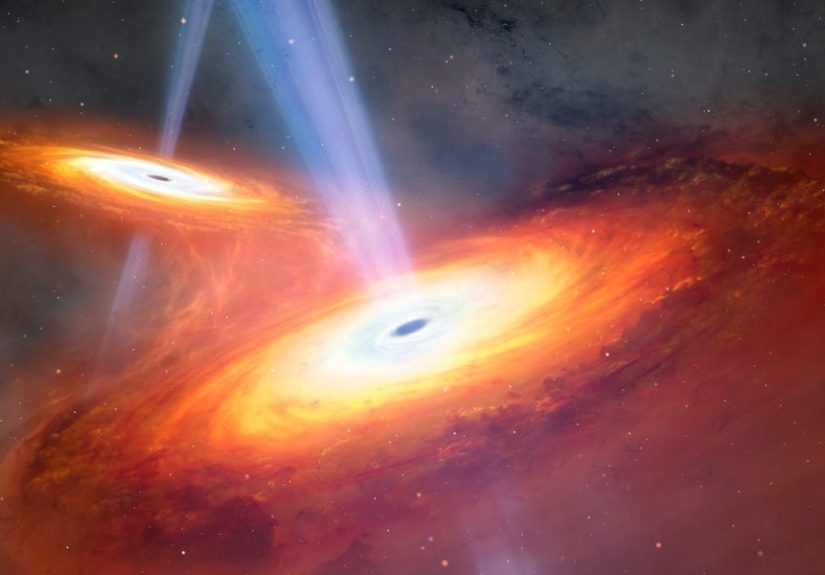
A quasar isn’t the black hole itself. It’s what happens when a supermassive black hole at a galaxy’s center is actively feeding. Gas spirals into an accretion disk, heats up, and blasts out radiation. That’s why quasars can outshine entire galaxies. The black hole is the engine; the quasar is the stadium lighting.
Why These Black Holes “Shouldn’t” Exist (According to the Usual Rules)
The problem isn’t that black holes exist. The problem is that they got enormous too quickly.
The Growth-Speed Limit: The Eddington Problem
Black holes grow by eating matter. But if they eat too fast, the energy they release pushes incoming gas away. That push creates a kind of natural throttle called the Eddington limit. It’s not a law that says “never,” but it’s a strong hint from physics that “going way faster is hard.”
Here’s the simplified math that keeps astronomers awake:
- Start with a “normal” black hole seed: say ~100 solar masses (a remnant of a very massive star).
- Grow at the Eddington-limited pace (steady, efficient feeding).
- To reach ~1,000,000,000 solar masses, you need about 16 “doubling-times” worth of exponential growth.
- Under common assumptions, that’s on the order of hundreds of millions of years of near-continuous, perfect feeding.
Now add real-world complications: galaxies are chaotic, gas supply isn’t constant, radiation and winds blow fuel away, and black holes don’t politely schedule their meals. The result is a cosmic question mark: how did billion-solar-mass black holes appear when the Universe hadn’t even celebrated its first billionth birthday?
Meet the “Impossible” Elders: Early Supermassive Black Holes We’ve Actually Seen
Let’s name names. A few early quasars have become celebrities in the astronomy world because they show up shockingly early with shockingly large black hole masses.
1) J0313–1806: A Big Black Hole in a Tiny Universe
This quasar is seen when the Universe was only about ~670 million years old, and it hosts a black hole around ~1.6 billion solar masses. That’s the kind of number that makes “How?” the most common word in the research group chat.
2) J1007+2115 (Pōniuāʻena): Another Early Heavyweight
Also from roughly the Universe’s first ~700 million years, this quasar’s black hole is estimated at around ~1.5 billion solar masses. The nickname “Pōniuāʻena” has helped it break out of the alphanumeric witness protection program that most quasars live in.
3) J1342+0928: The Classic “Ahead of Its Time” Headliner
Spotted at redshift ~7.5, this quasar shines from a time when the Universe was about ~690 million years old. Its black hole is estimated around ~800 million solar masses. That’s still “enormous,” just slightly less “how is this even legal?” than the billion-plus crowd.
Each of these objects is a reminder that the early Universe didn’t just build structure fastit built overachievers.
How Astronomers Find Ancient Black Holes Without a Time Machine
Finding these early black holes is less like “seeing a black hole” and more like detective work across wavelengths.
Step 1: Find Something Suspiciously Bright in Infrared
Because the Universe expands, light from the earliest epochs gets stretched out of visible wavelengths into the infrared. That’s why infrared surveys and telescopes are essential. If you hunt ancient quasars using only visible light, you’re basically trying to catch a radio station with a toaster.
Step 2: Confirm the Redshift With Spectroscopy
A candidate object becomes a confirmed high-redshift quasar when spectroscopy reveals telltale absorption and emission features. The famous Lyman-alpha break (where intergalactic hydrogen absorbs certain ultraviolet photons) shifts into infrared at high redshiftlike a cosmic barcode that says, “Yep, I’m from the early Universe.”
Step 3: Estimate the Black Hole Mass
Astronomers use the quasar’s brightness and the motion of gas near the black hole (inferred from the widths of spectral lines) to estimate mass. It’s not like putting the black hole on a scale. It’s more like watching a NASCAR track and estimating the engine size from the roar and the lap times.
JWST Changed the Story: Early Black Holes Might Be Everywhere (Just Hiding)
If early quasars were the loud, obvious black holes, the James Webb Space Telescope (JWST) started revealing a quieterbut potentially much more commonpopulation.
Enter the “Little Red Dots”
JWST found compact, reddish objects in the early Universe that look like tiny red pinpoints. Some may be dense galaxies packed with stars. But a growing chunk of evidence suggests many could be obscured black holesactive black holes wrapped in dust and gas, making them look red and hiding their true nature.
In several cases, spectroscopic signatures show gas moving fast enough to hint at accretion disksmeaning black holes feeding in the early Universe may have been far more common than the rare “bright quasar” samples suggested.
If that’s true, it’s a big deal: it implies an era when black holes grew rapidly behind curtains of dust, quietly packing on mass while the Universe was still assembling its first serious galaxies.
So… How Did They Grow So Fast? The Leading Explanations
To solve the “shouldn’t exist” problem, astronomers usually tweak one (or more) of these knobs:
- Start bigger (make the initial black hole seed heavier).
- Grow faster (allow periods of super-Eddington feeding).
- Merge more (build mass through frequent black hole collisions).
- Change the early environment (make gas inflows unusually efficient).
Option A: Heavy Seeds (Direct Collapse Black Holes)
Instead of starting with a ~100-solar-mass stellar remnant, some models propose “heavy seeds” of ~10,000 to 1,000,000 solar masses. These could form when massive clouds of primordial gas collapse directly into a black holeskipping the normal star stage.
This idea is popular because it solves the time crunch: starting with a head start means you don’t have to break physics’ speed limits to reach a billion solar masses quickly.
Option B: Super-Eddington Accretion (The Black Hole Buffet With No Bouncer)
The Eddington limit is a powerful guideline, but nature sometimes finds loopholes. If gas flows are dense and structured in certain ways, a black hole might feed at above the Eddington rate for a while. Not foreverjust long enough to gain mass rapidly when the Universe is young, dense, and extremely gas-rich.
Think of it like this: the Eddington limit is the speed limit on a highway. Super-Eddington accretion is when the road turns into an empty desert and the speed camera is… still loading.
Option C: Lots of Mergers (Cosmic Group Projects)
In the early Universe, galaxies merged frequently. If their central black holes also merged, that could accelerate growth. The catch is timing: mergers take time, and gravitational interactions can stall black holes before they combine. Still, in a crowded young cosmos, mergers likely helped.
Option D: Primordial Black Holes (The Wild Card)
Some hypotheses suggest black holes could have formed extremely earlypossibly from density fluctuations shortly after the Big Bangcreating “primordial” black holes. If a fraction of these were massive enough, they could serve as unusually early seeds.
This idea is intriguing but tightly constrained by other observations. It’s not the leading explanation for supermassive black holesmore like the plot twist you keep on the whiteboard because the Universe has surprised us before.
What These Ancient Black Holes Teach Us About the First Galaxies
Early supermassive black holes don’t exist in isolation. They’re linked to the first generation of galaxies, stars, and the dramatic era called cosmic reionization, when the first luminous objects transformed the neutral hydrogen fog filling the Universe.
Here’s why that connection matters:
- Black holes shape galaxies. When they feed, they can launch winds and jets that heat gas and regulate star formation.
- Galaxies feed black holes. The same gas that makes stars can also funnel into the center to grow a black hole.
- Both affect reionization. Massive stars and AGN can produce ionizing radiation that clears the early “fog.”
If JWST’s “hidden” black hole populations are common, then black hole growth may have been a major player in shaping the first billion yearsnot just a rare curiosity.
FAQ: Quick Answers About “Impossible” Early Black Holes
Are these the oldest black holes in the Universe?
They’re among the oldest observed supermassive black holes (or strong candidates) because we see them at very high redshift. There could be earlier ones we haven’t detected yet, especially if they’re faint or heavily obscured.
Do we actually “see” the black hole?
No. We see the light from hot gas around it (the accretion disk) and the effects on surrounding material. Black holes themselves don’t emit light.
Could the mass estimates be wrong?
Estimates can be uncertain, especially at extreme distances, but multiple methods and follow-up observations help. Even with uncertainty, many of these objects remain uncomfortably massive for their age.
What’s Next: How We’ll Test These Ideas
The good news: this mystery is testable. Astronomers are actively collecting data that can distinguish between “heavy seed,” “fast feeding,” and “merger-driven” growth.
- JWST spectroscopy can reveal whether early sources are powered by stars, black holes, or bothand how obscured they are.
- Large sky surveys can find more high-redshift quasars to map how common these monsters were.
- Future gravitational-wave observatories may detect mergers of massive black holes, giving a direct growth channel we can measure.
- Better simulations can test whether realistic early galaxies can feed black holes fast enough without breaking known physics.
In other words, the Universe handed us an “impossible” math problemand astronomers are responding by building better calculators, bigger telescopes, and occasionally stronger coffee.
Conclusion: The Universe Was Busy Before It Was Cool
Ancient supermassive black holes are a reminder that the early Universe wasn’t a slow warm-up actit was a high-energy construction zone. Finding billion-solar-mass black holes less than a billion years after the Big Bang forces us to rethink how the first structures formed, how gas behaved in the young cosmos, and whether black holes started small and ate their way up… or started big and simply refused to be ordinary.
Either way, these objects aren’t just oddities. They’re clues. And in astronomy, clues that shine across 13 billion years are basically the Universe texting us: “You sure you understand me?”
The Experience: What It Feels Like to Chase the Universe’s Oldest Black Holes (About )
There’s a funny thing about studying ancient black holes: the objects are unimaginably violent, but the process of finding them can feel like patient, slow-burn detective workmore “library mystery” than “space explosion.” A lot of the experience is staring at faint smudges and tiny spikes in data, then realizing you might be looking at something that existed when the Universe was still learning how to be a Universe.
Imagine being part of a team combing through infrared images. Most of what you see is ordinary by cosmic standards: galaxies at moderate distances, stars in our own Milky Way photobombing the frame, and the occasional weird object that turns out to be less weird once you double-check the calibration. Then you notice a dot that’s too rednot “sunset red,” but “the Universe stretched my light so far I practically live in the infrared now” red. That’s when your brain starts doing the mental math: if this is really high redshift, this dot is ancient. Like, “the Milky Way wasn’t even a concept yet” ancient.
The next step is where the suspense kicks in: spectroscopy. It’s one thing to suspect an object is far away; it’s another to watch its spectrum reveal the signature break and emission lines that confirm you’re peering into the first billion years. People describe that moment like watching a blurry photo snap into focusnot because the image suddenly looks sharp, but because the meaning becomes sharp. You’re not just seeing light; you’re seeing a timestamp.
And then comes the part that feels almost unfair: the mass estimate. You take the line widthsevidence of gas whipping around at outrageous speedsand combine them with brightness and models. Out pops a number that looks like a prank: hundreds of millions or billions of solar masses. If you’re new to the field, you might assume you made a mistake. If you’re experienced, you still assume you made a mistakejust in a more sophisticated way. You recheck everything: instrument effects, assumptions, alternative explanations. You ask, “Could this be a dense starburst instead of an accreting black hole?” You try to falsify your own excitement.
Even outside research teams, the “experience” of ancient black holes hits people in a very human way. At a planetarium or on a late-night science video binge, you hear: “This black hole existed when the Universe was only 5% of its current age.” Suddenly time feels elastic. Your calendar stops mattering for a minute. Your brain tries (and fails) to picture what a galaxy looks like while it’s still assembling its first serious structure, while a central black hole is already acting like it owns the place.
That emotional whiplashtiny dot, huge meaningis the real thrill. Ancient black holes turn the sky into a historical archive. And every new discovery feels like finding a page that shouldn’t be in the book… but definitely is.