Table of Contents >> Show >> Hide
- Why Tom Gauld’s weekly comics work so well
- 30 Tom Gauld works worth revisiting
- 1. Batman’s Book Club
- 2. Nighthawks at the Library
- 3. Self Help for Dogs
- 4. The Novelist’s Exoskeleton Suit
- 5. The Espionage Book Club
- 6. His Wuthering Heights cartoon
- 7. The Modern Romance Novel
- 8. Preparing to Meet the Editor
- 9. The Rewards of Enhanced Reading
- 10. Writing in January
- 11. Difficult New Year’s Resolutions
- 12. Performative Reading
- 13. Reading Resolutions
- 14. 27 December
- 15. The Last-Minute Christmas Rush at the Bookshop
- 16. A Christmas Advert Plot Generator for Bookshops
- 17. The Best Conspiracy Books
- 18. Ordering Books Online
- 19. Librarians v Booksellers
- 20. Missing Out on the Booker Prize
- 21. Writing a Masterpiece
- 22. The Desk of a Late, Great Author
- 23. Count Dracula
- 24. You’re All Just Jealous of My Jetpack
- 25. Baking with Kafka
- 26. Department of Mind-Blowing Theories
- 27. Physics for Cats
- 28. Mooncop
- 29. Goliath
- 30. Revenge of the Librarians
- What makes these comics so shareable
- A longer reader experience: what spending time with Tom Gauld feels like
- Final thoughts
Some cartoonists go for chaos. Tom Gauld goes for precision. Then, just when you think you are safely strolling through a tidy little drawing of bookshelves, lab coats, robots, or gloomy writers, he quietly drops a joke that makes you laugh, wince, and wonder whether you have accidentally been roasted by one of the smartest cartoonists alive.
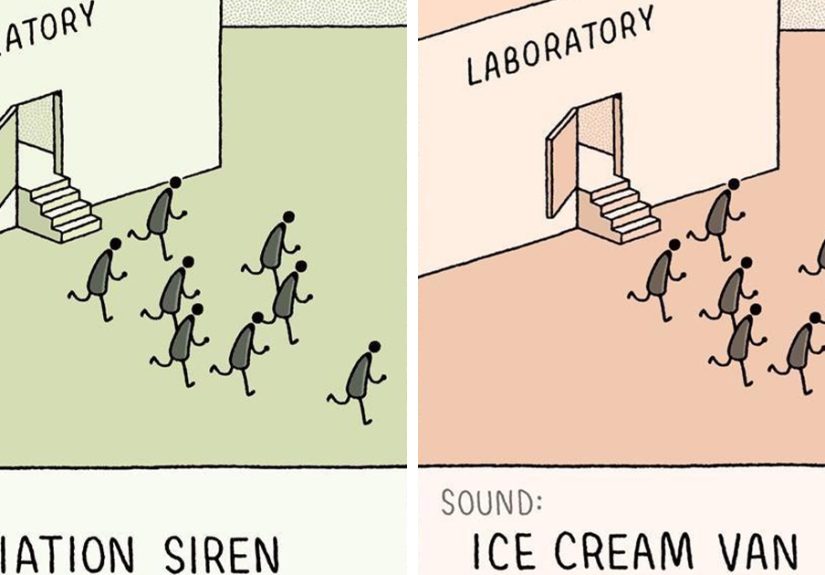
If the title did not already give the game away, the artist in question is Tom Gauld, the Scottish cartoonist and illustrator whose weekly comics for The Guardian and New Scientist have become catnip for readers who like their humor dry, literary, and just a little nerdy. His cartoons are never loud. They do not need to be. Gauld has built an entire creative universe out of minimalist figures, careful compositions, deadpan captions, and ideas that make books, science, and modern life feel equally ridiculous and oddly lovable.
That is why his work travels so well online. A Tom Gauld comic can hook a librarian, a physicist, a novelist, an overworked editor, a moody graduate student, or a regular person who simply enjoys a joke about how reading goals collapse by the second week of January. His panels are clean, his punchlines are sharp, and his humor treats people with affectionate skepticism rather than mean-spirited contempt. In other words, he understands the internet’s favorite snack: a smart joke that still leaves room for feeling.
Why Tom Gauld’s weekly comics work so well
Gauld’s magic trick is that he makes “intellectual humor” feel easy. He can riff on classic literature, the publishing industry, particle physics, or existential loneliness without sounding like a show-off. His cartoon voice is closer to the friend who slides a brilliant one-liner across the table and then goes back to sipping coffee like nothing happened.
Visually, he is just as disciplined. His pages often look simple at first glance, but that simplicity is engineered. The symmetry, the spacing, the tiny body language, the flattened architecture, and the restrained colors all help the joke land with surgical timing. He does not clutter the panel. He lets the idea breathe. Then he lets the reader do a little work, which makes the punchline hit harder.
Below are 30 Tom Gauld works, comic premises, and standout pieces of output that show why readers of The Guardian, New Scientist, and his books keep coming back for more.
30 Tom Gauld works worth revisiting
1. Batman’s Book Club
This is peak Gauld: a pop-culture icon dropped into a deeply bookish scenario, with the humor coming from the clash between brooding superhero mythology and the gloriously ordinary stress of finishing the monthly read. It is funny because it treats Batman not as a legend, but as a man who may or may not have skimmed chapter seven.
2. Nighthawks at the Library
Gauld loves art history almost as much as he loves literature, so this loving riff on Edward Hopper feels perfectly on brand. What makes it memorable is not just the reference, but the way he turns the hush of a library into something cinematic, lonely, and gently absurd all at once.
3. Self Help for Dogs
One of Gauld’s gifts is the ability to take a tiny premise and stretch it into a full comic ecosystem. A dog in a bookstore becomes a whole joke about taste, aspiration, and species-specific reading habits. It is silly, yes, but it is also the sort of idea that makes you think, “Obviously. Dogs would absolutely have a genre section.”
4. The Novelist’s Exoskeleton Suit
Few people understand the ridiculous mythology of writing better than Gauld. This cartoon turns the novelist’s struggle into a wearable machine, which is both hilarious and uncomfortably accurate. Every writer wants inspiration, discipline, and a spinal support system. Gauld simply had the decency to draw it.
5. The Espionage Book Club
Here he fuses the secretive glamour of spy fiction with the gentle bureaucracy of a reading group. The result is a joke about genre conventions, but also about how readers perform identity through taste. In Gauld’s world, even a discussion circle can feel like an intelligence operation.
6. His Wuthering Heights cartoon
Gauld is especially good at poking classic literature with a sharp stick while still loving it. A Wuthering Heights riff lets him play with the grand emotional weather of the novel and shrink it down into a coolly observed visual joke. He turns literary reverence into something more human and much funnier.
7. The Modern Romance Novel
This one works because Gauld understands how genres constantly reinvent themselves while keeping the same emotional machinery under the hood. He can mock romance tropes without mocking romance readers. That distinction matters. He is teasing the packaging, not insulting the audience.
8. Preparing to Meet the Editor
Publishing panic is one of Gauld’s richest comic veins, and editor anxiety gives him plenty to work with. The humor here comes from escalation: a normal professional interaction gets treated like an encounter requiring strategy, psychological preparation, and possibly ceremonial armor. That is funny because it feels true.
9. The Rewards of Enhanced Reading
Gauld often satirizes the idea that every cultural activity must be optimized, upgraded, and made “smarter” by technology. This cartoon skewers the language of enhancement without turning into a sermon. It is a joke about reading, but also about how modern life keeps trying to add features to experiences that were already good.
10. Writing in January
No one understands doomed ambition like Tom Gauld. January is perfect Gauld territory: hope, schedules, self-improvement, and the creeping awareness that the year has barely begun and you are already behind. He makes productivity culture look like a seasonal disorder with stationery.
11. Difficult New Year’s Resolutions
This is classic Gauld because the title sounds innocent and the joke is usually lurking two steps behind it with a smug smile. He knows that resolutions are miniature works of self-fiction. We invent a better version of ourselves, then immediately trip over reality. Gauld just draws the moment of impact beautifully.
12. Performative Reading
Readers love to pretend reading is a pure and private act, which is exactly why Gauld’s jokes about reading as a public performance land so well. He notices the vanity hidden inside taste-making. A book is never just a book in his cartoons; it is also a prop, a signal, a costume, and occasionally a weapon.
13. Reading Resolutions
If your yearly reading list has ever begun as a noble summit and ended as a half-climbed molehill, this is your cartoon. Gauld captures the optimism of the planned reading life and the messy comedy of actual reading life. He understands that bookish people are very serious about their unserious delusions.
14. 27 December
Only Gauld could take that strange, foggy post-holiday date and turn it into a cultural mood piece. His comedy often lives in overlooked stretches of time: not the big event, but the odd emotional corridor after it. The joke here is less about a plot twist than a universal atmosphere of low-stakes disorientation.
15. The Last-Minute Christmas Rush at the Bookshop
Bookstores in Gauld’s work are practically a recurring cast. He understands them as temples, workplaces, performance spaces, and anxiety factories. A Christmas rush cartoon lets him combine all those energies at once: commerce, chaos, literary taste, and the special panic of people trying to buy intelligence in hardback form.
16. A Christmas Advert Plot Generator for Bookshops
This is Gauld at his most mischievously contemporary. He takes the emotional manipulation of holiday advertising and runs it through the book world, exposing how quickly sincerity becomes formula. It is funny because it feels one boardroom away from being real.
17. The Best Conspiracy Books
Gauld loves the overlap between paranoia and publishing, because both depend on interpretation. A conspiracy-book joke lets him poke fun at the appetite for hidden meanings while also reminding us that readers are, by nature, suspicious little detectives. Some of us just do it with tote bags instead of corkboards.
18. Ordering Books Online
The joke here is bigger than shopping. Gauld is really writing about desire, procrastination, and the way acquiring books often masquerades as reading them. He gets the emotional difference between wanting a book, owning a book, and actually opening the thing. Those are three distinct sports.
19. Librarians v Booksellers
Gauld excels when he stages tiny cultural rivalries like they are ancient wars. Librarians and booksellers are natural material for him because both are heroic in slightly different, slightly fussy ways. He turns the comparison into a comic duel and somehow makes everybody look charmingly competitive.
20. Missing Out on the Booker Prize
Award culture is another Gauld specialty. He understands the blend of vanity, longing, prestige, disappointment, and theater that surrounds literary prizes. Instead of going grand, he goes bone-dry, which makes the joke feel sharper. In his hands, disappointment is almost architectural.
21. Writing a Masterpiece
Gauld knows that every masterpiece begins as a person alone in a room, mildly dehydrated, with unrealistic expectations. This is one of his enduring themes: the distance between artistic fantasy and artistic labor. He turns genius into a logistical problem, which is both devastating and very funny.
22. The Desk of a Late, Great Author
He is brilliant at puncturing literary mythology without destroying its romance. The sacred writer’s desk becomes, in Gauld’s hands, an object full of clues, projections, and wishful thinking. He gently reminds us that readers love relics because they hope genius might still be contagious.
23. Count Dracula
When Gauld borrows from classic monsters, he does not go for horror. He goes for the delight of seeing a familiar figure dragged into a fresh conceptual frame. Dracula becomes less a nightmare and more a deadpan participant in cultural life, which somehow makes him even more entertaining.
24. You’re All Just Jealous of My Jetpack
This collection helped bring many of Gauld’s Guardian strips to a wider audience, and it still feels like an ideal introduction to his sensibility. The book captures his range: literary satire, social observation, tiny speculative jokes, and an ability to make simple drawings feel oddly elegant.
25. Baking with Kafka
If you ever wanted a book that proves literary criticism and absurdity can share a sofa, this is it. Gauld’s jokes about authors, narrative conventions, and readerly habits are wonderfully compact. He does not merely reference literature; he understands the little neuroses that grow around it.
26. Department of Mind-Blowing Theories
This collection shows how naturally Gauld’s style fits science. He treats laboratories, theories, and research cultures the same way he treats novelists and critics: with affection, accuracy, and a straight face. The comedy comes from placing huge ideas inside very human systems full of jargon and ego.
27. Physics for Cats
The title alone is a perfect Tom Gauld joke because it sounds both ridiculous and strangely plausible. His science humor works best when it makes advanced ideas feel playful without dumbing them down. Add cats, and the whole thing becomes a small monument to intellectual nonsense done exactly right.
28. Mooncop
This graphic novel reveals the melancholy engine humming beneath Gauld’s comedy. On paper, a lonely police officer on the moon sounds like science fiction whimsy. In practice, it becomes a beautiful deadpan meditation on work, isolation, fading dreams, and the stubborn possibility of connection.
29. Goliath
Gauld’s retelling of the biblical story from the giant’s point of view is a great example of how he humanizes the supposedly grand and monumental. His Goliath is not a roaring symbol but a tired, reluctant figure trapped in a narrative that has already decided what he means. It is funny, sad, and surprisingly tender.
30. Revenge of the Librarians
This collection feels like Tom Gauld operating at full power: books, status anxiety, literary ambition, absurd plots, and affectionate mockery all packed into beautifully composed cartoons. It is a love letter to readers disguised as a series of excellent jokes, which is basically Gauld’s brand in one sentence.
What makes these comics so shareable
Tom Gauld’s best work is built for rereading. The first pass gets the laugh. The second pass catches the structure. The third pass makes you admire how economically he arranged the whole thing. That is a powerful formula for online culture, where the most durable humor is not always the loudest joke, but the one people want to send to a friend with the message, “This is painfully specific and therefore about us.”
His cartoons are also remarkably searchable in the best SEO sense of the word. Readers looking for literary cartoons, book humor, science comics, Guardian weekly comics, or New Scientist cartoons all end up in Tom Gauld territory because his work genuinely lives at the intersection of those interests. He is not chasing trends. He simply occupies a niche so well that the niche now looks like real estate.
A longer reader experience: what spending time with Tom Gauld feels like
Reading Tom Gauld’s comics in a bunch is a peculiar pleasure because they change your mental temperature. Most internet humor arrives like fireworks: bright, instant, a little chaotic, and then gone. Gauld works more like a radiator. The warmth builds slowly. At first you grin. Then you read a few more. Then suddenly you realize you are fully inside a world where librarians are action heroes, writers are fragile goblins with deadlines, physicists speak like bewildered office workers, and the quietest panel in the room is somehow the funniest one.
That experience matters because it explains why his audience is so loyal. You do not just read a Tom Gauld comic. You start recognizing a Tom Gauld way of seeing. You begin to notice the strange comedy in bookstore etiquette, the theater of literary prizes, the absurd confidence of tech language, the loneliness of desk jobs, and the secret drama of people who care way too much about culture. His cartoons sharpen the reader’s eye. After enough of them, real life begins to feel a little more Gauld-shaped.
There is also something comforting about how unhurried his jokes are. He is not desperate to impress you in the first half-second. He trusts the setup. He trusts composition. He trusts the reader. That confidence is rare, and it gives his work a kind of rewatch value. A joke about a bookshop or a doomed masterpiece can hit differently depending on whether you are feeling ambitious, burned out, overcaffeinated, or just guilty about the unread pile next to your bed that now resembles a mildly hostile tower.
His humor is especially rewarding for people who live near books, art, academia, or any field where taste can become a personality trait. But the genius of Gauld is that you do not need a graduate seminar to enjoy him. The cartoons stay open. You can laugh because you know the reference, or because the human behavior is so recognizable, or because the drawing turns some giant concept into one tiny elegant absurdity. He offers layers without becoming smug. That is harder than it looks.
And maybe that is the final reason his work sticks. Under all the cleverness, Tom Gauld is deeply interested in people trying to make meaning. Writers trying to write. Readers trying to read. Scientists trying to understand the universe. Workers trying to look competent. Dreamers trying not to look foolish. He makes fun of those efforts, sure, but he also honors them. The joke is never that curiosity is pointless. The joke is that human beings keep wrapping curiosity in vanity, ritual, panic, and costume. Which, frankly, is one of our more endearing habits.
Final thoughts
Tom Gauld has spent years proving that weekly comics do not have to choose between smart and funny. His work for The Guardian and New Scientist shows that a cartoon can be literary without being stuffy, scientific without being cold, and stylish without becoming sterile. Whether he is drawing Batman at a book club, a moon cop on a lonely patrol, or a writer collapsing under the weight of imagined greatness, he keeps finding new ways to make intelligence feel playful.
That is why these 30 works matter. They are not just funny cartoons. They are part of a larger body of work that has turned Tom Gauld into one of the most distinctive voices in contemporary comics: sly, precise, generous, and devastatingly good at making a single panel do the work of a small novel.