Table of Contents >> Show >> Hide
- Why Seated Exercises Matter More Than People Think
- Before You Start: The Chair Rules
- Top 5 Seated Exercises for Older Adults to Boost Strength
- A Simple 15-Minute Chair Strength Routine
- How to Progress Without Overdoing It
- Common Mistakes That Can Undercut Your Results
- Everyday Benefits You Might Notice
- Experiences Older Adults Often Have With Chair-Based Strength Training
- Final Thoughts
- SEO Tags
Let’s give the humble chair a little respect. It holds your coffee breaks, your crossword sessions, and, with the right routine, your strength-training comeback tour. Seated exercises for older adults are not the “easy way out.” They are a smart, practical way to build muscle, improve confidence, and make daily tasks feel less like a wrestling match with gravity.
That matters more than ever with age. Strength is what helps you get out of a chair without a dramatic sound effect, carry groceries without needing a halftime show, and move more safely through everyday life. And the good news is that you do not need a fancy gym, a wall of mirrors, or a playlist that sounds like a nightclub at 2 a.m. You need a sturdy chair, a little consistency, and a routine you will actually do.
This guide breaks down five of the best seated exercises for older adults to boost strength, along with form tips, simple progressions, and a realistic way to turn them into a routine you can stick with. No gimmicks. No macho nonsense. Just effective chair-based strength work that meets you where you are and helps you move forward.
Note: This article is for educational purposes only. If you have been inactive for a while, have osteoporosis, severe arthritis, recent surgery, balance problems, dizziness, chest pain, or a chronic condition that affects exercise tolerance, check with your healthcare professional before starting a new routine.
Why Seated Exercises Matter More Than People Think
One of the biggest myths in fitness is that exercise only “counts” if you are standing, sweating, or looking mildly annoyed in a gym. Not true. Chair exercises can help older adults maintain strength, mobility, and confidence, especially when standing workouts feel intimidating or uncomfortable.
Seated movement is especially useful for people who are easing back into exercise, managing joint pain, feeling unsteady on their feet, recovering from illness, or simply wanting a safer starting point. A chair gives you support, helps you focus on posture, and allows you to train key muscle groups without asking your balance system to do all the extra work.
Better yet, seated strength exercises can connect directly to real life. Stronger legs help with standing up and walking. Stronger arms help with lifting, reaching, and carrying. A stronger core helps with posture, balance, and stability. In other words, this is not “just exercise.” It is maintenance for the machine.
Before You Start: The Chair Rules
Use the right chair
Pick a sturdy chair that does not roll, slide, or swivel. Dining chairs are usually a better choice than office chairs. If the chair has arms, that is fine, but make sure they do not get in the way of your movement.
Set up your posture
Sit tall with both feet flat on the floor, about hip-width apart. Keep your shoulders relaxed, your chest open, and your chin level. Try not to sink into the backrest like a melting candle.
Move slowly
Slow, controlled movement beats flinging your limbs around like you are trying to swat invisible bees. Lift with control, lower with control, and breathe throughout.
Stop for warning signs
Muscle effort is normal. Sharp pain, dizziness, chest discomfort, or severe shortness of breath are not. If anything feels wrong, stop and get medical advice.
Top 5 Seated Exercises for Older Adults to Boost Strength
1. Seated Marches
Why it works: Seated marches strengthen the hip flexors, thighs, and core while improving coordination. They are simple, approachable, and surprisingly useful for maintaining the kind of leg control that helps with walking and getting around safely.
How to do it:
- Sit tall near the front of the chair.
- Place both feet flat on the floor.
- Lift one knee as high as feels comfortable without leaning back.
- Lower it with control.
- Repeat on the other side in a steady marching rhythm.
Beginner goal: March for 20 to 30 seconds, rest, then repeat once or twice.
Make it easier: Lift each foot only a little. Even a modest knee lift counts.
Make it harder: Pause for one second at the top of each march or add a gentle arm swing to wake up the core.
Common mistake: Leaning far backward to lift the knee. Keep your torso upright so your hips and core do the work.
2. Seated Knee Extensions
Why it works: This move targets the quadriceps, the big muscles at the front of the thigh. Those muscles are key players when it comes to standing up, climbing stairs, and lowering yourself into a chair without dropping the last few inches like a sack of laundry.
How to do it:
- Sit tall with both feet flat on the floor.
- Slowly straighten one knee until your leg is extended in front of you.
- Pause briefly.
- Lower your foot back down with control.
- Repeat on the other side.
Beginner goal: Start with 6 to 8 repetitions per leg.
Make it easier: Do not straighten the leg all the way at first. A partial extension is perfectly fine.
Make it harder: Hold the leg straight for two to three seconds before lowering, or add a light ankle weight if your clinician or physical therapist says that is appropriate.
Common mistake: Snapping the leg up quickly and letting it drop. The lowering phase matters just as much as the lift.
3. Seated Biceps Curls
Why it works: Biceps curls strengthen the front of the upper arms and help with practical tasks like carrying shopping bags, lifting a laundry basket, or picking up a grandchild who insists they are “still tiny” while weighing as much as a medium dog.
How to do it:
- Sit tall with a light dumbbell or water bottle in each hand.
- Let your arms rest by your sides with palms facing forward.
- Bend your elbows and bring the weights toward your shoulders.
- Keep your elbows close to your body.
- Lower slowly back to the starting position.
Beginner goal: Try 8 to 10 repetitions.
Make it easier: Use no weights at first and focus on the movement pattern.
Make it harder: Add slightly heavier weights once the last few reps feel too easy and your form stays solid.
Common mistake: Swinging the torso or jerking the weights upward. If momentum is doing all the work, your muscles are off the hook.
4. Seated Resistance-Band Rows
Why it works: Rows strengthen the upper back, shoulders, and the muscles that help pull your shoulder blades back. That is a big deal for posture, especially if years of reading, driving, typing, and looking down at phones have gently turned the body into a question mark.
How to do it:
- Sit tall with your legs slightly extended and loop a resistance band around your feet.
- Hold one end of the band in each hand.
- Start with your arms extended in front of you.
- Pull your elbows back as if you are rowing.
- Squeeze your shoulder blades together gently.
- Return to the starting position with control.
Beginner goal: Do 6 to 10 repetitions.
Make it easier: Use a lighter band or hold the band farther from your feet to reduce tension.
Make it harder: Pause briefly when your elbows are back and shoulder blades are squeezed together.
Common mistake: Shrugging the shoulders toward the ears. Keep the neck relaxed and the movement in your upper back.
5. Sit-to-Stand From a Chair
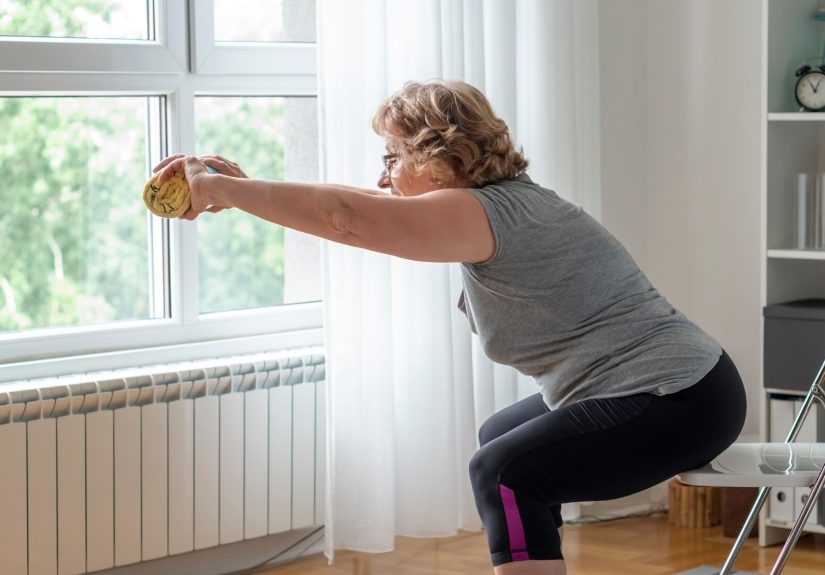
Why it works: Yes, this move starts seated and ends standing, and it absolutely deserves a spot on the list. Chair rises are one of the most practical strength exercises older adults can do because they build the thighs and glutes and directly train the everyday skill of getting up from a chair. That is functional fitness in its most honest form.
How to do it:
- Sit toward the front of a sturdy chair.
- Place your feet flat on the floor, about shoulder-width apart.
- Lean your chest slightly forward.
- Press through your feet and stand up slowly.
- Pause, then lower yourself back down with control.
Beginner goal: Start with 4 to 6 repetitions.
Make it easier: Use your hands lightly on the chair or armrests.
Make it harder: Cross your arms over your chest or slow down the lowering phase.
Common mistake: Plopping back into the chair. The controlled sit-down is where a lot of the strength work happens.
A Simple 15-Minute Chair Strength Routine
If you like structure, here is a no-fuss way to combine these movements into a short session:
- Seated Marches: 30 seconds
- Seated Knee Extensions: 8 reps per leg
- Seated Biceps Curls: 8 to 10 reps
- Seated Resistance-Band Rows: 8 reps
- Sit-to-Stand: 4 to 6 reps
Rest as needed, then repeat the circuit 1 to 2 more times. Done. That is a real workout, not a warm-up pretending to be productive.
For many older adults, doing strength-focused chair exercises two or three times per week is a realistic starting point. On other days, light walking, gentle stretching, or balance practice can round things out nicely.
How to Progress Without Overdoing It
The trick with senior strength training is not to chase soreness like a trophy. It is to build gradually. A good rule of thumb is this: when an exercise feels smooth, steady, and almost a little too easy for more than one workout, increase just one thing.
You can increase:
- the number of repetitions,
- the number of sets,
- the length of the hold, or
- the resistance, such as a slightly heavier dumbbell or firmer band.
Do not increase everything at once. Your joints and muscles prefer negotiation over surprise attacks.
Common Mistakes That Can Undercut Your Results
Doing too much too soon
Motivation is wonderful. So is being able to walk the next day. Start small and build.
Holding your breath
Exhale during the effort part of the movement, such as when standing up or curling the weight. Breathe in as you return.
Using a flimsy chair
If the chair wobbles, rolls, or feels unstable, it is not your workout buddy.
Ignoring posture
Slouching changes how the muscles work and can make moves less effective. Sit tall, even if your spine initially acts like this is a wildly unreasonable request.
Skipping consistency
One heroic workout followed by ten days of nothing is not the goal. Regular, manageable sessions win every time.
Everyday Benefits You Might Notice
When older adults stick with seated strength exercises, the wins often show up outside the workout itself. Standing from the toilet or couch may feel easier. Walking may feel steadier. Carrying bags, reaching shelves, and doing kitchen tasks may require less effort. Posture often improves. Confidence usually tags along too.
And that confidence matters. Once people feel more capable moving through their day, they tend to move more often. That creates a useful cycle: more movement supports more strength, and more strength makes movement feel less intimidating.
Experiences Older Adults Often Have With Chair-Based Strength Training
One of the most common experiences older adults describe is surprise. Not movie-plot-twist surprise, but genuine, quiet surprise that something this simple can make a real difference. A lot of people begin chair exercises expecting them to be “better than nothing.” After a few weeks, they realize the routine is actually helping. The knees may feel less stiff when getting out of bed. Standing up from the breakfast table may require less planning. Walking across the house may feel more secure, especially first thing in the morning when the body is still negotiating with the day.
Another common experience is that progress shows up in tiny, useful ways before it shows up in dramatic ones. Maybe a person notices they can get out of the car more smoothly. Maybe they carry groceries in one trip instead of two. Maybe they stop using both hands every single time they rise from a chair. Those moments can seem small, but they are deeply meaningful because they restore a sense of independence. Strength is not always about lifting heavier weights. Sometimes it is about making ordinary life feel less demanding.
There is also a mental shift that happens when exercise feels safe and doable. Many older adults have spent years hearing messages that make movement sound risky, exhausting, or only for people in perfect health. Chair-based training can change that story. A person who feels nervous about standing workouts may feel comfortable enough to start in a chair. Once that fear fades, confidence grows. That confidence can spill into other habits, too, like taking short walks, joining a gentle class, or being less hesitant to stay active around the house.
For some people, the biggest change is posture and endurance. They find they can sit taller at the table, stand longer while cooking, or finish a simple chore without needing a break halfway through. Arms may feel stronger when lifting dishes into a cabinet. The upper back may feel less tight after regular rows and curls. Even breathing can feel easier during movement when posture improves and the chest is not constantly collapsed forward.
Consistency, of course, is where the magic lives. Older adults who get the most out of seated exercise usually are not the ones doing marathon workouts. They are the ones doing manageable sessions over and over again. Ten to fifteen minutes a few times a week can add up. The body responds to repetition, not perfection.
And perhaps the best experience of all is this one: feeling capable again. Not twenty-five-years-old again. Not superhero again. Just capable. Strong enough to move with more ease. Steady enough to trust your body a little more. Independent enough to keep doing the things that make life feel like your own. That is a powerful return on investment for a routine that starts with one sturdy chair and a decision to begin.
Final Thoughts
The best seated exercises for older adults are not the flashiest ones. They are the ones that strengthen real-life movement patterns, feel safe enough to repeat, and fit into an ordinary day without requiring a motivational speech first. Seated marches, knee extensions, biceps curls, resistance-band rows, and sit-to-stands cover a lot of ground. Together, they work the legs, arms, back, and core while supporting the bigger goal: staying strong enough to keep doing life on your own terms.
So start where you are. Use the chair you already have. Do a few reps with good form. Then come back and do it again in a couple of days. Strength does not always arrive with fireworks. Sometimes it shows up quietly, the moment you stand up and realize it felt easier than it used to.