Table of Contents >> Show >> Hide
- A Building with More Than One Past
- Why Tuckey Design Studio Was the Right Fit
- How the Renovation Reframed the House
- The Color Story Is Where the Project Gets Playful
- Material Honesty Beats Fake Perfection
- Performance Matters, Even in Romantic Buildings
- Why the Project Works So Well
- What Designers and Homeowners Can Learn from Wool Hall
- Experiences Related to Wool Hall and the Beauty of Adaptive Reuse
- Conclusion
Some buildings age quietly. Others collect enough stories to qualify for their own biopic. Wool Hall, a 16th-century structure in Somerset, falls firmly into the second camp. First, it served as a center for the local wool trade. Centuries later, it evolved into a recording studio with a résumé most musicians would frame and hang over the fireplace. Then came Tuckey Design Studio, which stepped into the messy middle and pulled off the rarest trick in architecture: making a historic building feel more like itself by changing it a lot.
This is what makes the project so compelling. The studio did not treat Wool Hall like a fragile museum piece, nor did it bulldoze its personality in pursuit of polished minimalism. Instead, the design embraces the building’s wrinkles, repairs its structural and environmental headaches, and introduces a more playful, more livable, and more visually confident future. The result is a family home and private recording studio that feels grounded in history without being trapped by it.
If you care about adaptive reuse, historic renovation, colorful interiors, or the idea that old walls can still surprise you, this project is worth a close look. Tuckey Design Studio’s update of Wool Hall is not just attractive. It is a smart lesson in how to restore character without turning a house into a costume party.
A Building with More Than One Past
Wool Hall was originally built in the late 1500s in Beckington, Somerset, when the wool trade played a major role in the region’s economy. Even today, the exterior carries the kind of architectural features that stop you in your tracks: an arched ground-floor entrance, an exterior staircase, a rubble balustrade, and the sturdy, slightly theatrical presence that only old masonry seems to manage. It is listed Grade II, which means its historic and architectural significance is officially recognized and legally protected.
That alone would make it interesting. But Wool Hall did not stop at being a handsome survivor from the Tudor era. In the 1980s and 1990s, it became a recording studio and creative hideaway. Tears for Fears and Van Morrison were among its notable owners, and artists including The Smiths, Annie Lennox, Joni Mitchell, The Cure, and Paul Weller recorded there. In other words, the building went from trading wool to shaping pop-cultural memory. Not many places can say they contributed to both local commerce and moody album lore.
By the time Tuckey Design Studio arrived, however, Wool Hall was not basking in glamorous nostalgia. The property had been altered over time with unsympathetic additions, especially from the 1980s. The once-legible layout had become muddled. Thermal performance was poor. The interiors were fragmented. What should have felt storied instead felt stitched together in the wrong places, like a magnificent old coat repaired with three different zippers and a questionable patch kit.
Why Tuckey Design Studio Was the Right Fit
Tuckey Design Studio has built a strong reputation around adaptive reuse and materially sensitive design. That matters here because Wool Hall did not need a flashy rescue. It needed restraint, intelligence, and a willingness to listen to the building before trying to impress it. The studio’s broader design philosophy tends to focus on revealing what is already valuable in older structures while adding new interventions that are honest, useful, and visually distinct.
That approach shows up clearly in Wool Hall. Rather than pretending the 1980s never happened, the design team studied what could stay, what needed to go, and what could be transformed from liability into character. They treated the historic stone hall and the more recent additions as different chapters of the same story. The goal was not to flatten time, but to organize it.
That distinction is important. Great historic renovation is rarely about going backward. It is about making the past legible while creating a present that feels generous, functional, and durable. At Wool Hall, Tuckey Design Studio makes that balancing act look almost easy. It was not easy, of course. Good architecture just has a habit of hiding how hard it worked.
How the Renovation Reframed the House
From awkward sprawl to intuitive flow
One of the project’s biggest wins is circulation. Before the redesign, the building had a long, narrow, somewhat clumsy arrangement that has been described as “train-carriage-like.” Rooms followed one another too rigidly, and the old plan did not do much to clarify how the historic hall and later additions related to one another. The result was less grand old landmark, more confused backstage corridor.
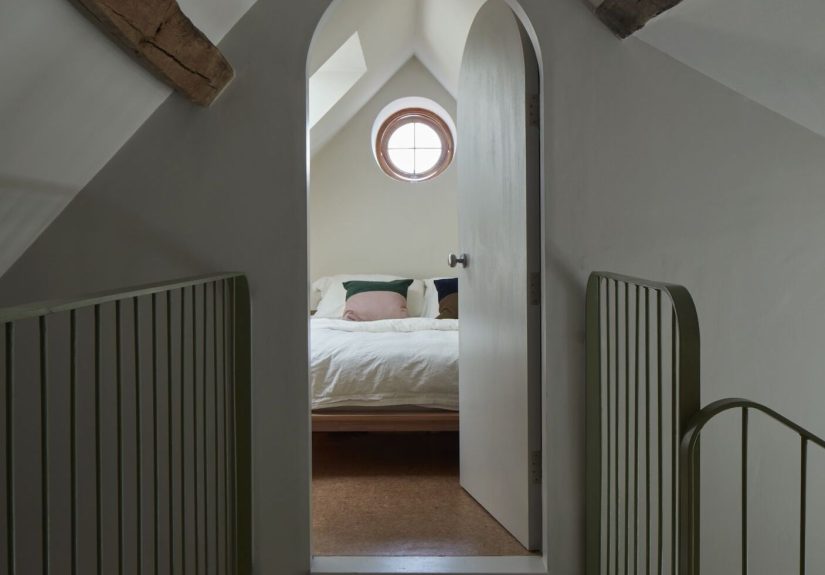
Tuckey Design Studio reorganized the experience of the house by introducing a clearer central entry where old and new meet. This move changes everything. Instead of dragging occupants through a sequence of disconnected rooms, the house now opens up into a three-tier atrium that acts as the project’s heart. Sightlines connect different wings and floors. Bedrooms branch upward. The study and lounge unfold on one side. The open-plan kitchen and living spaces of the original hall extend on the other.
This is the kind of move that sounds simple on paper and transforms daily life in practice. Good circulation is not only about convenience. It shapes how a building is understood. In Wool Hall, the new arrangement makes the whole property easier to read, easier to inhabit, and much more generous in spirit.
Selective demolition that actually adds value
Demolition is often treated as the villain in preservation stories, but here it becomes a tool of clarity. Tuckey Design Studio removed portions of the later extensions to reveal the historic stone wall and reconnect the building to its courtyard setting. These strategic subtractions carve out small landscape rooms and courtyards that improve cross-ventilation, reduce overheating, and restore breathing space around the older structure.
That decision is especially smart because it does not rely on nostalgia alone. The courtyards are not decorative apologies. They are practical devices that improve environmental performance and strengthen the experience of moving through the home. They also give the architecture something old buildings often need after years of alteration: a little elbow room.
The Color Story Is Where the Project Gets Playful
For a historic stone building, Wool Hall has a surprisingly lively palette. This is not color used as a gimmick or a social-media stunt. It is color used with precision, often against rough, tactile surfaces, so that even modest interventions feel energetic.
The entrance atrium features green-painted steel elements that help knit the volumes together. Yellow accents appear in structural moments, turning something purely utilitarian into a visual wink. Elsewhere, the reworked extension is marked by crimson timber cladding, which gives the newer portion a clear identity without trying to impersonate the Tudor hall. Inside, green-stained plywood cabinetry adds warmth and personality, especially in the kitchen, where the old stone fabric could easily have drifted into austere territory.
This is one reason the project feels fresh instead of reverent. Tuckey Design Studio understands that historic buildings do not need to be sepia-toned to be respected. Sometimes the best way to honor age is to create contrast. Rough stone, exposed blockwork, concrete lintels, painted steel, terrazzo markers, and richly stained joinery all coexist here. The palette is modest, but the effect is anything but timid.
Material Honesty Beats Fake Perfection
Another standout quality of Wool Hall is the way the renovation treats ordinary materials with unusual dignity. Exposed breeze blocks and concrete lintels from the later additions are not hidden in embarrassment. They are left visible, placed in conversation with the older stone walls, and allowed to contribute to the building’s layered identity. This is a deeply contemporary move, but it also feels truthful. Not every surface has to pretend it was handcrafted for a palace in 1582.
Terrazzo flooring is used to trace former partitions, marking where earlier rooms once stood. This is a small but brilliant gesture. Instead of erasing the evidence of change, the design turns it into a subtle visual record. The building does not deny its revisions; it wears them well.
Outside, salvaged bricks from demolition are reused to create “brick rugs” at thresholds between courtyards and interior spaces. It is the kind of detail that architecture lovers adore because it is both poetic and practical. These elements root the project in reuse rather than just talking about it. Sustainability, in other words, is doing some actual lifting here.
Performance Matters, Even in Romantic Buildings
Historic buildings often get a free pass on comfort because they are charming. Drafty? Character. Cold walls? Atmosphere. Uneven temperatures? Welcome to history. Tuckey Design Studio politely rejects that nonsense.
At Wool Hall, improving thermal performance was a central part of the project. The team used breathable lime-and-cork insulation on the inside of stone walls so the building could retain heat without losing its textural richness. In some areas, Diathonite spray was added to support thermal upgrades. New double glazing and underfloor heating also help the home work better as a year-round living environment.
This matters because adaptive reuse cannot just be visually persuasive. It has to function. If a historic house is too uncomfortable or energy-hungry to live in properly, it becomes vulnerable again. One of the strongest ideas in this project is that conservation and performance should not be treated as enemies. Wool Hall proves they can be partners, even if they occasionally need a good mediator and a lot of site meetings.
Why the Project Works So Well
The renovation succeeds because it avoids three common traps. First, it does not romanticize the past to the point of paralysis. Second, it does not impose a slick contemporary identity that bulldozes the building’s memory. Third, it does not confuse “minimal” with “blank.”
Instead, Tuckey Design Studio gives Wool Hall a clear architectural logic. The historic hall remains the emotional anchor. The later additions are edited, not denied. New insertions are confident enough to be seen and modest enough to belong. The palette is warm, tactile, and occasionally mischievous. Most importantly, the building now makes sense.
That sense-making is the real achievement. Plenty of renovations look impressive in photographs. Fewer feel convincing as arguments. Wool Hall does both. It argues that old buildings deserve comfort, coherence, and joy. It argues that preservation can be lively. It argues that color, reuse, and technical upgrades can deepen a place rather than dilute it.
What Designers and Homeowners Can Learn from Wool Hall
Even if you are not restoring a 16th-century hall with rock-star credentials, there are useful lessons here. One is that flaws can become assets when treated with imagination. Another is that sustainability works best when it is embedded in decisions about layout, demolition, reuse, and materials rather than sprinkled on top like moral garnish.
There is also a lesson about contrast. Too many renovations either mimic the old so closely that the new feels timid, or clash so hard that the whole thing starts shouting. Wool Hall finds a more interesting middle ground. The new work is clearly new, but it learns from the massing, rhythm, and roughness of what already exists.
And finally, there is a lesson about mood. The best adaptive reuse projects are not just technically correct. They create atmosphere. Wool Hall feels textured, calm, and slightly surprising. It has the grounded gravity of a historic structure, the lived-in warmth of a family home, and just enough visual swagger to acknowledge that, yes, a lot of cool people once made music here.
Experiences Related to Wool Hall and the Beauty of Adaptive Reuse
There is a particular feeling that comes from stepping into a restored historic building that still remembers its former lives. It is not the same as visiting a pristine luxury home, and it is definitely not the same as walking through a museum where everything seems one velvet rope away from being annoyed at your presence. A place like Wool Hall offers something more intimate. It feels inhabited by time.
Imagine arriving from the quiet Somerset landscape and seeing that dramatic arched entrance and exterior stair. Before you even step inside, the building tells you it has been important for a long time. Then the door opens, and instead of a dusty historical reenactment, you find texture, warmth, color, and movement. The old stone does not feel frozen. It feels awake.
That is one of the most powerful experiences related to a project like this: discovering that history can feel lively rather than solemn. The green steel, yellow structural accents, crimson cladding, and carefully exposed materials all create small moments of delight. They remind you that preservation does not have to be humorless. In fact, old buildings often benefit from a little wit. They have already survived centuries. They can handle a canary-yellow beam.
There is also an emotional experience tied to contrast. In a building like Wool Hall, you notice the shift from rough stone to smooth plywood, from enclosed passage to open atrium, from old wall to new courtyard. Those transitions make you aware of architecture in a physical way. You do not just see the house; you feel it unfolding. The experience becomes cinematic. Each threshold reveals a different chapter.
For people who love design, that kind of journey is thrilling because it turns space into narrative. For people who simply want a home to feel good, it is even better. The house does not rely on expensive sparkle. It relies on proportion, light, material honesty, and a clear sense of identity. That tends to age better than trend-driven perfection.
Projects like Wool Hall also change how you think about comfort. In many old buildings, beauty and comfort are treated like reluctant roommates. You get gorgeous stone walls, but also cold drafts and suspiciously dramatic winter mornings. Here, the thermal upgrades, breathable insulation, and underfloor heating suggest a different future. You can preserve atmosphere without preserving misery. That is an experience many homeowners would happily sign up for.
There is something especially moving about the musical history, too. Even without hearing a single note, you can sense that the building once hosted long creative sessions, false starts, breakthroughs, coffee-fueled debates, and probably at least one ego with excellent cheekbones. When a place has held that much making, reinvention feels appropriate. Tuckey Design Studio did not erase the artistic past. It gave it a new tempo.
Ultimately, the experience of Wool Hall is about layered authenticity. It is historic without being stiff, contemporary without being disposable, and colorful without turning into a design gimmick. That combination is rare. It is what makes adaptive reuse so rewarding when it is done well. You leave with the feeling that the building was not rescued from history. It was invited to keep going.
Conclusion
Tuckey Design Studio’s update of Wool Hall is a masterclass in adaptive reuse because it understands that heritage is not a fragile ornament. It is a working resource. By restoring the 16th-century hall, editing the weaker later additions, improving energy performance, and introducing a confident material and color palette, the studio created a home and recording space that feels layered, useful, and unmistakably alive.
What makes this project memorable is not just its history, although that history is undeniably rich. It is the way the design turns complexity into coherence. Wool Hall now feels more readable, more comfortable, and more joyful than before. It respects the building’s age without turning age into a design straightjacket. And in the process, it offers a broader lesson for anyone interested in historic renovation: the best updates do not silence the past. They teach it how to speak in the present tense.