Table of Contents >> Show >> Hide
- How Nails Are Classified (The 4 Big Things That Matter)
- Nail Materials (What They’re Made Of, and Why You Should Care)
- Finishes & Coatings (Because Rust Never Sleeps)
- Nail Anatomy: Head, Shank, and Point
- Nail Sizes Explained (Including the Penny System)
- Common Types of Nails (And Exactly When to Use Them)
- Choosing Nails by Project (Practical Matchmaking)
- Pressure-Treated Wood: The Nail Choice That Actually Matters
- Quick “Don’t Do This” Checklist
- FAQ: Nail Questions People Google at 1:00 AM
- Experience Section (Real-World Lessons From Picking the “Wrong” Nail)
- Conclusion
Nails are the unsung heroes of building. They don’t ask for credit, they don’t demand a raise, and yet they quietly keep your deck from becoming a surprise trampoline. But here’s the twist: not all nails are created equal. Pick the wrong nail and you can get rust streaks, popped shingles, squeaky floors, split trim, or a “Why is this falling apart?” moment that really kills the vibe.
This guide breaks down the most common types of nails, how nail sizes actually work, what nails are made of, and which finishes/shank styles matter in the real world. Along the way, you’ll get practical examples (and a few hard-earned lessons) so you can choose nails like a person who definitely owns a level and doesn’t pretend they can eyeball it.
How Nails Are Classified (The 4 Big Things That Matter)
When you’re choosing nails, you’re really choosing four features that determine performance:
- Material (steel, stainless, copper, etc.) and corrosion resistance
- Finish/coating (bright, galvanized, epoxy, cement-coated, etc.)
- Size (length and diameteroften shown with the “penny” system)
- Design (head type + shank type + point type)
A nail that’s perfect for interior trim can be a terrible choice outdoors. A nail that’s great for sheathing can be a menace on delicate molding. And a nail that looks “close enough” in the store can turn into a squeak factory later.
Nail Materials (What They’re Made Of, and Why You Should Care)
Steel: The Everyday Workhorse
Most common nails are steel. It’s strong, affordable, and widely available. The catch: bare steel rusts, so steel nails usually rely on a finish (like galvanizing) when used outdoors or in damp locations.
Best for: framing, general carpentry, interior projects, and many structural uses (when code-approved and properly specified).
Stainless Steel: The “I Never Want to Think About Rust Again” Option
Stainless steel nails cost more, but they shine (sometimes literally) in harsh environmentsespecially coastal air, constant moisture, or projects where staining from corrosion would be a disaster.
- 304/305 stainless: great general corrosion resistance
- 316 stainless: better for salt air and marine exposure
Best for: coastal decks and fences, cedar/redwood projects where staining is a concern, exterior trim, and high-exposure builds.
Hot-Dipped Galvanized Steel: Outdoor Armor (When Done Right)
Galvanized nails are steel nails coated in zinc to fight corrosion. The key detail is how they’re galvanized. For serious exterior work (and especially pressure-treated lumber), you typically want hot-dipped galvanized fasteners that meet appropriate standards, not the light-duty stuff meant for dry interiors.
Best for: exterior framing, fencing, decking, siding, roofing, and pressure-treated lumber (when specified).
Copper and Silicon Bronze: The Fancy Lifeguards
Copper and silicon bronze nails resist corrosion extremely well and are often used in specialty exterior applicationsthink traditional roofing details, historic projects, and marine-grade builds. They’re also popular where fasteners might be visible and you want a particular look.
Best for: premium exterior work, some roofing applications, marine environments, and certain restoration jobs.
Aluminum: Lightweight, Specialty Use
Aluminum nails show up in specific roofing or siding situations, but they’re not a universal outdoor solution. In some environments and material pairings, aluminum can corrode. Always match the nail to the manufacturer’s fastening requirements for the product you’re installing.
Finishes & Coatings (Because Rust Never Sleeps)
Nail finish isn’t just aestheticsit changes corrosion resistance and driving performance.
Bright (Uncoated)
“Bright” nails are basically bare steel. They’re strong and cheap, but they can rust quickly in moisture.
Use them indoors where they’ll stay dry.
Electro-Galvanized
A thinner zinc coating than hot-dipped. Good for light-duty corrosion resistance, but typically not the top choice for wet, salty, or pressure-treated environments.
Hot-Dipped Galvanized (HDG)
A thicker zinc coating designed for tougher environments. HDG nails are a common go-to for exterior work and many pressure-treated lumber applications.
Mechanical/Proprietary Coatings
Some fasteners use proprietary coatings designed to match connector systems or boost corrosion resistance. If you’re using metal connectors (like joist hangers), follow the connector manufacturer’s fastener guidance. Mixing “whatever nails were in the bucket” with structural hardware is a classic way to invent new problems.
Vinyl, Cement-Coated, or Epoxy-Coated
These coatings reduce friction so nails drive smoother and can increase holding power once the coating “sets.”
Great for: framing and production work where driving efficiency matters.
Nail Anatomy: Head, Shank, and Point
Head Types (How the Nail Sits and Holds)
- Flat head: common on framing/general nails; strong holding surface
- Finish head (small head): designed to be countersunk and hidden with filler
- Brad head: very small; minimizes visible holes in delicate trim
- Roofing head: wide head to hold shingles/felt without tearing through
- Duplex head: double head designed to be pulled out later (temporary work)
Shank Types (The “Will This Back Out Later?” Factor)
- Smooth shank: standard; relies on friction in wood fibers
- Ring shank (annular): ridges bite into wood; higher withdrawal resistance
- Spiral/screw shank: twists as it drives; strong grip in framing and subfloors
If you’re fastening sheet goods (like sheathing or subfloor) or building something that will see movement and vibration, ring or spiral shanks can reduce “nail pop” and squeaks.
Points (How the Nail Starts)
Many nails use a diamond point to start cleanly. Some specialty nails have blunter points to reduce splitting in thin stock. The point geometry matters most when you’re nailing near edges or into brittle materials.
Nail Sizes Explained (Including the Penny System)
Nail size usually includes length and diameter. In the U.S., many nails are labeled using the penny system (written as “d”): 8d, 10d, 16d, and so on. Bigger “d” generally means a longer nail, but penny size isn’t a direct measurement of weight or diameterthink of it as a traditional naming system that stuck around because builders are creatures of habit.
Common Penny Sizes (Quick Reference)
| Penny Size | Typical Length | Common Use |
|---|---|---|
| 6d | 2″ | Light framing, fastening thin lumber |
| 8d | 2 1/2″ | General carpentry, light structural work |
| 10d | 3″ | Framing, nailing studs to plates (project-dependent) |
| 12d | 3 1/4″ | Heavier framing, built-up members |
| 16d | 3 1/2″ | Classic framing nail for many applications |
| 20d | 4″ | Heavy framing, timber connections |
Pro rule of thumb: for wood-to-wood fastening, aim for nail penetration into the second piece that’s roughly 2–3× the thickness of the first piece, when practical. For engineered assemblies and structural connections, follow code requirements and approved fastening schedules.
Common Types of Nails (And Exactly When to Use Them)
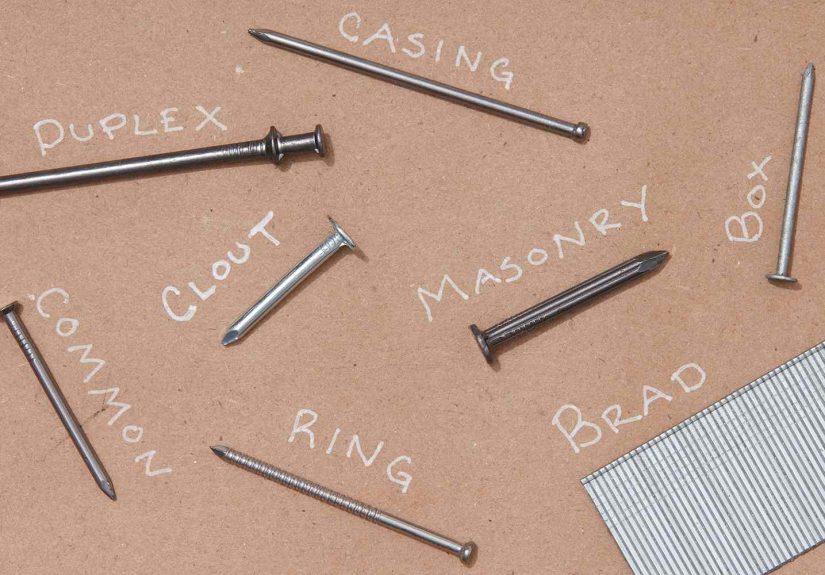
Common Nails
The classic general-purpose nail: strong shank, broad head, good for framing and structural tasks where appearance isn’t the main event.
Use for: framing, rough carpentry, blocking, general construction.
Box Nails
Box nails are similar to common nails but have a thinner shank. That means less splitting in thinner boardsat the cost of some strength.
Use for: thinner lumber, light carpentry, some trim backing where structural strength isn’t required.
Sinker Nails
Sinkers are often used for framing. Many have coatings (like vinyl or epoxy) for easier driving, and heads designed to set slightly below the surface.
Use for: framing, subfloors, general construction where speed matters.
Framing Nails (Collated for Nail Guns)
Framing nails are made for power nailersoften in strips or coils. They can be smooth, ring, or clipped/full head depending on tool type and code requirements.
Use for: wall framing, roof framing, sheathing, and high-volume builds.
Finish Nails
Finish nails have small heads so you can countersink them and hide the holes with filler. They’re typically thicker than brads and provide stronger holding power for trim.
Use for: baseboards, crown molding, door/window casing, interior trim.
Brad Nails
Brads are thin, small-headed nails often used when you want minimal wood splitting and tiny holes. They’re great for delicate trimless great for anything that needs real muscle.
Use for: thin trim, small moldings, light woodworking, temporary holds while glue cures.
Pin Nails
Pin nails are ultra-thin (often 23-gauge) and almost invisible. They’re like the “polite cough” of fasteners: gentle, discreet, and not meant to hold a bookshelf to a wall.
Use for: delicate trim returns, small craft work, holding pieces until adhesive sets.
Roofing Nails
Roofing nails have a wide head designed to hold shingles and underlayment without tearing through. Many codes and manufacturers specify minimum shank diameter and head diameter. You’ll also see smooth or ring shank versions depending on wind and performance needs.
Use for: asphalt shingles, roofing felt/underlayment, some exterior insulation boards (with cap nails).
Flooring Nails & Cleats
Flooring fasteners (often cleats or staples rather than classic nails) are designed to grip hardwood without splitting tongues and to reduce squeaks. Traditional flooring nails and cut nails are still used in restoration and certain solid-wood installs.
Use for: hardwood flooring installation, flooring repairs, restoration work.
Drywall Nails
Drywall nails were common before drywall screws took over. They typically have textured or ring-like features and large heads to prevent pull-through. Nowadays they’re mostly a specialty or “old-school” choice.
Use for: limited drywall tasks, repairs, or matching existing older installations.
Duplex (Double-Headed) Nails
Duplex nails are built to be removed later. The second head sticks up so you can pull the nail without wrecking the workpiece.
Use for: concrete forms, temporary bracing, mock-ups, staging builds.
Masonry/Concrete Nails (Hardened Steel)
Masonry nails are hardened so they can be driven into concrete or masonry (within limits). Many are fluted to improve grip. They’re handy for attaching furring strips or plates to certain concrete conditionsjust wear eye protection and don’t pretend you’re indestructible.
Use for: fastening wood to concrete, furring strips, masonry attachments (project-dependent).
Cut Nails
Cut nails are sheared from steel plate (not drawn wire), giving them a wedge-like profile. They’re popular in flooring and historic work because their shape can offer strong holding in wood grain and they match traditional construction aesthetics.
Use for: restoration, wide plank floors, historic trim, specialty carpentry.
Choosing Nails by Project (Practical Matchmaking)
Framing Walls
- Typical choices: 10d–16d framing/common/sinker nails (often collated for nail guns)
- Consider: structural requirements, head type allowed, and local code
Decks and Outdoor Structures
- Typical choices: hot-dipped galvanized or stainless steel nails (or screws, depending on application)
- Consider: pressure-treated lumber chemistry and coastal exposure
Trim and Finish Carpentry
- Typical choices: finish nails (15/16 gauge) for heavier trim; brads (18 gauge) for delicate trim
- Consider: nail hole size, splitting risk, and whether adhesive is also used
Roofing Shingles
- Typical choices: roofing nails with wide heads; galvanized or specified corrosion resistance
- Consider: required head diameter, shank gauge, and deck penetration (manufacturer + code)
Sheathing & Subfloors
- Typical choices: ring shank or spiral shank nails for improved withdrawal resistance
- Consider: minimizing squeaks and nail pops over seasonal wood movement
Pressure-Treated Wood: The Nail Choice That Actually Matters
Modern pressure-treated lumber often uses copper-based preservatives that can accelerate corrosion of fasteners. That’s why many manufacturers and connector companies recommend hot-dipped galvanized fasteners meeting the correct standards or stainless steel for maximum service lifeespecially in higher exposure environments.
Translation: if you build an outdoor project with the wrong fasteners, you’re basically scheduling a future repair. And Future You is already busy.
Quick “Don’t Do This” Checklist
- Don’t use bright (uncoated) steel nails outdoors unless you enjoy rust as a design element.
- Don’t assume all “galvanized” is equal; match galvanizing type to exposure and treated wood requirements.
- Don’t use brads where structural holding power matters. They’re tiny for a reason.
- Don’t mix random nails with structural connectors; connector manufacturers often require specific fasteners.
- Don’t overdrive (especially in roofing). Crushing material can reduce holding and create leaks.
FAQ: Nail Questions People Google at 1:00 AM
What does “16d” mean?
It’s a penny size designation. A 16d nail is typically 3 1/2 inches long. The “d” comes from an old term tied to currency/denarius, and it stuck as a sizing convention.
Are screws better than nails?
Screws generally offer higher withdrawal resistance, but nails handle shear forces well and can be faster for framing. Many assemblies are designed around nails specifically. Use the fastener type the application (and code/manufacturer) calls for.
Do ring shank nails really hold better?
Yesring shank and spiral shank designs increase grip and help resist pull-out, especially in sheet goods and areas that see movement.
Experience Section (Real-World Lessons From Picking the “Wrong” Nail)
If you want to learn nails the easy way, you read a guide like this. If you want to learn nails the classic way, you grab whatever’s closest, start hammering, and then spend the next weekend fixing the consequences while whispering, “How did this happen?”
One of the most common “new builder” mistakes is treating nails like they’re all basically the sametiny metal sticks with confidence. The first time you use bright, uncoated nails outdoors, you’ll understand why corrosion resistance is not optional. At first, everything looks fine. Then weather happens. A few rain cycles later, you’ll notice dark streaks bleeding down the wood like your project is crying. That’s the rust leaching out and staining the surface. You can sand, you can clean, you can repaintyet the real fix is “use the right nail next time.”
Another lesson: thin trim plus thick nails equals splitting. You line up a piece of delicate molding, tap in a chunky nail, and crackthe wood splits right near the end like it had a hidden grudge. That’s when brads and finish nails start making emotional sense. Brads are great for light trim because they leave smaller holes and reduce splitting, but they don’t have the holding power of thicker finish nails. So the best move often isn’t “brad vs finish,” it’s “brad plus wood glue” for lightweight assemblies, and “finish nails” for trim that might get bumped, flexed, or cursed at during vacuuming.
Flooring and subfloors have their own personality. If you’ve ever walked across a room that sounds like a choir of mice stepping on bubble wrap, you’ve heard what happens when wood movement and fastener choice don’t get along. Smooth shank nails can work, but in areas that expand and contract with moisture, ring shank or spiral shank fasteners can reduce loosening over time. That doesn’t mean squeaks can’t happen (wood finds a way), but it stacks the odds in your favor. Also: spacing and fastening patterns matter. A perfect nail in the wrong pattern can still give you squeaks. Fasteners are part of a system, not a magic spell.
Roofing is where nail specs stop being “suggestions” and start being “your leak prevention plan.” It’s tempting to think, “A nail is a nail.” But roofing nails need wide heads so shingles don’t tear, and they need correct penetration so they actually hold in the deck. Overdriving is a sneaky problem tooif the nail head cuts into the shingle, you’ve reduced the holding surface and invited wind to start negotiations. The best roofers aren’t just fast; they’re consistent. Same depth, correct placement, correct fastenerboring in the best possible way.
Pressure-treated lumber is the big one. People hear “treated” and think “invincible wood.” It’s more like “wood with chemicals that help it survive,” and those chemicals can be rough on fasteners. Using the right corrosion-resistant nails (hot-dipped galvanized to the right spec, or stainless for maximum durability) isn’t being fancyit’s preventing early failure. If you’ve ever pulled apart an exterior connection and found a fastener that looks like it aged 50 years in two seasons, you’ve met the consequence.
Finally, there’s the “organization tax.” Nails come in a million variations, and it’s easy to toss them all into one bucket like a chaotic trail mix. Then you grab what you think is a 2 1/2″ nail and discover it’s actually 1 3/4″ halfway through the job. If you’re doing any repeat work, label your boxes, keep small bins, and don’t mix finishes (bright vs galvanized) unless you want surprise rust later. A little sorting up front saves you from that special frustration of undoing work because of a tiny metal choice you made while standing under fluorescent lighting in aisle 14.
The good news: once you understand materials, sizes, and uses, nails stop being mysterious. The “right nail” becomes obvious. Your builds last longer, look cleaner, and don’t require random mid-project trips to the store for “the nails that are like these but… not bad.”
Conclusion
Choosing nails isn’t about memorizing every fastener in existenceit’s about matching material, finish, size, and design to the job. Use bright nails indoors, corrosion-resistant nails outdoors, the right shank type where movement matters, and the right gauge/diameter when you care about strength or split risk. When in doubt, follow manufacturer requirements and building code guidance for structural and weather-exposed projects.