Table of Contents >> Show >> Hide
- Why Faceted Crystals Work So Well on a Flush Mount
- Before You Start: Safety and Reality Checks (Not the Fun Part, But the Important Part)
- Choose Your Method: 3 Ways to Upgrade a Dome Light with Faceted Crystals
- Materials and Planning: What You Actually Need (and What You Don’t)
- Design Choices That Make It Look Expensive (Even If It Isn’t)
- Example Makeover Scenarios
- Maintenance: Keeping Crystals Pretty Without Losing Your Mind
- of “Real-Life” Experience Notes (What People Commonly Learn the Hard Way)
- Conclusion
You know the light. The basic flush-mount dome that shows up in rentals, starter homes, hallways, builder-grade bathroomseverywhere.
It works. It’s also… not exactly bringing “main character energy” to your ceiling.
The good news: you can upgrade a dome ceiling light into something that looks custom and high-end by adding
faceted crystalswithout turning your house into a full-blown electrical project. Done right, this makeover
adds sparkle, softens harsh overhead lighting, and makes the whole room feel more intentional.
This guide breaks down three practical approaches (from renter-friendly to “I’m replacing the whole fixture”),
plus design tips, safety guardrails, and a real-world planning checklist so you don’t end up with a crystal chandelier situation… trapped inside a dome.
Why Faceted Crystals Work So Well on a Flush Mount
Faceted crystalswhether glass or acrylicact like tiny prisms. Even with ordinary bulbs, facets catch and redirect light, creating
sparkle, highlights, and movement. That’s a big deal for flush mounts, which often cast a flat, “office hallway” glow.
A crystal upgrade can also solve three common dome-light complaints:
- Too basic: crystals add texture and detail without changing your ceiling height.
- Too harsh: a crystal layer helps diffuse light and reduce that “staring into the sun” vibe.
- Too dated: pairing crystals with an updated finish (matte black, warm brass, satin nickel) modernizes the whole fixture.
Designers and DIY sites talk a lot about swapping “boob lights” for better flush mountsbut if you can’t (or don’t want to) replace the fixture,
a crystal update is a clever middle path: more style, less demo.
Before You Start: Safety and Reality Checks (Not the Fun Part, But the Important Part)
Ceiling lights involve electricity, height, and glassaka the triple threat. If you’re under 18, do this with a parent/guardian,
and for anything that involves opening wiring connections, call a licensed electrician. Seriously.
1) Don’t rely on the wall switch
If you remove the dome cover only, you can often avoid touching wiringbut you still need to be careful.
Major DIY authorities recommend turning off power at the breaker and verifying power is off with a tester before you work near a fixture.
2) Respect heat and wattage ratings
Decorative add-ons can trap heat. Use bulbs that match the fixture’s label. Many safety sources emphasize not exceeding fixture ratings and
choosing bulbs carefully to avoid overheating. LEDs generally run cooler than incandescent, but “cooler” isn’t the same as “magic.”
Follow the fixture label and avoid crowding crystals against bulbs.
3) Keep modifications lightweight
Flush mounts weren’t designed to carry a pound of extra bling. Your goal is a crystal “veil,” not a ceiling anchor test.
If your plan adds meaningful weight, choose approach #3 (replace the fixture) or use a purpose-built shade/cover system.
4) Know the UL/ETL reality
Listed fixtures are tested as manufactured. Big changes (drilling into key structural parts, altering wiring space, adding unapproved electrical components)
can affect how the product performs and may impact safety certification assumptions. Translation: keep your DIY upgrade decorative, not electrical.
Choose Your Method: 3 Ways to Upgrade a Dome Light with Faceted Crystals
Method 1: The “No-Wiring” Crystal Add-On (Best for Beginners)
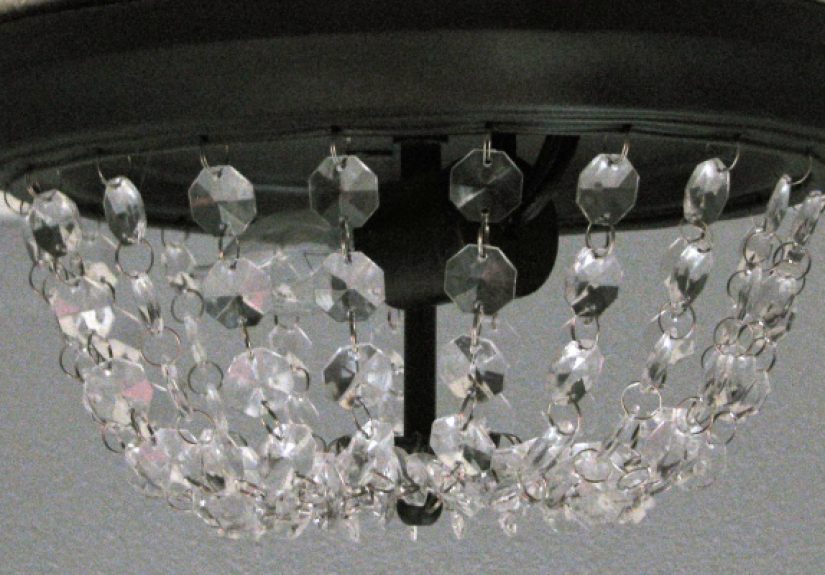
This approach updates the look while you keep the fixture installed. You remove the glass dome (the cover), then attach crystals to a removable structure
that re-installs with the domeso you’re not rewiring anything.
How it works (high-level):
- Remove the dome cover and measure the diameter.
- Create a lightweight “crystal skirt” using a ring (craft ring, metal hoop, or pre-made shade frame).
- Hang faceted crystal strands from the ring at varying lengths for dimension.
- Mount the ring so it sits below the bulb line and doesn’t touch the bulb or block ventilation.
- Reinstall the dome (or swap the dome for a clear/open look depending on your fixture style).
Why it’s popular: you can do the glam part at a table, then install the decorative assembly in minutes.
Many DIY makeovers follow this general concept: paint or refresh the metal base, then add strands for a “mini chandelier” feelwithout changing the ceiling box.
Design tip: use two strand lengths (for example, “short” and “medium”) in a repeating pattern.
It reads more intentional than one length everywhere and helps hide imperfections in spacing.
Best rooms: entryways, powder rooms, hallways, closetsanywhere you want sparkle without a chandelier drop.
Method 2: The “Cover-Up” Upgrade for Renters (Crystal + Shade Strategy)
If you’re renting or just don’t want to mess with the original fixture, renter-friendly ceiling shades and covers have become a whole category.
Some systems use magnets or removable fasteners to hide ugly flush mounts without wiring changes.
To make it “faceted crystal,” you can pair a cover system with crystal accents:
- Add a thin band of small faceted crystals around the lower edge of the shade (like a trim).
- Use a few short crystal strands inside the cover where they won’t touch bulbs or interfere with ventilation.
- Keep materials lightweightacrylic faceted beads are usually safer than heavy glass in a rental hack.
Why it works: it changes the silhouette and the light diffusion at the same time.
You’re essentially styling the ceiling fixture the way people style windows: a “treatment,” but for lighting.
Pro tip: If your flush mount is in a bedroom, this method can soften light dramatically and make the room feel calmer.
Pick a warm bulb (many designers recommend warmer tones for cozy spaces) and keep the crystal accents subtle so it reads “sparkly,” not “disco ball.”
Method 3: Replace the Fixture with a Crystal Flush Mount (Best Result, Most Commitment)
Sometimes the dome is beyond savingyellowed glass, damaged hardware, weird buzz, or a base that looks like it survived three decades of landlord paint.
In that case, replacing it with a crystal flush mount (a fixture designed to hold crystals, properly vented and tested) can be the cleanest solution.
Many home-improvement guides note that fixture replacement should be done with power off at the breaker and verified with a tester,
and that heavier fixtures may require appropriate support hardware. If you’re not experienced, hire a pro.
When replacement makes sense:
- The current fixture has cracked sockets, scorch marks, or loose parts.
- You want a big crystal look (more weight, more structure) that a DIY add-on can’t safely support.
- You’re upgrading long-term and want a certified, purpose-built crystal fixture.
Materials and Planning: What You Actually Need (and What You Don’t)
Crystal options
- Acrylic faceted crystals: lightweight, budget-friendly, safer for ceiling applications.
- Glass crystals: sharper sparkle, heavier weight, better for fixtures designed for crystals.
- Pre-strung garlands: faster installation, consistent spacing, less fiddling with jump rings.
- Individual pendants: more custom, more time, more tiny parts that will try to escape your fingers.
Hardware (decorative only)
- Metal hoop or shade frame sized to your dome
- Jump rings or small connectors
- Small hooks/anchors designed for the frame (not for electrical parts)
- Optional: spray paint for the fixture base (if you can remove it safely and legally for your situation)
Skip: anything that requires splicing wires, adding transformers, modifying the socket assembly, or drilling where wires pass.
Keep the upgrade decorative and removable.
Design Choices That Make It Look Expensive (Even If It Isn’t)
1) Pick a finish that matches your room’s “metal story”
If your room already has black hardware, go matte black. If it’s warm and vintage, go brass. If it’s clean and modern, try satin nickel.
The crystals are the sparkle; the finish is the frame that makes it feel intentional.
2) Don’t overfill the dome
The most common DIY mistake is crowding. A flush mount needs airflow and bulb clearance.
Visually, crystals look better when they have room to move and catch light.
Think “light curtain,” not “crystal lasagna.”
3) Use symmetrybut not perfect uniformity
Even spacing feels polished, but identical strand lengths everywhere can look flat.
Alternate lengths or use a gentle “longer in the center” gradient. It reads custom without requiring a math degree.
4) Make the bulb choice part of the makeover
A crystal upgrade highlights the light source. Consider:
- Warm white (often preferred for living spaces): cozy sparkle
- Neutral white (often used for bathrooms/vanities): crisp and clean
- Dimmable LED: lets you tone down glare and make crystals twinkle instead of scream
Always follow fixture labeling for bulb type and wattage (or LED equivalent guidance). If your fixture label is missing or unreadable,
that’s a sign to consider replacement or professional input.
Example Makeover Scenarios
Example 1: Hallway Dome → “Mini Boutique Hotel”
A long hallway with a basic dome often feels like a tunnel. A crystal add-on can break up the flat light and add visual interest without lowering the ceiling.
Use acrylic faceted strands, keep the overall drop short, and choose a warm bulb so the sparkle feels inviting rather than clinical.
Example 2: Small Bathroom Dome → “Clean + Glam”
Bathrooms benefit from crisp, flattering lightwithout harsh glare. A light crystal layer plus a neutral bulb can add polish without turning the space overly fancy.
Pair it with matching hardware (faucet, mirror frame, towel bar) and suddenly your “builder basic” bathroom looks like it tried.
Example 3: Rental Bedroom Dome → “Softened Light Cover + Subtle Crystals”
If you’re renting, a ceiling shade/cover approach can be the biggest comfort upgrade. Add minimal crystal trim at the edge for sparkle,
but prioritize a soft diffusion so the bedroom feels calmer. The goal is bedtime vibes, not interrogation lighting.
Maintenance: Keeping Crystals Pretty Without Losing Your Mind
- Dust regularly: faceted pieces show dust faster because they reflect everythingincluding your procrastination.
- Use a soft cloth: avoid harsh cleaners on acrylic (they can haze). Mild soap and water is usually safest.
- Check fasteners: occasionally ensure strands are secure and not drifting toward bulbs.
- Stay heat-aware: if you notice discoloration, warping, or a hot smell, stop using the light and reassess the setup.
of “Real-Life” Experience Notes (What People Commonly Learn the Hard Way)
People who do a dome-light crystal makeover often start with the same thought: “This will take an hour.” Then they meet the crystals.
Faceted strands are the glitter of the lighting worldbeautiful, reflective, and somehow always multiplying when you’re not looking.
A common experience is underestimating how long it takes to make the strands look evenly spaced. The fix isn’t complicated; it’s just patience.
Many DIYers end up making a quick paper template or doing a “dry hang” test so the spacing looks balanced once everything is installed.
Another frequent lesson: weight adds up fast. A few glass pendants feel light in your hand, but once you multiply them across a ring,
your ceiling fixture suddenly has a side hustle as a gym weight. That’s why people often switch to acrylic faceted crystals after a first attempt.
Acrylic still sparkles nicely, especially with a warm bulb and a clean dome, and it’s much kinder to older flush-mount hardware.
People also notice that the bulb matters more than expected. The same crystal setup can look “high-end boutique”
with a warm, dimmable LED and look “discount jewelry display” with a harsh, cool bulb. When someone says, “My crystals look cheap,”
the culprit is often color temperature or glare rather than the crystals themselves. Switching to a softer bulb and adding dimming control
tends to make the sparkle look intentional instead of chaotic.
The install moment brings its own reality check: working overhead is awkward. Even if you built the crystal ring perfectly on the table,
the ceiling is where tiny misalignments show up. Many people find it easier to install in stagesmount the ring, step down, look from multiple angles,
adjust, and only then secure everything fully. It’s also common to realize the strands need to sit a little lower (for visibility) or a little higher
(for bulb clearance). That’s normal. Most “perfect” before-and-after photos are the result of a couple small tweaks, not a single magical attempt.
Finally, there’s the emotional experience: the makeover often feels disproportionately satisfying. It’s a small project, but it changes how a room feels
every single dayespecially in spaces you pass through constantly like hallways or entryways. People describe it as a “why didn’t I do this sooner” upgrade,
because lighting affects mood and perception more than we give it credit for. When the crystals catch light in the morning or shimmer during the evening,
it adds a little delight to a very ordinary part of the house. And honestly, delight is a valid home improvement goal.
Conclusion
Updating a dome ceiling light with faceted crystals is one of those rare DIY wins that can look dramatic without requiring a full renovation.
Keep it lightweight, keep it heat-safe, and keep it decorative (not electrical). Whether you choose a no-wiring crystal add-on,
a renter-friendly cover strategy, or a full fixture replacement, you’ll end up with a ceiling light that feels deliberatelike you picked it on purpose,
not like it came free with the building permit.