Table of Contents >> Show >> Hide
- The Discovery That Reset the Record Books
- Why the USS Samuel B. Roberts Matters So Much
- The Battle off Samar Turned a Small Ship Into a Giant Story
- Why This Wreck Is Different From Famous Wrecks Like the Titanic
- How Explorers Actually Found the Sammy B
- A Record, a War Grave, and a Reminder
- The Legacy of the Samuel B. Roberts Keeps Echoing
- Final Thoughts
- A Longer Reflection: The Experience of Encountering the Story of the USS Samuel B. Roberts
Some shipwreck stories feel frozen in time. Others seem to get bigger every time the ocean gives up a new clue. The story of the USS Samuel B. Roberts somehow does both. For decades, the “Sammy B” lived in naval history as a legend from World War II, a small destroyer escort that charged into one of the fiercest surface battles in American history and fought with a kind of stubborn courage that still makes historians sit up straighter.
Then the ocean added one more jaw-dropping detail: the ship was found nearly seven kilometers down in the Philippine Sea, deeper than any shipwreck ever discovered. That is not “deep” in the casual, beach-vacation sense. That is “your dropped keys are gone forever, and also the sunlight left hours ago” deep. It is the kind of depth where pressure is punishing, temperatures hover near freezing, and technology has to work very hard just to say hello.
The discovery instantly turned the USS Samuel B. Roberts into more than a dramatic wartime story. It became a symbol of how modern undersea exploration can reconnect the present with one of the most extraordinary acts of naval bravery of World War II. The wreck’s rediscovery did not change what happened in 1944, but it changed how vividly we can remember it. Suddenly, this was not only a story in books and battle reports. It was a real place, a real ship, and a real war grave resting in one of the most unforgiving environments on Earth.
The Discovery That Reset the Record Books
When explorers announced in 2022 that they had located the USS Samuel B. Roberts off Samar in the Philippines, the headline was immediate and irresistible: this was the deepest wreck ever found. Initial reporting placed the ship at about 22,621 feet, or 6,895 meters below the surface. Later calibration refined the figure slightly, but the headline did not change. The Sammy B still holds the distinction as the deepest known shipwreck ever discovered.
That matters because shipwreck records are not just trivia for maritime obsessives and people who watch submarine documentaries for fun on Friday night. The deeper a wreck lies, the harder it is to find, verify, photograph, and respectfully document. Reaching the Sammy B required advanced sonar, painstaking analysis, and a crewed submersible capable of descending into the hadal zone, the deepest region of the ocean. This is exploration at the edge of what humans can safely do underwater.
The discovery team, led by explorer Victor Vescovo and supported by Caladan Oceanic and EYOS Expeditions, first identified debris from the ship before locating the main wreckage. The ship was found broken but still recognizable, with the wreck offering visible evidence of the violent fight that sent her to the bottom. Even after decades underwater, the remains still told a story of impact, separation, and battle damage.
In practical terms, the Sammy B sank deeper than the USS Johnston, the previous record-holder and another heroic U.S. warship lost in the same battle. In emotional terms, the discovery felt even bigger. The ocean had not merely revealed a deeper wreck. It had brought back into public view one of the boldest “against-all-odds” stories in U.S. naval history.
Why the USS Samuel B. Roberts Matters So Much
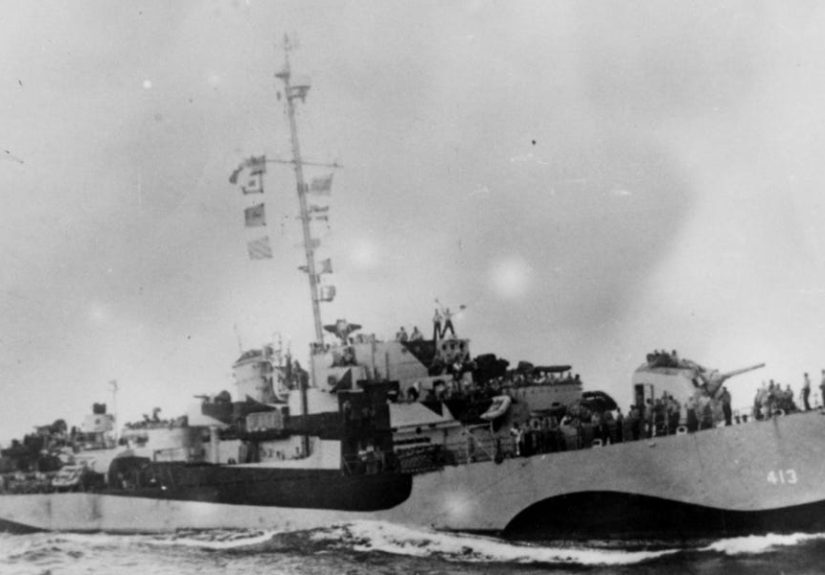
The USS Samuel B. Roberts was not a giant battleship. It was not a glamorous aircraft carrier. It was a John C. Butler-class destroyer escort, a smaller and lighter warship designed primarily to protect larger vessels and convoys. On paper, it was not supposed to become the star of a desperate surface fight against some of the most powerful ships in the Imperial Japanese Navy.
But history rarely checks the paperwork before making legends.
The ship was named for Coxswain Samuel Booker Roberts Jr., who was killed during the Battle of Guadalcanal while helping cover the evacuation of fellow Americans under fire. The destroyer escort that later bore his name was commissioned in April 1944 and entered service in a war that was already demanding everything from the young men sent into the Pacific.
By the time the Sammy B reached the waters off the Philippines, it had become part of Task Unit 77.4.3, better known as “Taffy 3,” a group of escort carriers screened by a small force of destroyers and destroyer escorts. Their job was to support operations around Leyte Gulf, not duel with a powerful Japanese surface fleet. That would have seemed like an absurd assignment, right up until it became a real one.
The Battle off Samar Turned a Small Ship Into a Giant Story
On October 25, 1944, during the larger Battle of Leyte Gulf, Taffy 3 suddenly found itself facing an overwhelming Japanese force. The mismatch was almost comical if you ignore the part where people were being shot at by battleships. The Americans had escort carriers, destroyers, and destroyer escorts. The Japanese force included battleships, cruisers, and destroyers, including the mighty Yamato, the largest battleship ever built.
This should have ended badly and quickly for the Americans. Instead, it became one of the U.S. Navy’s most famous examples of grit, improvisation, and raw nerve.
“The destroyer escort that fought like a battleship”
The Sammy B earned its legendary nickname because it did exactly what destroyer escorts were never expected to do at that scale: it attacked. Despite being smaller, slower, and more lightly armed than the enemy ships bearing down on Taffy 3, the USS Samuel B. Roberts charged into action. It fired torpedoes, used its guns aggressively, and helped cripple Japanese cruiser forces during the chaotic fight.
Accounts of the battle describe a crew that pushed its ship far beyond its intended role. The Sammy B reportedly fought at extreme speed, burned through ammunition at a blistering pace, and stayed in the action long enough to disrupt enemy momentum and help shield the vulnerable carriers it was assigned to protect. This was not a symbolic gesture. It was a practical, dangerous, and very expensive act of courage.
Eventually, the ship paid the price. The destroyer escort was hammered by enemy fire and sank after one of the most audacious performances by a small American warship in World War II. Of the 224 men aboard, 89 were killed in the battle, while 120 were rescued. Survivors endured long hours in the water before help arrived, a brutal aftermath that reminds us that naval heroism does not end when the ship disappears beneath the surface.
And yet the sacrifice mattered. The ferocity of Taffy 3’s defense contributed to the Japanese decision to turn back. That outcome helped protect the larger American effort in Leyte Gulf and preserved one of the most important operations in the Pacific theater. In other words, the Sammy B was not just brave. It was strategically important.
Why This Wreck Is Different From Famous Wrecks Like the Titanic
The Titanic tends to dominate popular shipwreck imagination. It has the myth, the luxury, the iceberg, the movies, and enough cultural afterlife to keep half the internet supplied with “Did Jack have room on the door?” debates forever. But in terms of depth, the Titanic is nowhere near the Sammy B.
The USS Samuel B. Roberts lies thousands of feet deeper, in a part of the ocean so extreme that very few wrecks can even be studied there. That changes the entire challenge. It is not simply a matter of sending down cameras and hoping for a dramatic shot. At hadal depths, every technical system has to survive crushing pressure and darkness that is total, not poetic.
This is one reason the Sammy B’s discovery resonated so widely. It combined military history, underwater archaeology, and extreme exploration in one story. It was not merely “another wreck found.” It was the recovery of memory from one of the hardest places on Earth to search.
How Explorers Actually Found the Sammy B
Finding a wreck at this depth is a little like trying to find a specific car part on a mountain at midnight while wearing oven mitts and being told the mountain is also trying to crush your equipment. The process begins with records, estimates, and historical detective work, but at some point the technology has to do the heavy lifting.
The discovery effort used advanced sonar systems, including deep-ocean ship-mounted sonar and submersible-mounted side-scan sonar capable of operating beyond the standard commercial limits of around 6,000 meters. That detail matters because it highlights just how close this search came to the boundary of current capability. The team first found debris, including a torpedo launcher component, before positively locating and surveying the main wreck site.
Reports from the expedition described the ship as having hit the seafloor with enough force to create buckling, while the stern had separated from the main hull by several meters. The wreck bore clear signs of the battle and the violence of its descent. And because there is relatively little biological growth at such depths compared with shallower wrecks, the imagery preserved an eerie clarity. The ship did not look untouched, but it looked unmistakably real.
That visual reality is part of what makes deep-ocean discovery so powerful. A history book can tell you a ship fought heroically. A photograph of the wreck, resting in darkness after nearly eight decades, can make that sacrifice feel immediate in a way that words alone rarely do.
A Record, a War Grave, and a Reminder
It would be easy to treat the Sammy B as a record-setting curiosity: deepest wreck, amazing technology, fascinating headline, moving on. But that would miss the most important part. The U.S. Navy has made clear that the wreck site is a protected sunken military craft and a hallowed war grave. The point of locating it is not treasure hunting. It is remembrance, documentation, and respect.
That perspective changes the emotional center of the story. The wreck is not just an object. It is the final resting place of sailors who fought under overwhelming odds. The ocean floor, in this case, is not a museum shelf. It is sacred ground, just very wet and unimaginably far away.
There is something deeply moving about that. The ship lies in darkness, but its story has only become clearer. Technology did not make the Sammy B more heroic than it already was. It simply allowed the modern world to look again and say, with fresh certainty, yes, this happened, and yes, it still matters.
The Legacy of the Samuel B. Roberts Keeps Echoing
The Sammy B’s legacy did not end in 1944. More than four decades later, a later warship bearing the same name, USS Samuel B. Roberts (FFG-58), survived a mine strike in the Persian Gulf in 1988 after an extraordinary damage-control fight by her crew. That later story became part of the same larger tradition: sailors facing impossible-seeming danger and refusing to quit.
That connection matters because it shows how naval memory works. A ship’s name carries stories forward. Courage becomes a standard, not just a one-time event. The original destroyer escort inspired later sailors not because of nostalgia, but because its example still felt useful. Calm under pressure. Duty without drama. Resolve when the odds look ugly. Those lessons do not expire.
And maybe that is why the deep discovery of the Sammy B landed so hard with historians, veterans, and ordinary readers. It did not feel like random marine news. It felt like a reunion between history and evidence.
Final Thoughts
The rediscovery of the USS Samuel B. Roberts is one of those rare moments when science, history, and human emotion all line up perfectly. It is a triumph of deep-sea exploration, a major milestone in underwater archaeology, and a powerful reminder of what happened off Samar in October 1944.
Yes, the record matters. The Sammy B is the deepest wreck ever discovered. That is astonishing. But the real reason this story continues to grip people is not the number of feet below the surface. It is the number of feet this small ship refused to give up when it mattered most.
A destroyer escort was never supposed to become the stuff of legend. The USS Samuel B. Roberts did it anyway. Then it went to the bottom of the sea and somehow, decades later, managed to become even more unforgettable.
A Longer Reflection: The Experience of Encountering the Story of the USS Samuel B. Roberts
There is a strange emotional progression that happens when people first learn about the USS Samuel B. Roberts. At the beginning, the hook is usually the record: deepest wreck ever discovered. That phrase lands with the force of a blockbuster headline. It sounds cinematic, dramatic, and a little unreal. You picture a tiny submersible dropping through black water toward a ghostly ship far below where sunlight can reach. It feels like adventure.
Then the deeper experience begins. You realize this is not just a shipwreck story. It is a human story wrapped in steel, saltwater, and memory. The more you read about the Battle off Samar, the more the scale of it becomes hard to shake. A lightly protected force met an enemy it had no business defeating, and the crews of little ships like the Sammy B attacked anyway. That is the moment the story stops being “interesting” and starts becoming personal, even for readers separated from the event by generations.
There is also something unforgettable about the contrast between the ship’s size and the size of its reputation. The Sammy B was not built to dominate headlines 80 years later. It was a working warship, practical and compact, designed for escort duty. Yet when the moment came, it performed with the kind of fury usually reserved for much larger ships and much more comfortable war movies. That contrast gives the story its emotional voltage. You are not looking at invincibility. You are looking at courage.
For many people, the experience of engaging with this story becomes even more powerful when oral histories and museum accounts enter the picture. Survivor recollections, battle descriptions, and images from related wreck discoveries around Samar have a way of collapsing time. Suddenly, the battle is not a tidy paragraph in a textbook. It is noise, spray, smoke, confusion, command decisions made in seconds, and crews doing their jobs while fully aware the math is not in their favor.
And then comes the deepest layer of the experience: imagining where the ship is now. Nearly seven kilometers down, in darkness and crushing pressure, the Sammy B rests in silence. That silence feels meaningful. It is not empty. It is full of consequence. A place like that makes ordinary language sound flimsy. “Shipwreck” feels too mechanical. “Site” feels too sterile. “War grave” is closer. It captures the fact that this is history, but also loss.
Maybe that is why the discovery resonates beyond military enthusiasts. It offers a rare combination of wonder and weight. There is wonder in the exploration, in the technology, in the sheer audacity of reaching a place so remote. There is weight in the realization that the ocean was holding a chapter of sacrifice all along. The Sammy B is not compelling because it is the deepest wreck ever found. It is compelling because even at that depth, the courage attached to it still rises to the surface.