Table of Contents >> Show >> Hide
- The Big Idea: A Headset Stops Being Just a Headset
- First, a Quick Reality Check: This Is Not Magic HDMI Fairy Dust
- Why the Cyberdeck Community Immediately Sat Up in Its Ergonomic Chair
- What a VR-Cyberdeck Can Do Better Than a Laptop
- But Let’s Not Pretend It’s Perfect
- This Idea Has History, and That History Is Weirdly Charming
- So What Would a Great VR-Cyberdeck Look Like?
- Why This Matters Beyond the Maker Crowd
- What It Feels Like to Use a VR-Cyberdeck in Real Life
- Conclusion
For years, the cyberdeck has lived in a strange little neighborhood between science fiction, maker culture, and “I swear this is practical if you squint.” It is part laptop, part field terminal, part prop from a future that somehow still smells like solder and black coffee. Now a new twist has arrived: the VR headset as display. And not in the vague, hand-wavy “someday we’ll all work in mixed reality” way. This is more direct, more hackable, and frankly more fun. Once a headset can behave like a screen for external devices, the idea of a wearable cyberdeck stops being a cyberpunk daydream and starts looking like a legitimate design category.
That is why the headline “VR Headset With HDMI Input Invites A New Kind Of Cyberdeck” lands so well. It captures a moment when several streams of technology suddenly overlap: cheaper mixed-reality headsets, compact capture hardware, keyboard-computer builds, portable batteries, and the long-running maker urge to build a machine that feels more personal than a generic slab of aluminum. In other words, the future did not arrive in a chrome suitcase. It arrived in a headset, a small computer, a cable, and a very suspicious grin.
The Big Idea: A Headset Stops Being Just a Headset
The most important shift here is conceptual. A VR headset is no longer only a device for games, immersive apps, or virtual meetings where somebody’s avatar forgot how legs work. In this new setup, the headset becomes a private display for an external machine. That machine might be a Raspberry Pi, a handheld PC, a laptop, a game console, or some weird homemade contraption that looks like it belongs on a moonbase. Once the headset can show that device’s output on a floating virtual screen, you have separated the computer from the physical monitor. That changes everything.
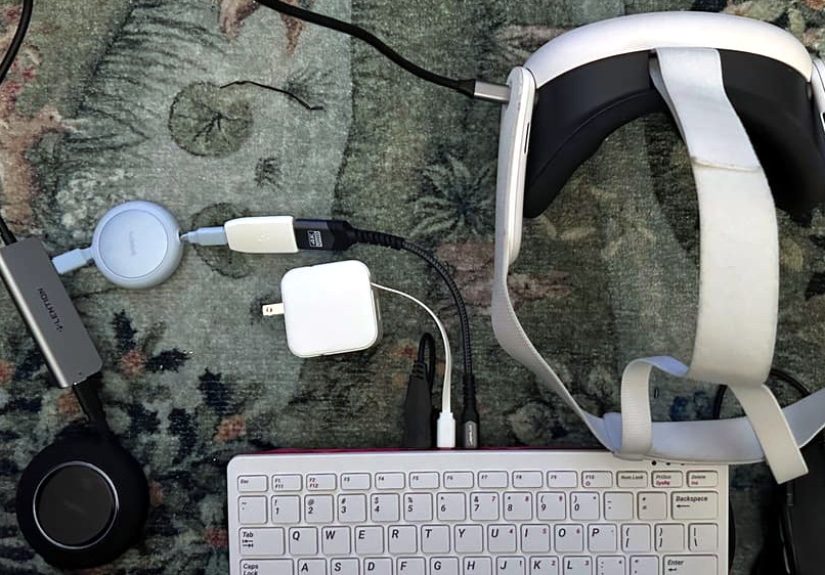
Traditionally, a cyberdeck has needed three obvious things: computing power, input controls, and a display. The display has always been the annoying part. It takes space, consumes power, adds weight, limits portability, and often forces the build into clamshell or slab shapes. But if the display moves onto your face, the body of the machine can shrink, reshape itself, or disappear into a keyboard case, shoulder bag, chest rig, or backpack. Suddenly a keyboard-computer like a Raspberry Pi 400 makes a ridiculous amount of sense. The “screen” is no longer bolted to the deck. It lives in your headset.
First, a Quick Reality Check: This Is Not Magic HDMI Fairy Dust
Let’s clean up one technical detail, because accuracy matters and the internet has suffered enough. When people say a VR headset now has “HDMI input,” they are usually using friendly shorthand. In the most talked-about examples, the headset is not literally a dumb display with a plain old HDMI jack waiting on the side like a living room TV from 2012. The trick is smarter than that.
In the Meta Quest workflow that sparked so much excitement, the headset uses an app to display video from supported external sources. HDMI, DisplayPort, or USB-C output from the source device is routed through compatible accessories, typically including a USB capture device that presents the signal in a format the headset can understand. That may sound less romantic than “plug in HDMI, become console cowboy,” but the practical result is still impressive: a resizable virtual screen inside the headset, driven by another machine.
And that nuance actually makes the story better, not worse. Why? Because it shows that the cyberdeck opportunity is not tied to one single headset model or one all-in-one gadget. It is part of a broader trend toward modular wearable computing. The headset handles the visual layer. The external machine handles the workload. Small adapters bridge the gap. This is exactly the kind of modular nonsense maker culture thrives on, and I mean that as a compliment of the highest order.
Why the Cyberdeck Community Immediately Sat Up in Its Ergonomic Chair
Cyberdeck builders have always been motivated by two goals that do not always get along: style and utility. On one hand, they want a machine that looks like it came out of Neuromancer, a field lab, or a very well-funded rebellion. On the other hand, they want something genuinely useful for writing, coding, diagnostics, radio work, security testing, media playback, mapping, or off-grid computing.
A wearable display solves a real problem for both camps. For the style crowd, it pushes the build deeper into that “jacked-in” aesthetic without forcing them to glue a seven-inch LCD to everything they own. For the practical crowd, it offers privacy, portability, and flexibility. A cyberdeck used in a cramped airplane seat, train ride, workshop corner, or event floor no longer needs a visible screen inviting everyone nearby to read your terminal output, your code, or your deeply embarrassing folder names.
That is one reason earlier portable builds were so interesting: many of the best cyberdecks were designed around very specific real-world frustrations. Tight spaces. Glare. Battery life. Ruggedness. Awkward seating. Lack of desk space. A headset-display approach continues that tradition. It is not just theatrical; it is logistical.
What a VR-Cyberdeck Can Do Better Than a Laptop
1. It creates a large private screen almost anywhere
A laptop screen is public by default. A headset display is private by design. That alone makes it appealing for travel, field work, or focused tinkering in shared spaces. If you are running a terminal, reviewing diagrams, monitoring feeds, or playing with a retro emulation setup, a personal virtual screen is a delightful upgrade.
2. It frees the computer from the display form factor
Remove the built-in screen requirement and your base device can become much weirder in the best possible way. It can be keyboard-first, modular, wrist-mounted, chest-mounted, backpack-based, or split into pieces. That is fertile ground for cyberdeck design, because makers love rearranging computing into shapes the big manufacturers would never approve in a board meeting.
3. It pairs beautifully with compact computers
Small systems like Raspberry Pi-based builds, handheld PCs, mini PCs, and keyboard computers become far more compelling when they no longer need a separate monitor. This makes the headset less like a toy accessory and more like an enabling component.
4. It can preserve environmental awareness
Here is the clever part: modern mixed-reality headsets can let you keep awareness of your surroundings through passthrough. That means you are not necessarily sealed off in a dark digital cave like an overcaffeinated mole person. You can place the virtual screen in your view while still seeing the room around you. For a mobile cyberdeck, that is huge.
But Let’s Not Pretend It’s Perfect
The cyberpunk fantasy is strong here, but so are the compromises. A headset-display setup is not automatically superior to a conventional screen. In fact, for long productivity sessions, it may still be worse. Comfort, eye strain, heat, battery management, cable routing, and face fatigue remain very real issues. Research on extended work in VR has found that today’s headsets can still be less comfortable and less usable than traditional desktop setups, especially over long sessions.
That does not kill the idea. It simply narrows the best use cases. A VR-cyberdeck shines when mobility, privacy, novelty, or spatial convenience matter more than all-day office comfort. It is brilliant for bursts of focused use, travel scenarios, field diagnostics, maker demos, temporary setups, and “I need a screen right now but do not want to carry one.” It is less ideal for eight uninterrupted hours of spreadsheets unless you are either unusually tolerant or secretly powered by spite.
There is also the issue of accessory sprawl. Once you add the headset, capture hardware, power support, cables, adapters, and possibly a dock, the build can become a hydra of tiny parts. That is still better than lugging a monitor in many situations, but it means good cable management is not optional. A bad wearable build does not feel futuristic. It feels like a snake pit with a battery pack.
This Idea Has History, and That History Is Weirdly Charming
The notion of wearing your display is not new. Earlier generations of personal display hardware, including old HDMI-fed head-mounted viewers, already hinted at this direction. Some of them felt like miniature private theaters strapped to your skull. Others felt like your face had volunteered for a beta test against its will. But they all pushed the same basic dream: untether the screen from the room.
What is different now is that the ecosystem around the display has matured. Compact computers are faster. Battery tech is better. Capture devices are tiny. XR glasses and wearable displays are lighter. Companies like XREAL and VITURE have normalized the idea that a wearable display can connect to phones, handhelds, consoles, and HDMI-equipped devices through adapters, docks, or supported USB-C workflows. Meanwhile, mixed-reality headsets bring something those older personal viewers often lacked: spatial software and passthrough awareness.
That matters because a modern cyberdeck is not only about watching a video feed. It is about placing a useful screen in space while keeping the rest of your device compact and adaptable. In that sense, the newest generation of wearable displays and headset workflows feels like the missing bridge between old-school cyberdeck aesthetics and actually usable portable computing.
So What Would a Great VR-Cyberdeck Look Like?
Not every build needs to resemble a prop from a rainy neon alley. The most convincing VR-cyberdeck designs will probably lean toward practical minimalism. Think of a small computer with excellent battery planning, a satisfying keyboard, and just enough ports or adapters to stay flexible. The headset handles the display. The deck body handles the workflow.
A smart build might include:
- a keyboard-centric base for writing, coding, and command-line tasks,
- a compact computer or handheld as the processing unit,
- a clean power strategy that can run both deck and accessories,
- a short, sane cable path instead of spaghetti with ambition,
- and a case or frame built for use in motion, not just for beauty shots.
The best part is that the deck no longer needs to commit to one role. It can be a terminal, retro gaming station, media deck, SDR rig, portable editing machine, or remote workstation. With the right headset-display path, all of those uses gain a giant personal screen without forcing the physical build to grow.
Why This Matters Beyond the Maker Crowd
Even if you never build a cyberdeck, this trend says something important about where personal computing is headed. We are inching toward a world where “computer” and “display” are no longer assumed to live in the same shell. That opens the door to screenless laptops, pocket workstations, wearables with modular compute units, and more flexible private-display workflows for travel and work.
In plain English: the monitor is becoming optional, at least some of the time. And once that becomes normal, every portable computer can be reimagined. Some of those reimaginings will be polished consumer products. Others will be glorious garage-built chaos. Both matter.
The cyberdeck community often acts like the weird little skunkworks division of personal computing. It tests ideas before the mainstream has language for them. A headset-driven deck is one of those ideas. Today it looks experimental. Tomorrow it may look obvious.
What It Feels Like to Use a VR-Cyberdeck in Real Life
The first experience is not “wow, this is the future.” It is more like, “wait a second… this actually works.” That is an important difference. A lot of futuristic gear is flashy for about six minutes and then collapses into setup pain, heat, and battery anxiety. A decent VR-cyberdeck, though, has a very different vibe. Once the source device appears in front of you as a floating screen, something clicks in your brain. The machine stops feeling like a project and starts feeling like a place.
You notice small things right away. Your hands are on a real keyboard, not some sad touchscreen pretending to be one. Your computer can sit off to the side, in a bag, on your lap, or integrated into the keyboard itself. The screen feels big without being physically present. In a cramped seat or a messy workspace, that can feel almost absurdly liberating. You are not hunting for a flat surface to prop up a display. You are not trying to angle a laptop around glare. You are just there, wearing the screen and using the machine.
There is also a private, cocooned quality to it that is hard to describe until you try it. A public café becomes less visually noisy. A train ride feels less compromised. A convention floor turns from chaos into background scenery. If passthrough is available, you still know where you are, but your actual workspace remains yours. It is not total isolation; it is selective attention. That can be wonderful for writing, coding, emulation, diagnostics, or simply focusing on one task without the whole room climbing into your eyeballs.
Of course, the experience is not all sleek cyberpunk perfection. Wear the setup too long and your face may file a complaint. Some headsets are still bulky. Some cable arrangements still feel like they were designed by a gremlin with a vendetta. And the magic drops fast if the battery plan is sloppy. Nothing ruins futuristic immersion like realizing your “portable command rig” is one dying adapter away from becoming a stylish paperweight.
But even with those annoyances, the appeal is real. The experience feels less like using a laptop and more like deploying a workstation. That sounds dramatic, and yes, maybe a little nerdy, but that is exactly the point. A good cyberdeck should feel intentional. It should feel built for a job, even if that job is “play retro games in a hotel room like a very committed goblin.”
The emotional payoff is surprisingly strong too. A normal computer disappears into routine. A VR-cyberdeck does not. It reminds you that personal computing can still feel inventive. It can still feel handcrafted. It can still feel like a machine with personality instead of one more anonymous rectangle made for everybody and nobody at the same time.
And that may be the real reason this concept matters. Not because everyone will replace their laptop with a face-mounted display rig, but because it reopens the imagination. It suggests that portable computing can be rearranged again. New shapes are possible. New rituals are possible. New kinds of focus are possible. The best cyberdecks have always promised exactly that: not just a tool, but a different relationship with the tool. A VR headset used as the display finally makes that promise feel a lot less theoretical.
Conclusion
A VR headset used as an external display does not automatically create the perfect cyberdeck. It does, however, unlock a compelling new blueprint. By moving the screen off the device and onto the user, it makes portable computers more modular, more private, and more imaginative. The result is not merely a gimmick. It is a meaningful shift in how a cyberdeck can be built and used.
The headline gets it right: this kind of headset really does invite a new kind of cyberdeck. Not because it fulfills every cyberpunk fantasy overnight, but because it gives builders something better than fantasy: a workable starting point. And once makers get a workable starting point, history suggests only one outcome. Things are about to get gloriously weird.