Table of Contents >> Show >> Hide
- Why Small Apartment Icons Matter
- The Wood Redux Philosophy
- From Milk Crate to Modular Shelf
- The Cinder Block Reimagined
- Sliding Boxes, Berry Boxes, and the Beauty of Small Storage
- Wood as a Small-Space Mood Setter
- Multifunctional Furniture: The Real Luxury
- Vertical Storage: The Wall Is Not Just a Wall
- Designing for Movement
- How to Style Wood Redux Pieces Without Making the Room Feel Rustic
- Choosing Better Wood Pieces
- Specific Small Apartment Ideas Inspired by Wood Redux
- Experience Notes: Living With Small Apartment Icons
- Conclusion
Small apartments have always been laboratories for invention. When square footage gets stingy, furniture suddenly has to earn its keep. A chair cannot merely be a chair. It must be a reading perch, a guest seat, a step stool in emotional disguise, and occasionally the place where laundry waits for the courage to fold itself. That is why the idea behind We Are Always Moving: Icons of the Small Apartment, Wood Redux feels so satisfying: it turns humble, movable, stackable apartment objects into warm, useful wood pieces that look intentional rather than temporary.
The phrase “wood redux” suggests more than a material swap. It is a design attitude. It asks: What if the milk crate, the cinder block, the berry box, and the simple storage bin were not signs of “I just moved in,” but icons of practical urban living? What if the objects we drag from lease to lease could become beautiful enough to keep?
In an age of studio apartments, hybrid work, rising rents, downsizing, and “my dining room is also my office and possibly my gym,” small-space design needs fewer bulky status pieces and more clever companions. Wood, especially plywood, maple, birch, Douglas fir, oak, walnut, and responsibly sourced hardwoods, brings texture, repairability, and visual calm. It softens the chaos of compact living. It also ages better than plastic, which tends to announce every scratch like it is auditioning for a crime show.
Why Small Apartment Icons Matter
Every small apartment has its unofficial icons. The folding chair behind the door. The crate by the bed. The wall shelf doing the work of three cabinets. The storage box that contains cables, tax documents, mystery keys, and at least one object nobody in the household can identify. These pieces are not glamorous, but they are honest. They exist because compact homes demand furniture that can move, stack, vanish, reappear, and change jobs without filing a complaint.
The best small apartment furniture is not just small. It is agile. A tiny table that only does one thing may still be a nuisance. A well-designed wooden box, however, can become a bedside table, entryway catchall, wall-mounted shelf, plant stand, toy bin, or portable office supply caddy. That is the magic of simple forms: they do not dictate how you live. They politely offer possibilities.
The Wood Redux Philosophy
“Redux” means brought back, revived, or restored. In this context, wood redux revives the scrappy furniture language of apartment life and upgrades it with material dignity. Instead of plastic milk crates or rough concrete blocks, imagine birch plywood crates, Douglas fir blocks, maple berry boxes, and sliding-lid wooden storage that feels crafted rather than improvised.
The appeal is partly emotional. Wood makes utilitarian objects feel warmer and more permanent. It carries grain, color, weight, and touch. It can be sanded, refinished, oiled, repaired, and passed along. Even when it is engineered as plywood, it can offer strength with relatively light weight, which matters when you move apartments more often than you replace your toothbrush holder.
From Milk Crate to Modular Shelf
The milk crate is one of the greatest accidental inventions in small-space living. It stacks. It carries. It stores books, records, shoes, pantry goods, cleaning supplies, pet toys, and all the cables that allegedly belong to something. But the plastic version often looks like it escaped from a college dorm in 2009.
A wooden milk-crate-inspired design keeps the flexibility while changing the mood. Stack two beside a sofa and they become a side table. Mount one horizontally on a wall and it becomes a small shelf. Place one near the entry and it holds scarves, leashes, mail, and reusable bags. Use three together and suddenly there is a modular bookcase that can be rearranged whenever the room needs a reset.
Why It Works in a Small Apartment
Small rooms benefit from furniture that is open, modular, and visually light. A wooden crate with cutouts or slatted sides provides storage without becoming a solid visual block. It also lets the room breathe. That matters because in compact spaces, heavy furniture can make a room feel like it is wearing a winter coat indoors.
The Cinder Block Reimagined
Cinder blocks have long been the unofficial building system of first apartments. Add a plank and you have a bookshelf. Add another and you have a TV stand. Add too many and you have a minor structural concern. The problem is that concrete is heavy, dusty, and unforgiving. It is charming in a “my friends helped me move and now nobody speaks to me” sort of way.
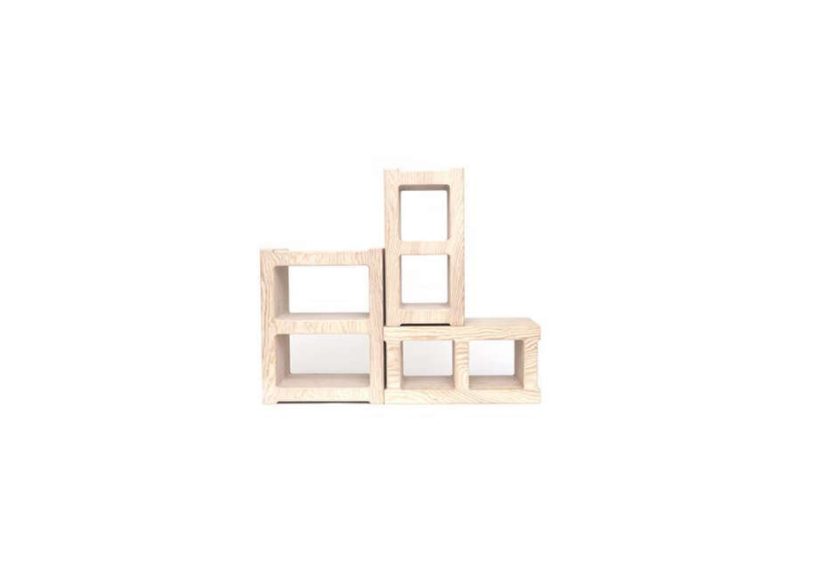
A wood version of the cinder block keeps the sculptural geometry but removes the punishment. Wooden blocks can act as risers, bookends, low stools, bedside tables, or supports for planks. They nod to industrial design without requiring a forklift. Douglas fir and similar softwoods are especially appealing here because they offer warmth, visible grain, and a lighter physical presence.
Sliding Boxes, Berry Boxes, and the Beauty of Small Storage
Small apartment organization is rarely solved by one giant cabinet. More often, it is solved by many small decisions. A sliding-lid wooden box on a desk can hide pens, chargers, sticky notes, receipts, earbuds, and the tiny screwdriver that appears exactly once every three years. A berry-box-inspired tray can hold fruit in the kitchen, toiletries in the bathroom, or keys by the door.
These objects succeed because they are easy to relocate. The smaller the apartment, the more important portability becomes. A good storage box should move from shelf to table to closet without ceremony. It should also look good in the open, because in a studio apartment, “hidden storage” often means “visible from the bed.”
Wood as a Small-Space Mood Setter
Small apartments can easily become visually noisy. One room may include a bed, sofa, desk, dresser, dining table, bookshelf, and kitchen within conversational distance. Wood helps unify that mix. Repeating similar wood tones across crates, shelves, stools, and tables can make a compact home feel curated rather than crowded.
Light woods such as birch, ash, maple, and pale oak can make rooms feel fresh and airy. Medium woods add warmth without overwhelming the space. Dark woods create drama and depth, especially when paired with light walls, linen, stoneware, or matte metal. The key is restraint. A small apartment does not need seven wood tones having a committee meeting in the living room.
Multifunctional Furniture: The Real Luxury
In a compact home, luxury is not always marble or massive sectionals. Sometimes luxury is a bench that stores shoes. A wall shelf that becomes a desk. A coffee table that opens. A bed with drawers. A crate that becomes a nightstand today and a plant stand tomorrow. Multifunctional furniture respects the reality of small living: rooms change roles constantly.
Think of the apartment as a stage. In the morning, the table is a breakfast spot. By noon, it is a laptop station. At night, it might hold dinner, mail, a candle, and a half-finished puzzle pretending to be a lifestyle choice. Furniture that can adapt makes these transitions easier and less chaotic.
Vertical Storage: The Wall Is Not Just a Wall
One of the most useful small apartment design principles is simple: use the walls. Vertical storage keeps the floor clear, and a clear floor makes a room feel larger. Floating shelves, peg rails, wall-mounted crates, tall bookcases, hanging racks, and slim cabinets can shift storage upward without swallowing precious walking space.
Wooden wall storage is especially effective because it adds warmth at eye level. A plain wall-mounted box can hold books, spices, bathroom jars, or entryway essentials. A row of peg rails can carry bags, hats, aprons, headphones, or the jacket you wear every day but somehow still throw over a chair. Wood makes these systems look intentional rather than purely tactical.
Designing for Movement
The title We Are Always Moving captures the modern renter’s condition perfectly. People move for jobs, relationships, rent increases, school, sunlight, shorter commutes, longer kitchens, quieter neighbors, or because the old apartment had a radiator that sounded like a haunted submarine. Furniture for this life should not be precious in the wrong way. It should be durable, flexible, and easy to carry.
This is where modular wood pieces shine. A crate does not care whether it lives in a bedroom, kitchen, or hallway. A wooden block can support books in one apartment and become a plant pedestal in another. A storage box can travel in the car and land on a new shelf without needing a new identity. Small-space icons survive because they are useful before they are decorative.
How to Style Wood Redux Pieces Without Making the Room Feel Rustic
Wood does not automatically mean farmhouse. In a small apartment, wood can be modern, Scandinavian, Japanese-inspired, industrial, minimalist, playful, or quietly luxurious. The styling choices around it determine the final effect.
Pair Wood with Clean Lines
Use simple silhouettes and avoid overdecorating. A birch plywood crate next to a low sofa looks crisp when paired with a linen cushion, a ceramic lamp, and one good book. It looks less crisp when buried under twelve remotes, three mugs, and a candle named “Forest Ambition.”
Mix Wood with Metal
Steel brackets, black hooks, aluminum lamps, and powder-coated shelves can make wood feel contemporary. The contrast keeps the look from becoming too cabin-like.
Add Softness
Rugs, curtains, cushions, and upholstered seating balance the hard edges of crates and boxes. In a small apartment, texture is the secret sauce. Wood brings grain; textiles bring comfort.
Choosing Better Wood Pieces
When buying wood furniture for a compact home, look beyond the photograph. Ask practical questions. Is it light enough to move? Can it stack? Can it mount to the wall? Does it have smooth edges? Is it finished well enough to resist daily use? If it uses composite wood, does it meet relevant formaldehyde emissions standards? If sustainability matters to you, look for responsible sourcing certifications or transparent material information.
Good small-space furniture should not punish you for living with it. It should be easy to clean, easy to reposition, and strong enough for everyday life. A beautiful box that cannot survive keys, coffee, and one dramatic grocery drop is not a box; it is a very expensive anxiety object.
Specific Small Apartment Ideas Inspired by Wood Redux
1. Create a Crate Wall
Mount a few wooden crates in a loose grid above a desk, kitchen counter, or entry bench. Use them for books, bowls, mail, or small plants. Keep some negative space between them so the wall feels designed, not crowded.
2. Replace a Bulky Nightstand
A compact wooden crate or block can hold a lamp, phone, glass of water, and one drawer-free commitment to minimalism. Add a small basket inside if you need hidden storage.
3. Build a Low Modular Bookcase
Stack wooden crates horizontally along a wall to create low storage under a window. This keeps sightlines open and avoids the “tiny room, giant cabinet” problem.
4. Use Wood Boxes as Drawer Dividers
Small sliding boxes can organize office supplies, craft materials, jewelry, batteries, or kitchen tools. The joy of a drawer divider is not glamorous, but neither is digging for a charger while late for a meeting.
5. Add a Movable Entry Station
Place a wooden box, bench, or crate near the door for shoes, keys, bags, and dog-walking gear. Small apartments often lack proper foyers, so the entry zone must be invented.
Experience Notes: Living With Small Apartment Icons
The first time you live in a truly small apartment, you learn that furniture has consequences. A sofa that looked “cozy” online may arrive like a cruise ship. A coffee table may block the only logical walking route. A dresser may technically fit, but only if you agree never to open the bottom drawer. Small-space living teaches humility, geometry, and the importance of measuring twice before buying anything with free delivery.
Wood redux pieces feel different because they start with everyday behavior instead of showroom fantasy. In real apartments, people move things. They drag a box from the closet to the sofa. They stack books by the bed. They need somewhere to drop mail before it becomes an archaeological layer. They want storage that can sit in plain sight without making the room look like a utility closet wearing pants.
One practical experience with wooden crates is how quickly they become part of the apartment’s rhythm. A crate beside the sofa starts as book storage, then becomes a snack table during movie night, then a temporary laptop stand, then a plant shelf because the plant has “better light there,” according to the plant’s legal representative. The point is not that one crate solves everything. The point is that it keeps saying yes.
Wooden blocks have a similar charm. They are wonderfully noncommittal. Use one as a bedside table in a studio. Move it to the hallway for shoes. Place a plank across two blocks and you have a low shelf. Stack them near a window and you have a sculptural plant display. Unlike many apartment purchases, they do not become useless when you move. They simply adapt to the next strange floor plan.
The best small apartment objects also reduce visual guilt. Plastic bins can be useful, but they often look temporary, even when they have been sitting in the same corner for four years and now know your secrets. Wood has a calming effect. A maple box holding mail looks like a design choice. A birch crate full of records looks charming. A fir block supporting a lamp looks intentional. The function is still humble, but the material gives it confidence.
There is also a psychological benefit to living with objects that can move easily. Heavy furniture makes a renter feel trapped. Flexible furniture makes a renter feel capable. When a room stops working, you can rearrange it in an hour. When a guest stays over, you can clear space. When remote work takes over the dining table, you can shift storage upward, slide a box under the bed, and pretend you planned it all along.
In the end, the small apartment is not a design problem to defeat. It is a design conversation. It asks for fewer objects with better manners. It rewards furniture that is useful, warm, portable, and forgiving. We Are Always Moving: Icons of the Small Apartment, Wood Redux is compelling because it honors the scrappy intelligence of apartment life while making it more beautiful. It says the temporary can be thoughtful. The practical can be elegant. The humble crate can grow up, get a wood finish, and finally meet your parents.
Conclusion
Small apartment living is not about shrinking your personality to fit the floor plan. It is about choosing objects that work hard without shouting. Wood redux design celebrates the everyday heroes of compact homes: crates, blocks, boxes, shelves, benches, and modular pieces that move when life moves. These icons are simple, but their simplicity is exactly the point.
In a world where many people rent longer, move more often, work from home, and expect one room to perform five jobs, adaptable wood furniture offers a smarter path. It brings warmth without clutter, durability without bulk, and flexibility without looking makeshift. The small apartment does not need more stuff. It needs better stuff: pieces that stack, store, support, travel, and age with grace.