Table of Contents >> Show >> Hide
- Why Your Words Matter When Someone Feels Overwhelmed
- 27 Helpful Phrases to Say When Someone Is Overwhelmed
- What Not to Say When Someone Is Overwhelmed
- How to Say the Right Thing the Right Way
- Examples of Supportive Responses in Real Life
- Experience and Perspective: What This Looks Like in Everyday Life
- Conclusion
- SEO Tags
When someone is overwhelmed, most people have good intentions and terrible timing. They want to help, so they reach for a phrase like “Don’t worry about it,” “Just relax,” or the all-time classic, “Calm down.” Unfortunately, that usually lands with the emotional grace of a shopping cart rolling downhill.
If you want to support someone who is stressed, anxious, emotionally flooded, or just plain done with the day, the right words can make a real difference. The goal is not to become their personal life coach, therapist, project manager, and emergency snack provider all at once. The goal is simpler: help them feel seen, safe, and a little less alone.
Below, you’ll find 27 helpful phrases to say when someone is overwhelmed, plus tips on how to say them without sounding like a motivational poster in human form.
Why Your Words Matter When Someone Feels Overwhelmed
When a person is overloaded, their brain is often not looking for a lecture, a silver lining, or a ten-step plan color-coded in a shared spreadsheet. They usually need emotional validation first. That means showing that you hear what they’re feeling, not rushing to erase it.
Supportive language works best when it does three things: it acknowledges the emotion, reduces shame, and offers realistic help. In other words, your job is not to “fix” the person. Your job is to make the moment feel less lonely and less chaotic.
27 Helpful Phrases to Say When Someone Is Overwhelmed
Phrases That Validate Their Feelings
-
1. “That sounds really hard.”
Simple, warm, and effective. This tells the person you are not brushing off what they’re carrying. -
2. “You have a lot on your plate right now.”
This helps name the overload without making the person defend why they feel stressed. -
3. “It makes sense that you feel overwhelmed.”
A little validation goes a long way. People often calm down faster when they stop feeling judged for having feelings in the first place. -
4. “Anyone in your position would feel stretched.”
This reduces shame and reminds them they are not failing at being a person. -
5. “You don’t have to pretend you’re okay with me.”
Helpful when someone is trying very hard to hold it together while clearly hanging on by one emotional paper clip. -
6. “I can see this is weighing on you.”
This shows you are paying attention, not just waiting for your turn to talk. -
7. “You’re not overreacting. This feels big because it is big to you.”
This is especially useful when the person is apologizing for being emotional.
Phrases That Create Safety and Connection
-
8. “I’m here with you.”
Not flashy, not dramatic, just grounding. Sometimes the best support is steady presence. -
9. “You don’t have to figure this out all at once.”
Overwhelm often comes from trying to solve everything in one mental sprint. This phrase gently slows the pace. -
10. “We can take this one step at a time.”
Great for work stress, family stress, health stress, or any other life mess that seems to be multiplying like rabbits. -
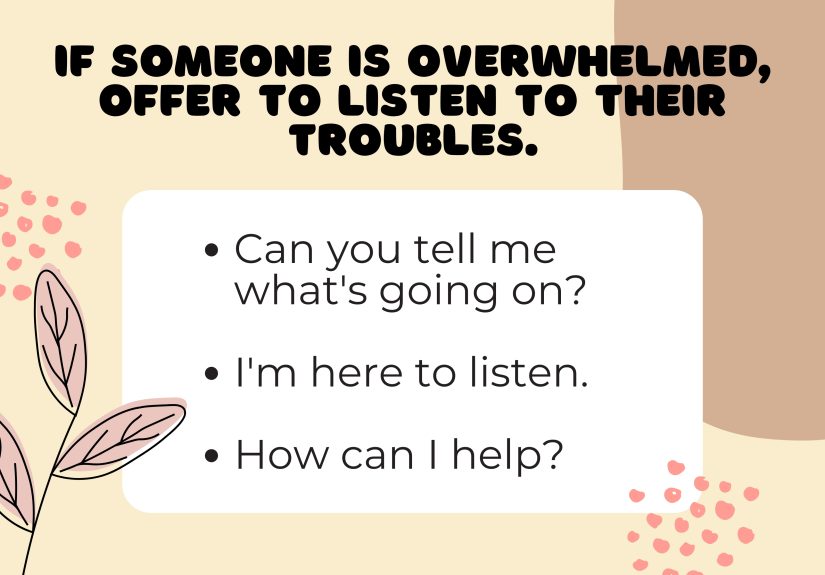
11. “Do you want me to listen, or help you problem-solve?”
This may be one of the most useful questions in human history. It keeps you from offering solutions when what they really need is a witness. -
12. “You can say as much or as little as you want.”
This removes pressure. Some people want to talk through every detail; others need quiet company. -
13. “I’m not going anywhere right now.”
For someone who feels emotionally flooded, a calm, reliable presence can be incredibly reassuring.
Phrases That Help Them Slow Down
-
14. “Let’s pause for a second and breathe.”
Notice the teamwork in that sentence. “Let’s” feels supportive; “you need to breathe” can sound bossy. -
15. “What feels most urgent right now?”
Overwhelm can make everything feel equally on fire. This question helps identify the one flame to address first. -
16. “What’s one thing we can do in the next ten minutes?”
Tiny action beats giant panic. A short time frame makes the next move feel possible. -
17. “You don’t need to make every decision today.”
Perfect for moments when someone feels cornered by deadlines, expectations, or 47 tabs open in both their browser and their brain. -
18. “Can we break this into smaller pieces?”
Helpful for both practical overwhelm and emotional overwhelm. Smaller pieces feel less impossible. -
19. “What would feel most helpful right now?”
This keeps support centered on their needs, not your guess about their needs.
Phrases That Offer Real Help
-
20. “I can help you with one specific thing.”
This is better than the vague “Let me know if you need anything,” which often sounds nice but creates homework for the overwhelmed person. -
21. “Do you want me to sit with you while you do this?”
Body doubling is real. Sometimes another person’s quiet presence makes a hard task feel less awful. -
22. “Would it help if I took this one task off your plate?”
Concrete help can be more comforting than a dozen inspirational speeches. -
23. “I can help you make a short plan if you want.”
Notice the if you want. Support should feel like a handrail, not a takeover.
Phrases That Encourage Support Without Pressure
-
24. “You don’t have to carry this by yourself.”
A kind reminder that asking for help is not a character flaw. -
25. “Have you talked to anyone else about this?”
This opens the door to broader support from family, friends, a manager, a doctor, or a mental health professional. -
26. “It might help to reach out for extra support, and I can help you do that.”
Gentle, respectful, and practical. This is useful when someone seems stuck, burned out, or deeply distressed. -
27. “If this feels like too much to handle alone, we can call or text 988 right now.”
If the person seems in crisis, talks about hopelessness, self-harm, or wanting to disappear, take that seriously and connect them to immediate support.
What Not to Say When Someone Is Overwhelmed
Knowing what to avoid is just as important as knowing what to say. Here are a few phrases that usually do more harm than good:
- “Calm down.” Almost nobody has ever become calmer because they were commanded to be.
- “It’s not that bad.” This minimizes the person’s experience.
- “Other people have it worse.” True or not, this rarely helps and often adds guilt.
- “Just think positive.” This can sound dismissive when someone needs empathy, not a slogan.
- “You need to…” Unless they asked for advice, leading with instructions can make them feel even more pressured.
If you catch yourself starting to say one of these, do not panic. You are still a redeemable human. Just reset and try something more validating instead.
How to Say the Right Thing the Right Way
Words matter, but delivery matters too. Keep your tone calm. Speak a little more slowly than usual. Avoid sounding rushed, skeptical, or overly polished. People can tell when empathy is real and when it sounds like it was copied from a corporate training video.
It also helps to match your response to the moment. If someone is crying in the kitchen after a brutal day, that is not the time for a long lecture about resilience. If someone is spiraling over a work deadline, try grounding them with one manageable next step. If someone is showing signs of crisis, safety becomes the priority.
A good rule of thumb is this: validate first, ask second, advise last. In many cases, that order is the difference between a helpful conversation and one that makes the overwhelmed person want to fake a Wi-Fi outage and leave.
Examples of Supportive Responses in Real Life
Scenario 1: A friend is drowning in responsibilities.
You might say, “You have a lot on your plate right now. What feels most urgent today?”
Scenario 2: Your partner is emotionally flooded after a hard day.
Try, “I’m here with you. Do you want me to listen, or do you want help figuring out what to do next?”
Scenario 3: A coworker is clearly overloaded.
Say, “This seems like a lot to manage at once. Want to break it into smaller pieces together?”
Scenario 4: Someone seems more than just stressed.
You can say, “You don’t have to carry this alone. If this feels too big, I can help you reach out for support right now.”
Experience and Perspective: What This Looks Like in Everyday Life
Most people do not remember the perfect sentence someone said during a hard time. They remember how that person made them feel. Did they feel rushed? Judged? Fixed? Or did they feel safe enough to exhale for the first time all day?
Think about the difference between two conversations. In the first, someone says, “You’re fine. Don’t stress. Just be positive.” The words are not cruel, exactly, but they create distance. The overwhelmed person now has two problems: the original stress and the awkward feeling that they should be handling it better. That kind of response often shuts people down.
In the second conversation, someone says, “That sounds really hard. You don’t have to solve it all tonight. What would help most right now?” Nothing magical happened. No fireworks. No violin soundtrack. But the overwhelmed person feels less alone, less ashamed, and more able to think clearly. That is what supportive language does. It lowers emotional temperature without dismissing the heat.
In families, these phrases can prevent small moments from becoming giant blowups. A parent saying, “I can see you’re overloaded” to a teenager can work much better than “Why are you acting like this?” A spouse saying, “Do you want comfort or solutions?” can stop a misunderstanding before it turns into a full debate about dishes, budgets, and who forgot the dry cleaning in 2022.
At work, the same principle applies. A manager who says, “Let’s identify the top priority” is usually more helpful than one who says, “We all have stress.” A coworker who offers to handle one task can be more useful than three people saying, “Hang in there,” while continuing to send emails marked urgent.
There is also an important personal lesson here: many overwhelmed people are incredibly competent. They are often the reliable ones, the fixers, the people others lean on. That means they may have a hard time admitting when they are maxed out. Gentle, respectful phrases help them keep dignity while still accepting support. That matters.
And sometimes, the most meaningful thing you can say is not especially poetic. It is “I’m here.” Or “Let’s do the next ten minutes.” Or “You don’t have to explain why this is hard.” Helpful support is not about dazzling someone with wisdom. It is about reducing isolation.
That is why the best phrases are usually short, human, and real. They leave room for the overwhelmed person to be honest. They do not force instant improvement. They do not demand gratitude. They simply say, in effect, “I see that this is heavy, and I’m willing to stand here with you while you figure out the next step.” In a world full of noise, that kind of response can feel like relief.
Conclusion
If you are wondering what to say when someone is overwhelmed, start with empathy, not efficiency. The most helpful phrases validate the person’s feelings, reduce shame, and offer support that is specific and respectful. You do not need the perfect script. You just need words that make the other person feel heard instead of handled.
And remember, if someone’s overwhelm seems severe, persistent, or unsafe, it is okay to encourage professional help. Supportive words are powerful, but they are not a substitute for mental health care when someone is truly struggling.