Table of Contents >> Show >> Hide
- The F-117 Was the Jet That Made Stealth Real
- It Looked Weird Because Aerodynamics Had to Take a Number
- The F-117 Rewrote the Opening Chapter of Modern Air War
- It Was Not Invisible, and That Somehow Makes It Cooler
- The Nighthawk Was a Bridge Between Secret Programs and Fifth-Generation Fighters
- Why the F-117 Still Feels So Cool Decades Later
- What the F-117 Experience Feels Like for Pilots, Maintainers, and Aviation Fans
- Final Approach
Note: This article is formatted as clean HTML body content for direct web publishing.
Some airplanes look fast. Some look elegant. The F-117 Nighthawk looks like a black paper airplane that got into a bar fight with a geometry textbook and won. And that, somehow, is exactly why it became one of the most legendary combat aircraft in American history.
If you judge the F-117 by normal fighter standards, you will miss the whole point. It was not built to dogfight like an F-15, strut around like an F-14, or flex brute force like a B-52. The F-117 was built for something far more nerve-rattling: slipping into heavily defended airspace, finding the target everyone else was worried about, dropping precision weapons, and leaving before the enemy fully understood what had just happened.
That is what makes the F-117 such a badass plane. It changed how modern air war worked. It proved stealth was not science fiction. It turned “impossible mission” into “Tuesday night.” It also did all of this while looking like a villain’s origami project and flying with the aerodynamic charm of a sharpened brick. That is not just cool. That is iconic.
The F-117 Was the Jet That Made Stealth Real
The biggest reason the F-117 matters is simple: it was the world’s first operational stealth aircraft. Before it showed up, stealth was mostly a mix of theory, testing, secrecy, and ambitious engineering. After the F-117 entered service, stealth became a proven combat advantage.
The Nighthawk first flew in 1981 and reached initial operating capability in 1983. Even then, the program stayed buried under layers of secrecy. For years, the jet lived in the shadows, flying mostly at night from Tonopah Test Range in Nevada. The secrecy was so intense that when the public finally got a look at it in the late 1980s, the aircraft seemed almost unreal. It did not resemble the sleek future people expected. It looked stranger, sharper, and somehow more menacing.
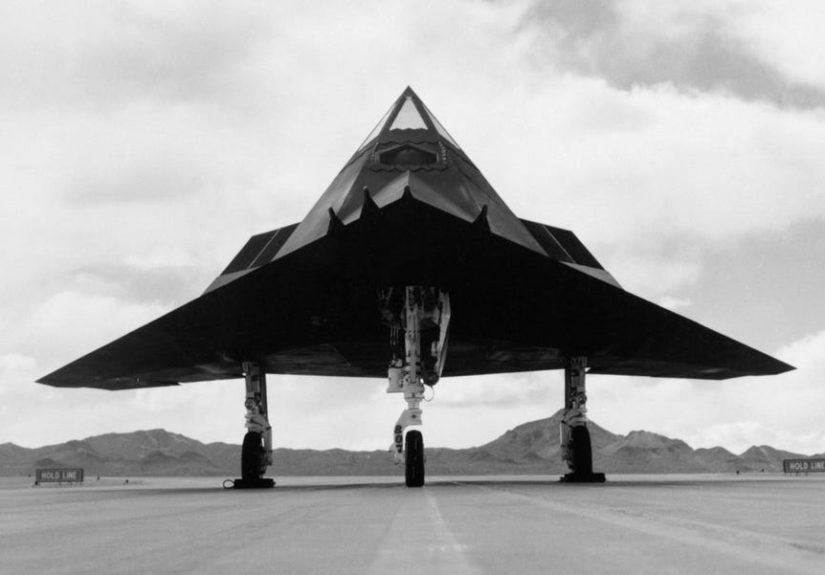
That weird faceted shape was not an aesthetic choice. It was a survival strategy. The aircraft’s angled surfaces were designed to scatter radar energy away from the emitter rather than bounce it back like a conventional aircraft. Add radar-absorbent materials, careful shaping, shielded engine inlets, reduced infrared signature features, and internal weapons carriage, and the result was a jet built around one goal: do not be seen until it is too late.
That may sound obvious now, in an age of stealth bombers and fifth-generation fighters, but the F-117 was the aircraft that dragged that idea out of classified theory and into operational reality. In plain English, it was the original proof that the smartest airplane in the room did not need to be the loudest one.
It Looked Weird Because Aerodynamics Had to Take a Number
The F-117’s shape remains one of the most famous “ugly genius” designs in aviation history. It was all sharp edges, flat panels, hard angles, and a profile that looked less like a jet and more like a warning sign. It was not pretty in a classic sense. It was pretty in the way a lockpick is pretty: strange, purposeful, and extremely effective in the wrong hands.
Facets Over Flair
The faceted design existed because early computing power could model radar reflections from flat surfaces more easily than from smooth curves. Later stealth aircraft, such as the B-2, F-22, and F-35, would use more advanced curves and blended shapes. But the F-117 embraced the technology of its moment and turned limitations into a breakthrough.
That came with trade-offs. The aircraft was aerodynamically unstable, which meant it relied on a fly-by-wire control system to stay manageable in flight. In other words, it needed computers helping it behave because pure aerodynamic common sense had already left the chat. That only adds to the legend. The jet was not naturally graceful. It had to be engineered into usefulness through a mix of brains, nerve, and sheer technical stubbornness.
Stealth Came First, Speed Came Second
The F-117 was subsonic and not built for air-to-air combat. Despite the “F” designation, it was really an attack aircraft in fighter’s clothing. That label was chosen in part because “fighter” had more swagger and helped attract top pilots. Fair enough. Even so, the truth matters: the Nighthawk was not a knife fighter. It was a lockpicker with a bomb bay.
Its job was to carry precision-guided weapons internally, preserve a tiny radar signature, and hit high-value targets in places other aircraft would have needed a small parade of escorts, jammers, suppression aircraft, and prayer circles to survive. The F-117 did not win style points by turning tightly or blazing past Mach numbers. It won by making enemy defenses look outdated.
The F-117 Rewrote the Opening Chapter of Modern Air War
The Nighthawk first saw combat during Operation Just Cause in Panama in 1989, but the aircraft’s true legend was forged in the Persian Gulf. During Operation Desert Storm, the F-117 became the sharp end of the spear.
Baghdad was one of the most heavily defended cities on Earth at the time. If there were ever a moment for stealth to prove it was more than a very expensive theory, this was it. The F-117 delivered. Nighthawks flew deep into Iraqi airspace, struck strategic targets, and helped open the air campaign in spectacular fashion. According to official Air Force and museum records, the aircraft flew 1,271 sorties during Desert Storm, achieved an 80 percent mission success rate, and suffered no losses or battle damage. That is not “pretty good.” That is a brutal mic drop.
Even more impressive, F-117 pilots flew only a small share of total combat sorties while attacking a huge portion of the most heavily defended strategic targets. That is the kind of return on investment that makes military planners sit up straighter and stop pretending stealth is optional.
The aircraft’s bomb load was modest by bomber standards, but that misses the point. The F-117 could carry its weapons internally and place them precisely where they mattered most. It was not trying to flatten a zip code. It was trying to remove the nerve center, the command bunker, the communications node, the air-defense site, or the hardened target that made the rest of the enemy system function. It was a surgeon wearing blackout paint.
It Was Not Invisible, and That Somehow Makes It Cooler
One of the laziest myths about stealth aircraft is that they are invisible. They are not. The F-117 was never a magic trick. It was a machine built to reduce detection, disrupt tracking, complicate engagement, and stack the odds in favor of survival and mission success.
That distinction matters because it makes the F-117’s combat record more impressive, not less. This was not an untouchable fantasy aircraft. It was a real airplane with real limitations. It had no radar of its own for air combat. It had no conventional dogfighting mission. It depended heavily on planning, route selection, maintenance discipline, pilot skill, and stealth integrity.
And yes, one F-117 was shot down over Serbia during Operation Allied Force in 1999. That event is often treated like a gotcha moment against stealth. It should not be. The more serious lesson is that no combat system is invincible. Tactics evolve. Defenses adapt. Routes become predictable. Windows of vulnerability open. Stealth reduces risk; it does not erase it from the universe.
Even with that loss, the broader story remains intact: the F-117 changed what was possible in contested airspace. It made deep-penetration strike more precise, more selective, and in many cases more survivable. It proved that the future of combat aviation would not belong only to speed, altitude, and raw power. It would belong to aircraft that could shape the enemy’s awareness before the enemy could shape the fight.
The Nighthawk Was a Bridge Between Secret Programs and Fifth-Generation Fighters
Another reason the F-117 deserves respect is that it served as the practical foundation for a whole era of American low-observable aircraft. The lessons learned from designing, building, maintaining, and operating the Nighthawk fed directly into later stealth systems.
That influence shows up everywhere. The B-2 refined stealth shaping and low-observable strategy for long-range bombing. The F-22 brought stealth to air superiority. The F-35 made stealth part of a broader multirole package. None of those aircraft are carbon copies of the F-117, but all of them owe something to the Nighthawk’s early hard lessons.
And those lessons were not just about shape. They were about coatings, manufacturing tolerances, maintenance demands, heat management, mission planning, weapons integration, and the brutally unglamorous truth that stealth is not a one-time trick. It is a whole operating philosophy. The F-117 taught the Air Force how to live with stealth as a daily combat reality rather than a classified experiment.
That is why calling the F-117 “important” almost undersells it. It was not merely another airplane. It was the combat classroom where modern stealth aviation earned its first serious report card.
Why the F-117 Still Feels So Cool Decades Later
Some aircraft age into nostalgia. The F-117 aged into myth.
Part of that is visual. The Nighthawk still looks futuristic, but in a Cold War fever-dream kind of way. It is the rare aircraft that can look both outdated and ahead of its time simultaneously. Another part is secrecy. The plane spent years hidden, based in remote Nevada, flying mostly at night, connected to whispered conversations about black programs and invisible jets. That kind of origin story does not exactly hurt the legend.
But the biggest reason it still hits hard is that the aircraft delivered. Plenty of military systems are famous because of promises. The F-117 is famous because of results. When it finally entered public view, it was not an overhyped concept model. It was a combat-ready machine that had already changed the logic of strike warfare.
Even its retirement in 2008 added to the mystique. The Air Force moved on because newer stealth aircraft offered broader capabilities and the F-117 was expensive to operate and maintain. Yet the story did not quite end there. Several airframes have remained in flyable condition for limited test and training roles, and the jet has reappeared from time to time like a retired hitman who still gets the occasional call. That kind of afterlife only makes the legend stronger.
What the F-117 Experience Feels Like for Pilots, Maintainers, and Aviation Fans
Now for the human side, because no airplane becomes legendary through engineering alone. Aircraft earn their place in memory through experience. And the F-117 experience is unlike almost anything else in military aviation.
For pilots, the Nighthawk represented a rare kind of responsibility. Flying it was not about showing off with high-G turns at an airshow. It was about carrying the first-night mission, the politically sensitive mission, the deeply defended mission, the mission where failure would echo well beyond the cockpit. Pilots who flew the F-117 often described the airplane in terms of access: going where other aircraft could not go, doing what other aircraft could not do, and knowing the enemy might not realize they were under attack until the target was already hit. That is a very specific kind of pressure. It is also a very specific kind of pride.
For maintainers, the F-117 experience was a grind of excellence. This was not a “wipe it down and send it” kind of jet. Its radar-absorbing materials and low-observable surfaces demanded patience, precision, and constant attention. Every panel line, coating repair, and inspection mattered. In many ways, the maintainers were as responsible for the jet’s stealth as the designers were. The aircraft’s mystique may have been built on secrecy, but its combat effectiveness was sustained by people doing exacting work under unforgiving standards.
For commanders and planners, the F-117 changed the emotional tone of strategy. Before stealth, attacking a heavily defended target often meant building a giant package around the strike aircraft: escorts, tankers, jammers, suppression assets, rescue coverage, and layers of contingency planning. The F-117 did not eliminate complexity, but it changed the conversation. Suddenly, there was an aircraft designed to go straight at the hardest target on the board. That creates a different kind of confidence in a crisis.
For aviation fans, seeing the F-117 in person can be weirdly unsettling. It is not huge, but it feels serious. The black finish absorbs attention. The angles do not flow the way normal airplane lines flow. The jet seems almost assembled from silence. You look at it and instantly understand that this machine was built with one question in mind: how do we get there without being noticed? Even parked in a museum, it still looks like it is hiding something.
And for people who grew up watching footage from Desert Storm or reading about Tonopah, Groom Lake, and black-world aircraft, the F-117 represents a whole era of American aerospace ambition. It is the airplane that made advanced technology feel slightly spooky again. It turned stealth into cultural mythology. It made a generation of readers, model builders, pilots, and military nerds stare at a faceted black jet and think, “That thing absolutely should not work.” Then it worked. Spectacularly.
That may be the best summary of the F-117 experience. It inspires the same reaction whether you are a pilot, maintainer, historian, or first-time museum visitor: disbelief first, admiration second, obsession shortly after. Plenty of aircraft are impressive. Very few feel like they changed the rules just by existing. The Nighthawk does.
Final Approach
So why is the F-117 Nighthawk such a badass plane? Because it was the first operational stealth aircraft to prove that low observability could transform warfare. Because it turned bizarre design into combat advantage. Because it struck high-value targets in the world’s most defended airspace and came home with a record that reshaped military thinking. Because it helped build the stealth future that followed. And because, even now, it still looks like something the future accidentally dropped into the past.
The F-117 did not need afterburners, flashy dogfights, or movie-star curves to earn respect. It earned that respect the hard way: by making enemy air defenses look confused, outdated, and suddenly very vulnerable. In aviation history, that is more than enough. That is badass.