Table of Contents >> Show >> Hide
- 1. How Did Stonehenge’s Altar Stone Travel So Far?
- 2. Why Was Göbekli Tepe Built Before Farming Took Over?
- 3. Who Made the Very Ancient Stone Tools on Sulawesi?
- 4. Who Painted the Earliest Cave Art, and What Did It Mean?
- 5. Who Were the Denisovans, Really?
- 6. Why Did Neanderthals Build Stone Rings Deep Inside a Cave?
- 7. What Were the Monumental Pits in England For?
- 8. How Did the First People Reach the Americas?
- 9. Just How Good Were Stone Age People at Seafaring?
- 10. What Was the Purpose of the Carnac Stone Alignments?
- Conclusion: Why Stone Age Mysteries Still Matter
- Extended Perspective: What These Stone Age Mysteries Feel Like Up Close
The Stone Age has a branding problem. The name makes it sound simple, as if humanity spent a few million years bonking rocks together until somebody finally invented metal and better ideas. But archaeology keeps ruining that stereotype in the best possible way. The deeper researchers dig, the stranger prehistory gets: giant stones hauled across impossible distances, cave art older than expected, vanished human relatives known from a handful of bones and a whole lot of genetic drama, and ritual sites that still refuse to explain themselves.
That is what makes Stone Age mysteries so irresistible. They are not just puzzles about old objects. They are questions about intelligence, belief, travel, engineering, survival, and imagination. The Stone Age was not one neat chapter either. It stretched across vast spans of time and many different cultures, which means there is plenty of room for surprises, contradictions, and debates that can make modern experts sound like detectives with muddy boots.
Here are 10 of the biggest Stone Age mysteries that still keep archaeologists, historians, and curious readers gloriously unsettled.
1. How Did Stonehenge’s Altar Stone Travel So Far?
Stonehenge has always been a show-off, but recent research made it look even more dramatic. One of its central stones, the Altar Stone, appears to have come from far to the north, likely from Scotland rather than nearby southern England or Wales. That raises a very awkward question for anyone who underestimates Neolithic people: how exactly did a massive stone travel hundreds of miles in a world with no engines, no steel cranes, and definitely no helpful moving company?
Why it remains a mystery
There are theories, of course. People may have moved it overland with rollers, sledges, ropes, and alarming levels of determination. A sea route is also possible, which would point to surprisingly capable maritime planning. But even if researchers solve the route, the motive remains fuzzy. Was the stone chosen for its symbolism, its political meaning, or its connection to distant communities? Stonehenge may turn out to be less a lonely monument and more a giant Neolithic networking project.
2. Why Was Göbekli Tepe Built Before Farming Took Over?
Göbekli Tepe in modern-day Turkey has a talent for making textbooks nervous. This monumental site, with its huge carved stone pillars and circular enclosures, was built more than 11,000 years ago by people who were still closer to hunter-gatherers than fully settled farmers. That flips an old assumption on its head. For a long time, the standard story said farming came first, then permanent settlements, then monuments and organized religion. Göbekli Tepe barges in like a rude guest and says, “Or maybe not.”
Why it remains a mystery
No one fully agrees on what the site was for. Some researchers see a ritual center. Others think it was also a place for feasting, alliances, seasonal gatherings, or social competition. There is another deliciously annoying question too: why was it deliberately buried? People clearly invested enormous labor in building it, then covered parts of it over. That makes Göbekli Tepe feel less like a simple temple and more like a chapter from a story whose middle pages survived but whose ending wandered off.
3. Who Made the Very Ancient Stone Tools on Sulawesi?
Stone tools found on the Indonesian island of Sulawesi suggest that ancient human relatives reached the region far earlier than once believed. The tools are astonishingly old, and the timing pushes human movement into Wallacea back to an era before our own species was even on the scene there. That is exciting, but it also creates a wonderfully frustrating problem.
Why it remains a mystery
There are tools, but not yet the fossil maker standing next to them and raising a hand to say, “Hi, yes, those were mine.” Were they made by Homo erectus? By a related population? By ancestors connected to other mysterious island hominins? Without diagnostic skeletal remains, archaeology is left with behavior but not identity. It is like finding someone’s toolbox, campfire traces, and travel receipts, but not the person. The tools prove somebody arrived. They do not yet reveal exactly who “somebody” was.
4. Who Painted the Earliest Cave Art, and What Did It Mean?
Cave art is one of the most moving things in prehistory because it feels so immediately human. Hand stencils, animals, abstract dots, and mysterious signs collapse time in an instant. Yet the oldest examples keep shifting the map. Important discoveries in Indonesia have shown that very ancient figurative and hand-stencil art was not only a European story. Meanwhile, some cave markings in Europe may even trace back to Neanderthals.
Why it remains a mystery
The questions multiply fast. Were these images ritual acts, teaching tools, territorial markers, memory devices, or all of the above? Why are some hands missing fingers in stencil art: injury, symbolism, gesture, or artistic style? Were the artists mostly men, women, or everybody? The art proves symbolic thinking, but symbolism is notoriously bad at leaving instruction manuals. We can date the pigments and admire the skill. We still cannot climb inside the prehistoric mind and ask what, exactly, the painter hoped another human would feel in the flicker of torchlight.
5. Who Were the Denisovans, Really?
Few Stone Age mysteries are as dramatic as the Denisovans. They were identified not from a complete skeleton or a grand burial, but from fragmentary remains and genetics. Since then, they have turned into one of the most important ghost populations in human evolution. Their DNA survives in some modern populations, and fossil evidence suggests they ranged far beyond Siberia.
Why it remains a mystery
We still know frustratingly little about what Denisovans looked like, how many distinct Denisovan groups existed, and how they interacted with Neanderthals and modern humans across Asia. New finds, including remains linked to Denisovans in places far from the original cave that gave them their name, keep expanding the map while keeping the portrait blurry. They are scientifically famous and visually mysterious at the same time. That is a rare trick. Imagine being one of the most consequential human lineages in prehistory and still mostly known through a few bones, some teeth, and your family resemblance in DNA.
6. Why Did Neanderthals Build Stone Rings Deep Inside a Cave?
Deep inside Bruniquel Cave in France, researchers found ring-like structures made from broken stalagmites. The builders were Neanderthals, and the setting is deep enough underground to rule out casual wandering. This was not somebody getting lost on a prehistoric weekend hike. It required planning, fire, movement into darkness, and a reason to build.
Why it remains a mystery
The purpose of the structures remains elusive. Some researchers suggest ritual or symbolic behavior. Others wonder whether the space served a practical but unusual function tied to social gathering, lighting, or controlled activity within the cave. Whatever the answer, the site shows Neanderthals doing something coordinated and conceptually rich. The old cartoon of Neanderthals as dim, grunting side characters has been crumbling for years, and Bruniquel helps kick more of that stereotype into the archaeological dustbin.
7. What Were the Monumental Pits in England For?
In Bedfordshire, archaeologists identified large Neolithic pits laid out across the landscape in a pattern too deliberate to ignore. These were not tiny garden mishaps or the world’s most inconvenient badger holes. They appear monumental, planned, and meaningful.
Why it remains a mystery
The pits may have marked territory, defined sacred space, structured movement through the landscape, or served ceremonial purposes now lost to time. They are a reminder that prehistoric people modified the environment in ways that may have been obvious to them but are baffling to us. A ditch, a bank, a ring of pits, or a path can be a sentence in a cultural language we no longer speak. Archaeologists can map the grammar. The vocabulary is harder.
8. How Did the First People Reach the Americas?
The peopling of the Americas is no longer told as one tidy migration story marching neatly over a land bridge and calling it a day. The evidence is more complicated. Some of the earliest clues may lie along ancient coastlines that are now underwater because sea levels rose after the last Ice Age. That means some of the oldest campsites may be submerged, hidden, or destroyed.
Why it remains a mystery
Researchers continue to debate timing, routes, and the number of migrations involved. Coastal travel appears increasingly important, but submerged archaeology is hard, expensive, and incomplete. It is an unfair puzzle: the very places early people may have favored are now the places least likely to hand over easy evidence. Every new site adds detail, but the full opening chapter of the Americas is still partly underwater, which is the sort of plot twist only geology could write.
9. Just How Good Were Stone Age People at Seafaring?
For years, many people treated Stone Age seafaring as limited and accidental, as if prehistoric humans only reached islands after being bullied by weather and luck. New evidence keeps making that view look timid. Finds from islands and coastal zones suggest that some Stone Age groups were capable of purposeful crossings, planning, and marine adaptation much earlier than once assumed.
Why it remains a mystery
The hard part is that boats rarely survive. Wood rots, fibers vanish, and the sea is not known for preserving instruction booklets. Archaeologists are left inferring sailing ability from what people managed to reach, transport, hunt, and leave behind. That means the evidence is indirect but powerful. If people were making regular crossings to islands like Malta or moving materials and knowledge across water more often than assumed, then the story of Stone Age mobility becomes bigger, bolder, and wetter than older models allowed.
10. What Was the Purpose of the Carnac Stone Alignments?
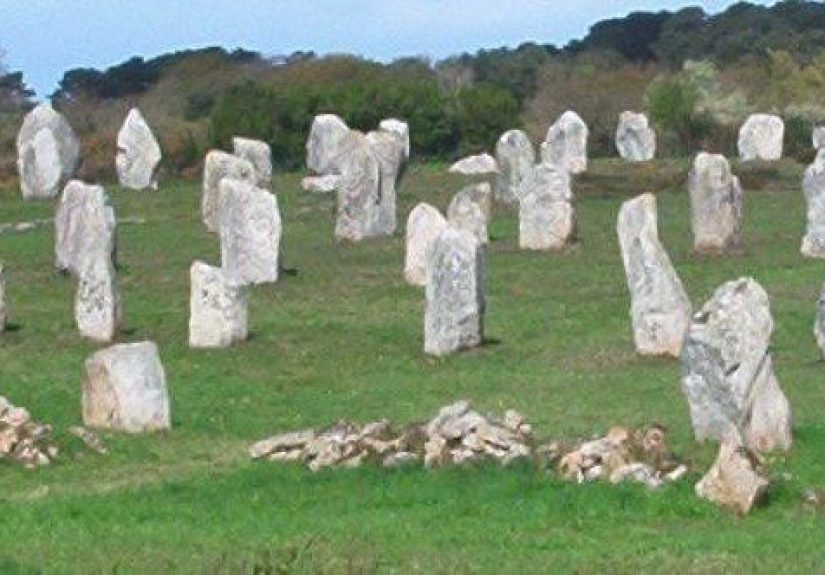
The stone alignments at Carnac in Brittany are among Europe’s most impressive prehistoric landscapes, with thousands of standing stones stretching across the countryside. Recent work has sharpened debates about just how early some of these megalithic traditions began. The age matters, but the function may be even more intriguing.
Why it remains a mystery
Were the stones processional markers, territorial statements, burial-related monuments, astronomical devices, or symbols of communal identity? Perhaps different alignments had different uses over time. That is the trouble with prehistoric monuments: they tend to collect meanings rather than politely sticking to one. Carnac may not be a single mystery at all. It may be a stack of them, arranged in stone and spread across generations that never thought they owed us an explanation.
Conclusion: Why Stone Age Mysteries Still Matter
Stone Age mysteries endure because they challenge one of humanity’s favorite bad habits: assuming the past was primitive just because it was early. Again and again, archaeology reveals planning, symbolism, adaptation, travel, engineering, and social complexity in places where older generations of scholars expected something simpler. The unknowns are not signs of failure. They are evidence that our ancestors were every bit as complicated as the evidence is fragmentary.
And that is the real thrill. A chipped tool, a cave mark, a submerged shoreline, a ring of stalagmites, or a giant stone dragged across a landscape can still force modern people to admit that prehistory was not a dark waiting room before civilization arrived. It was full of ideas, experiments, and decisions we are still trying to decode. The Stone Age remains mysterious not because people lacked intelligence, but because they had enough of it to leave behind puzzles worthy of them.
Extended Perspective: What These Stone Age Mysteries Feel Like Up Close
There is a special kind of experience that comes with reading about Stone Age mysteries for hours and then realizing the strangest part is not the age of the discoveries. It is the intimacy. A monument can be thousands of years old and still feel oddly personal. A hand stencil on a cave wall does not look like “prehistory” in the abstract. It looks like a person saying, with remarkable confidence, “I was here.” That emotional jolt is one reason these mysteries linger in the imagination long after the dates and site names blur together.
Think about the contrast. On one hand, archaeology deals in immense timescales, layers of sediment, climate shifts, species changes, and vanished landscapes. On the other hand, it often hinges on tiny details: the curve of a finger mark in soft cave rock, the angle of a flaked tool edge, the wear on a stone that was carried farther than common sense would recommend. Those details collapse time. They make the Stone Age feel less like a museum label and more like a room you have just walked into after everyone else stepped outside for a minute.
That feeling becomes even stronger at prehistoric sites or in museum galleries. Standing in front of a reconstructed pillar from a site like Göbekli Tepe or studying a model of Stonehenge, the mind starts doing what minds love to do: filling in the missing noise. You imagine footsteps, smoke, weather, argument, ceremony, laughter, mistakes, and the ordinary logistics behind extraordinary things. Someone had to quarry the stone. Someone had to persuade others. Someone had to bring food. Someone probably complained. Prehistory becomes real the moment it stops looking tidy.
There is also something humbling about how much survives and how much does not. Boats disappear. Wood vanishes. Clothes rot. Songs leave no fossils. Yet enough remains to prove that Stone Age communities were inventive, social, and sometimes spectacularly ambitious. That imbalance gives the subject its texture. We do not know everything, but we know enough to understand that the missing parts matter. In some ways, the gaps are the experience. They force imagination to work alongside evidence instead of replacing it.
Maybe that is why “10 Stone Age Mysteries” never feels like a closed list. It feels like a trailhead. Each mystery opens into another one: a stone leads to a journey, a journey leads to a social network, a social network leads to belief, and belief leads to art, death, memory, and identity. The farther back the evidence goes, the more modern the questions become. Who were these people? What did they value? How did they explain the world? Why did they choose this place, this symbol, this act, this risk?
Those are not ancient questions. They are human questions. The Stone Age simply asks them in a language of rock, bone, pigment, and landscape. And maybe that is the best experience of all: realizing that the mysteries are old, but the curiosity they provoke is completely current. We are still trying to understand the first great chapters of human life, and every fresh discovery reminds us that the story is not finished yet. It is still being excavated, one stubborn, thrilling clue at a time.