Table of Contents >> Show >> Hide
- How to Choose Ornamental Grasses for Texture (Without Overthinking It)
- Quick Care Basics (So Your Grasses Don’t Turn Into Garden Drama)
- The List: 25 Ornamental Grasses That Add Serious Texture
- 1) Feather Reed Grass ‘Karl Foerster’ (Calamagrostis × acutiflora)
- 2) Switchgrass ‘Northwind’ (Panicum virgatum)
- 3) Switchgrass ‘Shenandoah’ (Panicum virgatum)
- 4) Little Bluestem (Schizachyrium scoparium)
- 5) Big Bluestem (Andropogon gerardii)
- 6) Indiangrass (Sorghastrum nutans)
- 7) Pink Muhly Grass (Muhlenbergia capillaris)
- 8) Purple Love Grass (Eragrostis spectabilis)
- 9) Prairie Dropseed (Sporobolus heterolepis)
- 10) Tufted Hairgrass (Deschampsia cespitosa)
- 11) Northern Sea Oats (Chasmanthium latifolium)
- 12) Japanese Forest Grass (Hakonechloa macra)
- 13) Blue Fescue (Festuca glauca)
- 14) Blue Oat Grass (Helictotrichon sempervirens)
- 15) Fountain Grass ‘Hameln’ (Pennisetum alopecuroides)
- 16) Purple Fountain Grass (Pennisetum setaceum ‘Rubrum’)
- 17) Maiden Grass ‘Morning Light’ (Miscanthus sinensis)
- 18) Zebra Grass (Miscanthus sinensis ‘Zebrinus’)
- 19) Bottlebrush Grass (Elymus hystrix)
- 20) Bowles’ Golden Sedge (Carex elata ‘Aurea’)
- 21) Japanese Sedge ‘Everillo’ or ‘Evergold’ (Carex oshimensis)
- 22) Palm Sedge (Carex muskingumensis)
- 23) Pennsylvania Sedge (Carex pensylvanica)
- 24) Corkscrew Rush (Juncus effusus ‘Spiralis’)
- 25) Fiber Optic Grass (Isolepis cernua)
- Design Moves That Make Ornamental Grasses Look Expensive
- 500+ Words of Real-World “Experience” Tips (What Gardeners Learn the Fun Way)
- Conclusion
If your garden feels a little… flat, you don’t need a bigger shovelyou need better texture. Ornamental grasses are the
landscaping equivalent of adding a great jacket to a basic outfit: suddenly everything looks more intentional. They bring
movement (hello, breezes), contrast (fine vs. bold blades), and year-round interest (because winter deserves nice things, too).
And unlike some high-maintenance divas in the perennial world, most ornamental grasses show up, do their job, and don’t demand
daily affirmations.
Texture isn’t just a fancy design word people throw around while holding a coffee and pointing at your yard. Texture is the
difference between a garden that looks “pretty” and one that looks alive. It’s the soft, hairlike haze of prairie
dropseed beside a chunky sedum. It’s the upright punctuation of feather reed grass behind billowy coneflowers. It’s the
shimmering blue of fescue against warm brick or gravel. And it’s the way seed heads catch morning light like the garden is
quietly showing off.
Below are 25 ornamental grasses (and a few grass-like all-stars, like sedges and rushes) that add texture in different ways:
fountains, mounds, vertical spires, airy “clouds,” and shade-friendly cascades. You’ll also find practical tipsbecause beauty is
great, but beauty that survives August is better.
How to Choose Ornamental Grasses for Texture (Without Overthinking It)
1) Pick your “texture type”
- Fine texture: Threadlike blades, soft haze, lots of movement. Great for smoothing transitions between bold plants.
- Medium texture: The reliable middlereads as “grassy,” plays well with perennials and shrubs.
- Coarse texture: Big blades and bold clumps. Use like a living sculpture (and give it space to be dramatic).
2) Know the difference between clumping and spreading
Clumping grasses stay politely where you plant them (mostly). Spreading grasses can wander by seed
or rhizomes. Wandering isn’t automatically badsometimes it’s exactly what a naturalistic garden wantsbut it should always be
your decision, not the grass’s.
3) Match the grass to your light and moisture
Most ornamental grasses love sun, but several are genuinely shade-tolerantespecially certain sedges, tufted hairgrass, northern
sea oats, and Japanese forest grass. Moisture matters too: some grasses thrive in dry, lean soils, while others want consistently
moist ground (and will sulk if you treat them like desert plants).
Quick Care Basics (So Your Grasses Don’t Turn Into Garden Drama)
- Planting: Give them room. Crowding reduces airflow and makes the clump look tired faster.
- Watering: Water regularly the first season; most become more drought-tolerant once established (species dependent).
- Cutting back: Many gardeners leave grasses standing through winter for structure and wildlife value, then cut back in late winter/early spring.
- Dividing: If the center thins (the “donut effect”), it’s often time to divide and refresh the plant.
- Fertilizer: Usually minimal. Too much nitrogen can encourage floppy growth.
The List: 25 Ornamental Grasses That Add Serious Texture
1) Feather Reed Grass ‘Karl Foerster’ (Calamagrostis × acutiflora)
The poster child for upright texture. It shoots up early, stays narrow, and throws feathery plumes that read like vertical brushstrokes.
Use it to add structure behind flowering perennials or to “frame” a path.
- Look: Vertical clump + tidy plumes
- Great with: Coneflowers, black-eyed Susans, salvias
- Design tip: Plant in repeating drifts for a modern, architectural feel
2) Switchgrass ‘Northwind’ (Panicum virgatum)
A native grass with a strong, columnar habitlike a green exclamation point. Adds movement without flopping, and it often holds
its shape well into winter.
- Look: Upright blue-green blades + airy panicles
- Great with: Asters, goldenrod, Joe-Pye weed
3) Switchgrass ‘Shenandoah’ (Panicum virgatum)
Similar texture to other switchgrasses, but with extra color drama: foliage can develop burgundy tones as the season rolls on.
It’s texture and mood lighting.
- Look: Fine-to-medium blades with seasonal color shift
- Great with: Sedum, Russian sage, rudbeckias
4) Little Bluestem (Schizachyrium scoparium)
Blue-green in summer, then bronze-orange-red in fall. The texture is upright and tidy, with a natural prairie vibe that looks
effortless (even when you absolutely are trying).
- Look: Upright clumps; strong fall color
- Great with: Blanket flower, liatris, yarrow
5) Big Bluestem (Andropogon gerardii)
Tallgrass prairie royalty. This one is for gardeners who want height, habitat value, and a bold, swaying backdrop. Give it room
and use it where “big” is a feature, not a problem.
- Look: Tall vertical blades; distinctive seed heads
- Great with: Prairie perennials and meadow-style plantings
6) Indiangrass (Sorghastrum nutans)
A tall, clumping native grass with warm, golden seed heads that glow in fall light. It’s the kind of texture that makes a garden
look intentional from across the street.
- Look: Upright clumps + golden plumes
- Great with: Native wildflowers and pollinator gardens
7) Pink Muhly Grass (Muhlenbergia capillaris)
The “cotton candy cloud” of the grass world. In fall, it blooms into a pink haze that looks unreal in the best way. Plant in
masses for maximum effect and let the wind do the styling.
- Look: Fine blades + pink fall plumes
- Great with: Autumn-blooming perennials, stone, gravel, coastal gardens
8) Purple Love Grass (Eragrostis spectabilis)
Short, native, and full of airy purple seed heads that read like a mist above the foliage. Great for borders, hot slopes, and
“low effort, high payoff” gardeners.
- Look: Low clump + purple haze
- Great with: Coreopsis, echinacea, agastache
9) Prairie Dropseed (Sporobolus heterolepis)
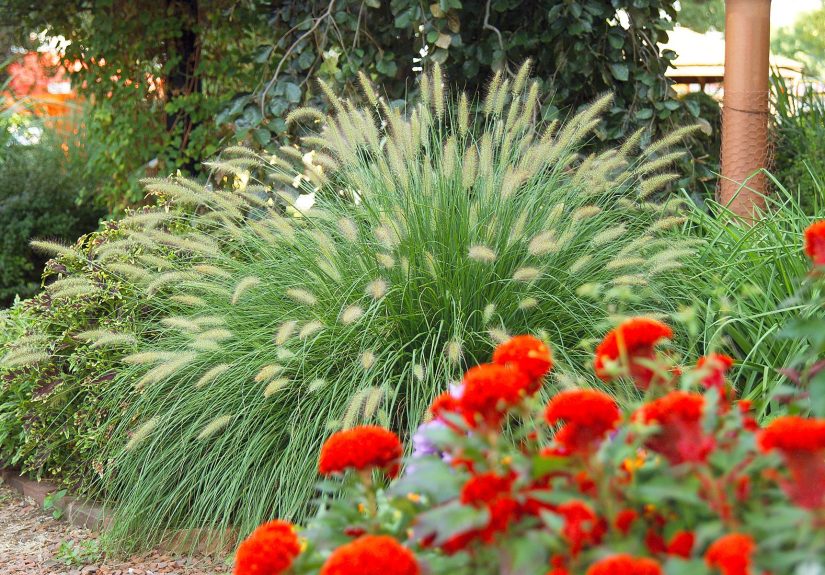
Fine, fountainlike texture that softens edges and makes everything around it look more expensive. In bloom, it can be pleasantly
fragrantyes, a grass can smell nice. Gardens are full of surprises.
- Look: Fine, arching mound + airy seed heads
- Great with: Sedum, alliums, prairie-style borders
10) Tufted Hairgrass (Deschampsia cespitosa)
A cool-season grass with airy, shimmering flower panicles that look like a delicate veil. It’s one of the better choices for
partial shade and consistently moist soil.
- Look: Fine mound + floating, misty flowers
- Great with: Ferns, hostas, astilbe
11) Northern Sea Oats (Chasmanthium latifolium)
Those flat, dangling seed heads are texture goldespecially in shade or part shade where many grasses refuse to cooperate.
It can reseed, so treat it like a charming guest who might overstay without boundaries.
- Look: Bamboo-like leaves + oat-like seed heads
- Great with: Woodland perennials and shade borders
12) Japanese Forest Grass (Hakonechloa macra)
The elegant cascade. In shade, it forms a soft, flowing mound that adds motion even when the air is still. It’s texture that
whispers instead of shouts.
- Look: Arching, waterfall-like blades
- Great with: Heuchera, hostas, Japanese-inspired gardens
13) Blue Fescue (Festuca glauca)
A compact, blue-toned grass that looks fantastic in gravel gardens, edging, and containers. It’s the “neat haircut” texture that
makes wilder plantings look intentional.
- Look: Blue, spiky mound
- Great with: Lavender, sedum, thyme, rock gardens
14) Blue Oat Grass (Helictotrichon sempervirens)
Bigger and bolder than blue fescue, with steel-blue blades that hold their own next to shrubs. Great for adding cool-toned texture
to warm-colored landscapes.
- Look: Coarse blue mound; tidy structure
- Great with: Roses, evergreens, Mediterranean-style plantings
15) Fountain Grass ‘Hameln’ (Pennisetum alopecuroides)
A classic “soft fountain” shape with bottlebrush plumes. Perfect for mid-border texture and movement. In some regions, related
types can be weedy or restrictedalways check local guidance and choose cultivars responsibly.
- Look: Arching mound + fluffy plumes
- Great with: Daylilies, salvias, compact shrubs
16) Purple Fountain Grass (Pennisetum setaceum ‘Rubrum’)
Dark foliage, dramatic plumes, and instant “designer container” energy. Often grown as an annual in colder climates. In warm
regions it may reseed, so it’s not a plant to set loose and forget.
- Look: Burgundy blades + dark plumes
- Great with: Bright annuals, tropical looks, patio pots
17) Maiden Grass ‘Morning Light’ (Miscanthus sinensis)
Fine, shimmering blades with a graceful arch. Miscanthus can self-seed in some areas, so treat this as a “know your region” pick.
If invasiveness is a concern locally, look for sterile selections or choose native alternatives.
- Look: Fine, fountainlike texture; elegant silhouette
- Great with: Hydrangeas, autumn perennials, large borders
18) Zebra Grass (Miscanthus sinensis ‘Zebrinus’)
Horizontal leaf banding gives bold, graphic texturegreat when you want the grass to be a focal point. Same regional cautions as
other miscanthus: beautiful, but not universally well-behaved.
- Look: Bold striped blades
- Great with: Simple companion plants that won’t compete visually
19) Bottlebrush Grass (Elymus hystrix)
A shade-tolerant native (in many regions) with bristly seed heads that add quirky, touchable texturelike the plant is quietly
making jazz hands.
- Look: Bristly seed heads; woodland-friendly habit
- Great with: Woodland natives, spring ephemerals, ferns
20) Bowles’ Golden Sedge (Carex elata ‘Aurea’)
Not a true grass, but a texture powerhouseespecially in wet spots or rain gardens. The bright, gold-green blades light up shade
like a living lantern.
- Look: Bright, arching sedge blades
- Great with: Iris, ligularia, moisture-loving perennials
21) Japanese Sedge ‘Everillo’ or ‘Evergold’ (Carex oshimensis)
A tidy, arching sedge that behaves beautifully in containers or shade borders. Think of it as the “textural garnish” that makes
nearby plants look more polished.
- Look: Arching, bright chartreuse or variegated blades
- Great with: Heuchera, hellebores, shade containers
22) Palm Sedge (Carex muskingumensis)
The leaves form little “palms” up the stem, adding a unique architectural textureespecially near water features or in rain gardens.
- Look: Layered leaf tufts; tropical-ish vibe in a hardy package
- Great with: Moisture lovers, woodland edges
23) Pennsylvania Sedge (Carex pensylvanica)
A low, lawn-alternative sedge for dappled shade. It’s subtle texturemore “soft carpet” than “statement plume”but it can make
hard-to-plant areas look intentional.
- Look: Fine, low groundcover texture
- Great with: Spring bulbs, woodland plantings, under trees
24) Corkscrew Rush (Juncus effusus ‘Spiralis’)
Twisted stems give you texture that looks like it came from a modern art museum. Loves consistently moist soil and is fantastic
in containers or water-garden edges.
- Look: Curly, sculptural stems
- Great with: Water features, bog containers, rain gardens
25) Fiber Optic Grass (Isolepis cernua)
A whimsical, fine-textured plant that looks like tiny fireworks at the tips of thin stems. Often used in pots or water gardens,
and it absolutely nails the “soft texture” assignmentespecially near patios where you can appreciate the detail.
- Look: Fine stems + dot-like tips (the “fiber optic lamp” effect)
- Great with: Container combos, water bowls, miniature gardens
Design Moves That Make Ornamental Grasses Look Expensive
Use grasses as “connective tissue”
If your border looks like a collection of individual plants having a meeting without an agenda, add fine-textured grasses between
bolder perennials. Prairie dropseed, pink muhly, and tufted hairgrass are especially good at making transitions feel intentional.
Repeat one grass for rhythm
Repetition is the difference between “nice garden” and “designed garden.” Pick one grass (like ‘Karl Foerster’ or blue fescue) and
repeat it every few feet. Your eye reads it as structure, even if the rest is joyful chaos.
Pair textures on purpose
- Fine + bold: Prairie dropseed + sedum ‘Autumn Joy’
- Vertical + rounded: Feather reed grass + echinacea
- Cool-toned + warm-toned: Blue oat grass + orange rudbeckias
- Shade cascade + big leaves: Japanese forest grass + hostas
500+ Words of Real-World “Experience” Tips (What Gardeners Learn the Fun Way)
People fall in love with ornamental grasses for the same reason they fall in love with a good playlist: the vibe is instant.
But gardeners also learnsometimes after one too many “why does this look terrible?” momentsthat grasses have personalities.
The good news is you can get almost all of them to behave with a few practical, experience-based habits.
First: placement is everything. A grass that looks elegant in a catalog can look like a sad mop if it’s stuck in deep shade when
it really wanted sun. Many gardeners discover this after planting a sun-loving grass near the north side of a fence and wondering
why it flops like it’s auditioning for a fainting couch. If you’re dealing with shade, lean into shade-tolerant picksJapanese
forest grass, northern sea oats, tufted hairgrass, and certain sedges tend to reward you instead of punish you.
Second: the first year is a patience test. A newly planted grass often spends its first season building roots and acting like it
doesn’t know you. By year two (sometimes year three), it typically fills out and starts showing its mature shape and plumes.
This is why gardeners who plant a drift of grasses often prefer to buy smaller sizes and commit to the long game. It’s cheaper,
and the plants adapt betterplus you get bragging rights later: “Oh, this? Yeah, it started as three tiny plugs.”
Third: don’t “help” grasses to death. Overwatering can be just as harmful as underwatering, especially for drought-tolerant types
like little bluestem and blue fescue. Many experienced gardeners end up with a simple rule: water deeply while establishing,
then taper off and let the plant’s natural toughness do its job. On the flip side, moisture lovers (like certain sedges and
rushes) will absolutely tell you when they’re unhappyusually by browning dramatically at the edges, as if they’re sending a
strongly worded email.
Fourth: cutting back is less about “tidiness” and more about timing. Leaving grasses standing through winter gives the garden
structure, catches snow beautifully, and provides habitat value. Then, in late winter or early spring, gardeners cut them back
before fresh growth really takes off. The trick is not to wait so long that you’re chopping new green shoots (which feels like
stepping on your own toes). In regions with fire risk, some gardeners cut back sooner once grasses brown, because dry foliage can
become fuel. The lesson here is simple: match your cleanup schedule to your climate and your garden’s reality, not just your
neighbor’s weekend routine.
Fifth: spreading surprises are real. Gardeners often learn to research a grass before plantingespecially with species known to
self-seed aggressively in some regions. The smartest “experience move” is choosing well-behaved cultivars or native alternatives
when invasiveness is a concern. That doesn’t mean you can’t grow a dramatic grass; it just means you pick responsibly and keep an
eye on seedlings. A five-minute spring patrol can save you a five-hour summer regret.
Finally: ornamental grasses are the ultimate “make everything look intentional” tool. If a border feels busy, grasses add calm
repetition. If it feels boring, grasses add movement. If winter looks bleak, grasses add structure. And if you ever feel like your
garden needs a little more magic, watch a backlit plume in late afternoon sun. It’s hard to stay unimpressed when your plants are
basically doing slow-motion choreography.
Conclusion
Ornamental grasses are one of the easiest ways to add texture, movement, and four-season interest to a garden. Choose a mix of
upright “structure” grasses, soft mounding grasses, and shade-friendly grass-like plants (sedges and rushes), and your beds will
look more layered and designedwithout turning maintenance into a second job. Start with one or two reliable performers, repeat
them for rhythm, and let the breeze handle the rest.