Table of Contents >> Show >> Hide
- Quick refresher: what “perimeter of a triangle” really means
- Method 1: Add all three sides (the classic triangle perimeter formula)
- Method 2: Use the Pythagorean theorem first (then add for right triangle perimeter)
- Method 3: Use coordinates and the distance formula (perimeter on the coordinate plane)
- Common perimeter mistakes (and how to avoid them)
- Mini practice: test your triangle perimeter skills
- FAQ: quick answers for triangle perimeter questions
- Conclusion: pick the right method and you’ll always land on the perimeter
- Real-life experiences and moments where triangle perimeter suddenly matters (500-ish words)
Perimeter is basically the “walk around the edge” distance of a shape. For a triangle, that means you’re adding up three side lengthsno drama, no secret handshake.
The only catch is that triangles show up in different disguises: sometimes you’re handed all three side lengths (thank you, math gods), sometimes one side is missing (hello, right triangles),
and sometimes the triangle lives on a coordinate grid like it pays rent there. This guide covers three simple, reliable methods to find the perimeter of a triangle, with clear examples and
a few “don’t do this” tips so your answer doesn’t wander off into the woods.
By the end, you’ll know exactly what to do whether you’re measuring fencing for a garden, checking a geometry homework answer, or trying to prove your friend’s “triangle” is actually just
three sticks that don’t meet the minimum requirements of being a triangle.
Quick refresher: what “perimeter of a triangle” really means
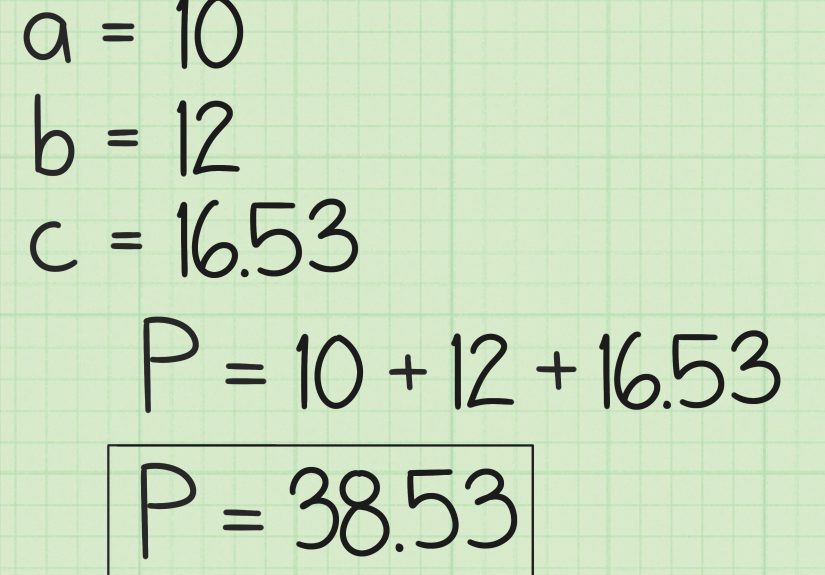
The perimeter of a triangle is the total distance around it. If the side lengths are a, b, and c, then:
Perimeter (P) = a + b + c
A tiny reality check before you add
Not every set of three lengths can form a triangle. If two sides are too short compared to the third, the “triangle” collapses into a sad, flat line. A quick validity check is the
triangle inequality:
a + b > ca + c > bb + c > a
If any of those fail, you don’t have a triangleyou have a geometry plot twist.
Method 1: Add all three sides (the classic triangle perimeter formula)
This is the simplest way to find the perimeter of a triangle: when you already know all three side lengths, just add them. That’s it. No square roots. No coordinate planes.
No interpretive dance.
When this method is best
- You’re given three side lengths directly (like 7 in, 8 in, 10 in).
- You’re working with an equilateral triangle (all sides equal) or isosceles triangle (two sides equal) and you know the needed lengths.
- You measured sides with a ruler/tape and want the total boundary distance.
Example 1: Perimeter with three known side lengths
Suppose a triangle has sides of 7 inches, 8 inches, and 10 inches.
P = 7 + 8 + 10 = 25 inches
Example 2: Equilateral triangle perimeter (same side repeated)
An equilateral triangle has all three sides the same length. If one side is 12 feet:
P = 12 + 12 + 12 = 36 feet
Small-but-important tips
- Keep units consistent. Don’t add inches to feet unless you convert first.
- Don’t round too early. If side lengths involve decimals, keep a few extra digits until the final step.
- Label your answer. Perimeter is a length, so it uses linear units (in, ft, cm, m, etc.).
Method 2: Use the Pythagorean theorem first (then add for right triangle perimeter)
Sometimes you’re asked to find the perimeter of a triangle, but you’re only given two side lengths. If the triangle is a right triangle (it has a 90° angle),
you can use the Pythagorean theorem to find the missing side, then add all three sides to get the perimeter.
The idea in one line
For a right triangle with legs a and b and hypotenuse c:
a² + b² = c²
How to do it, step by step
- Identify which sides are the legs (the sides meeting at the right angle) and which is the hypotenuse (the side opposite the right angle).
- Use
a² + b² = c²to solve for the missing side. - Add the three side lengths to get the perimeter.
Example 1: Find the hypotenuse, then the perimeter
A right triangle has legs of 6 and 8 (inches). Find the perimeter.
First find the hypotenuse:
c = √(6² + 8²) = √(36 + 64) = √100 = 10
Now add all three sides:
P = 6 + 8 + 10 = 24 inches
Example 2: Find a missing leg, then the perimeter
Suppose the hypotenuse is 13 and one leg is 5 (feet). Find the perimeter.
Find the missing leg:
b = √(13² − 5²) = √(169 − 25) = √144 = 12
Then perimeter:
P = 5 + 12 + 13 = 30 feet
Shortcut bonus: recognize common right triangles
If you see (3, 4, 5) or scaled versions like (6, 8, 10), you’re looking at a classic Pythagorean triple. Spotting these can save time and reduce calculator dependency (which, let’s be honest,
occasionally develops “battery anxiety” at the worst moment).
Method 3: Use coordinates and the distance formula (perimeter on the coordinate plane)
If a triangle is defined by points on a coordinate gridlike A(x₁, y₁), B(x₂, y₂), and C(x₃, y₃)you probably aren’t given side lengths directly.
No problem: each side is the distance between two points, so you can use the distance formula to find each side length, then add them for the perimeter.
The distance formula
The distance between points (x₁, y₁) and (x₂, y₂) is:
d = √((x₂ − x₁)² + (y₂ − y₁)²)
Step-by-step approach
- Compute
ABusing the distance formula between A and B. - Compute
BCusing the distance formula between B and C. - Compute
CAusing the distance formula between C and A. - Add:
P = AB + BC + CA.
Example: Perimeter of a triangle from three coordinates
Let the triangle have vertices:
A(1, 2), B(5, 2), and C(1, 7).
1) Find AB
Since A and B have the same y-value, this one is a straight horizontal segment:
AB = √((5 − 1)² + (2 − 2)²) = √(16 + 0) = 4
2) Find AC
A and C have the same x-value, so this one is straight vertical:
AC = √((1 − 1)² + (7 − 2)²) = √(0 + 25) = 5
3) Find BC
BC = √((1 − 5)² + (7 − 2)²) = √(16 + 25) = √41 ≈ 6.403
4) Add for the perimeter
P = 4 + 5 + 6.403 ≈ 15.403
If your instructions say “round to the nearest tenth,” then P ≈ 15.4.
Why this method is secretly powerful
The distance formula works even when sides are slanted, messy, or otherwise refusing to be “nice.” As long as you have coordinates, you can get side lengthsand therefore perimeterreliably.
Common perimeter mistakes (and how to avoid them)
1) Adding before you actually have all three sides
This happens a lot with right triangles and coordinate triangles. If one side is missing, you must find it first (Pythagorean theorem or distance formula), then add.
2) Rounding too early
If you round each side aggressively before summing, your final perimeter can drift. Keep more digits until the end, then round once.
3) Unit confusion
Perimeter is a length. If sides are in inches, your answer is in inches. If sides are in meters, your answer is in meters. Mixing units without converting is like mixing salt and sugar:
the result is memorable, but not in the way you want.
4) Forgetting the triangle inequality
Especially in word problems, it’s worth checking whether the given lengths can form a triangle. If not, the “perimeter” question might be testing validity, not arithmetic.
Mini practice: test your triangle perimeter skills
Practice 1
A triangle has sides of 9 cm, 11 cm, and 14 cm. What is its perimeter?
Practice 2
A right triangle has legs 10 ft and 24 ft. Find its perimeter.
Practice 3
Find the perimeter of the triangle with vertices (0, 0), (3, 0), and (0, 4).
Show answers
- Practice 1:
9 + 11 + 14 = 34 cm - Practice 2: Missing side
c = √(10² + 24²) = √(100 + 576) = √676 = 26, soP = 10 + 24 + 26 = 60 ft - Practice 3: It’s a (3,4,5) right triangle, so
P = 3 + 4 + 5 = 12
FAQ: quick answers for triangle perimeter questions
Is perimeter the same as area?
Nope. Perimeter is the distance around the outside; area is the amount of space inside. Perimeter is measured in linear units (like inches), while area is measured in square units (like square inches).
Can I find a triangle’s perimeter if I only know its area?
Not uniquely. Many different triangles can have the same area but different side lengths (and different perimeters). You’d need more information, like side lengths, angles, coordinates, or a special condition.
What if my triangle isn’t a right triangle and I’m missing a side?
Then you’ll typically need a different tool, like the Law of Cosines or Law of Sines, to find missing side lengths before you can compute the perimeter. (Not today’s main mission, but good to know.)
Conclusion: pick the right method and you’ll always land on the perimeter
Finding the perimeter of a triangle doesn’t have to feel like a boss battle. If you’re given all three sides, add them. If it’s a right triangle with a missing side, use the Pythagorean theorem first.
If you’re on a coordinate plane, use the distance formula to get side lengths, then add. Three methods, one goal: the total distance around the triangle.
And if your “triangle” fails the triangle inequality, you’re allowed to politely inform the problem that it’s not a triangleit’s an awkward line segment situation.
Real-life experiences and moments where triangle perimeter suddenly matters (500-ish words)
If triangle perimeter sounds like something that only exists inside a textbook, real life has a funny way of disagreeing. Triangles show up everywhereespecially when you’re trying to measure,
build, or fix something and suddenly realize the universe is made of angles and deadlines.
One common “aha” moment happens with DIY projects. Picture someone building a triangular planter box for a small patio garden. The wood is cut into three pieces, and you need to know
the total edging length to buy a protective trim. That’s perimeter in its natural habitat: not as a formula, but as “how much material do I need so I don’t have to go back to the store?”
The method is usually the simplest oneadd the three sidesbecause the wood pieces are already measured. But the lesson is the same: perimeter is the shopping list of geometry.
Another real-world scenario shows up in construction and carpentry, especially with right triangles. A classic example is checking whether a corner is square (hello, 3-4-5 triangle).
When a frame forms a right angle, the diagonal measurement matters. If you know two sides of a right triangle and need the third, the Pythagorean theorem isn’t just theoryit’s the reason your
shelves don’t tilt like they’re trying to escape. And once the missing side is known, perimeter helps estimate trim, border lengths, or reinforcing materials around triangular supports.
Then there’s the “triangle on a map” probleman everyday version of coordinate geometry. Imagine plotting three locations on a grid-like city map: a coffee shop, your apartment, and a friend’s
place. If you want to estimate the total travel distance to visit all three points in a loop (even roughly), you’re basically finding a triangle’s perimeter. Streets aren’t perfectly straight,
of course, but coordinates give a clean model of distance. That’s why learning the distance formula is useful: it’s a bridge between a coordinate plane and real measurements, like planning routes,
designing layouts, or estimating cable lengths between three anchor points.
Triangle perimeter also sneaks into design. Think about creating a triangular banner, a kite frame, or a piece of wall art with a triangular border. You might need ribbon, LED strip
lights, or a decorative edge that traces the triangle. The perimeter tells you how much material you’ll use, and it also helps you budgetbecause “I’ll just eyeball it” is a strategy that
mysteriously results in buying a second roll.
The best part is that these experiences make the methods feel natural. When you can measure all three sides, you add. When you’re missing a side in a right triangle, you calculate it. When points
are given on a grid, you use distance. Once you see perimeter as “the total boundary length,” the math stops being a memorized trick and starts feeling like a tool you can actually reach for.