Table of Contents >> Show >> Hide
- Greek monsters aren’t just “bad guys with teeth”
- A very unscientific hero’s guide to surviving monsters
- 30+ famous Greek myth monsters and creatures
- Gaze, curses, riddles, and “please don’t make eye contact”
- Hybrid beasts: ancient Greece loved a “combo platter”
- Sea troublemakers and island nightmares
- Serpents, drakons, and many-headed headaches
- Underworld security and the spirit squad
- World-ending bosses, living statues, and “why is it so big?”
- Hero-training monsters (a.k.a. “mythical gym equipment”)
- A few monsters worth a closer look
- Medusa: the monster you can’t just “stare down”
- The Minotaur: civilization vs. the beast in the basement
- The Hydra: why “solving one problem” can create two more
- Chimera and Pegasus: the monster and the miracle in the same headline
- Sirens, Scylla, and Charybdis: temptation and impossible choices
- Cerberus and the Underworld: fear with a job description
- Where you’ll “see” these monsters today (without needing a shield)
- FAQ: quick answers for curious mortals
- of Monster-Adjacent Experiences (No Sword Required)
Greek mythology didn’t just give us dramatic gods, heroic quests, and enough family drama to power a thousand TV seasons.
It also gave us monsterslots of them. Some are big, loud, and smashy. Some are quiet, clever, and psychologically terrifying.
And at least one can turn you into lawn decor if you make eye contact at the wrong moment.
This guide rounds up more than 30 of the most famous Greek myth monsters and mythical creaturesfrom Medusa to Pegasuswith
quick myth notes, what they “mean” in story terms, and why they’re still living rent-free in modern culture.
Consider it your monster field guide… minus the screaming sailors.
Greek monsters aren’t just “bad guys with teeth”
In ancient Greek stories, monsters often show up where the rules of ordinary life stop working: at the edge of the sea,
outside the city walls, deep in caves, or right at the gates of the Underworld. They’re not random jump scares. They’re
storytelling toolstests of courage, warnings about arrogance (hello, hubris), and reminders that nature, fate, and the gods
don’t always care about your plans.
That’s why Greek mythological creatures are so memorable: each one is a problem you can’t solve with “more confidence.”
You need strategy, help, sacrifice, or at minimum a really good helmet.
A very unscientific hero’s guide to surviving monsters
- Don’t fight fair. Greek heroes win with cleverness as often as muscle (looking at you, Odysseus).
- Borrow divine gear. A shield, a bridle, a magic weaponmyths love “gift items” that change the odds.
- Respect boundaries. Many monsters guard a place or rule. Crossing it carelessly tends to end badly.
- Watch the ego. Half of Greek tragedy is “I was doing great until I got cocky.”
- Bring a friend. Side characters matter: guides, helpers, and “the person with the plan” are MVPs.
30+ famous Greek myth monsters and creatures
Below are more than 30 iconic monsters of Greek mythologysome true “monsters,” some legendary beasts, and some supernatural
nightmares in human-ish form. Together they’re the original cinematic universe of “Nope.”
Gaze, curses, riddles, and “please don’t make eye contact”
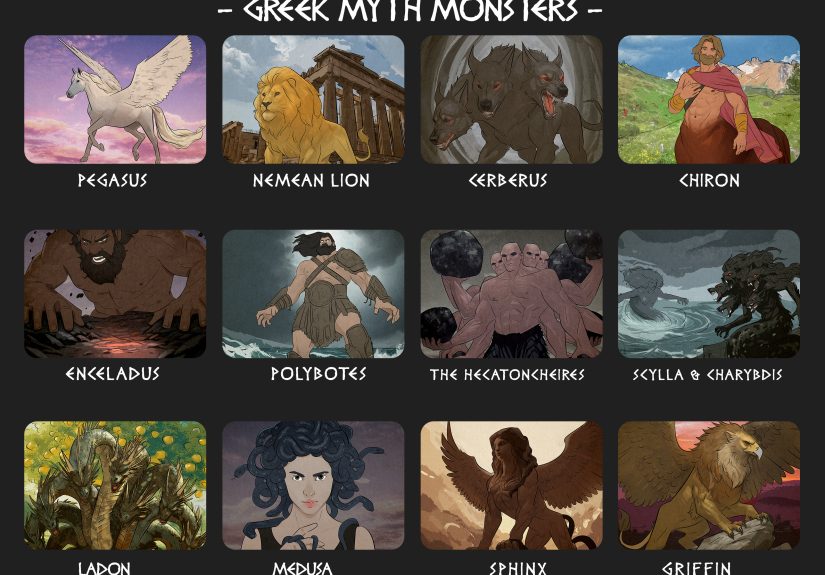
- Medusa (a Gorgon) Snake-haired and famously dangerous to look at; her story is tied to Perseus and a severed head that still does damage.
- Stheno One of Medusa’s Gorgon sisters; often described as immortal and terrifying.
- Euryale Another Gorgon sister; her name is frequently linked with far-reaching, springing power.
- The Graeae Three ancient sisters who share one eye and one tooth, a mythic “information gate” for heroes who need directions.
- The Sphinx A riddle-asking predator; she’s the ultimate reminder that “being smart” is also a survival skill.
- Arachne A mortal transformed after a pride-fueled challenge; her myth explains the spider as a symbol of skill, punishment, and persistence.
- Lamia A legendary child-snatching figure in later tradition; a cautionary tale that blends grief, fear, and folklore.
- Empusa A shapeshifting fright figure associated with night terrors and deception (the ancient version of “trust your gut”).
Hybrid beasts: ancient Greece loved a “combo platter”
- Chimera A fire-breathing mashup creature (lion/goat/serpent vibes, depending on the telling), famously linked to Bellerophon.
- Minotaur Man-body, bull-head, and a starring role in the Labyrinth of Crete.
- Pegasus The winged horse; not a “monster,” but absolutely a legendary creature who crashes the monster party in the best way.
- Centaurs Half human, half horse; often portrayed as wild, unpredictable forcesexcept when myths allow a wise exception.
- Nessus (a centaur) A named centaur whose story warns that “one bad choice” can echo for generations.
- Satyrs Goat-legged nature spirits; less “boss fight” and more “chaotic woodland energy.”
- Harpies Winged, stormy agents of chaos who snatch and tormentlike living consequences with feathers.
- Sirens Lurers whose song drags sailors toward disaster; they represent temptation, distraction, and the seductive pull of “just one more listen.”
- Hippocampi Mythic sea-horses; often linked with ocean imagery and divine sea processions.
- Orthrus A two-headed guard dog linked to monstrous cattle and a very unfortunate work environment.
Sea troublemakers and island nightmares
- Scylla A shoreline horror that turns narrow passages into impossible choices.
- Charybdis A raging whirlpool force; the original “pick your poison” travel problem.
- Cetus (sea monster) A generic name for sea-monster threats in myth; most famous in rescue-style tales where a hero has to act fast.
- Cyclopes One-eyed giants; sometimes craftsmen, sometimes hazards, always unforgettable.
- Polyphemus (a Cyclops) The Cyclops you probably remember: cave, sheep, and a hero who wins by thinking, not flexing.
- Laestrygonians Cannibal giants from wandering-epic tradition; a nightmare detour no one asked for.
Serpents, drakons, and many-headed headaches
- Lernaean Hydra Cut off one head, and more appear; it’s basically the mythic version of “unread email.”
- Python (Delphi) A serpent guardian linked to Delphi; a monster rooted in place and prophecy.
- Ladon A dragon/serpent guardian associated with golden apples; the “security system” of a sacred garden.
- Colchian Dragon A sleepless guardian of a legendary prize (the Golden Fleece), because Greek myths never store valuables normally.
- Ismenian/Theban Dragon A dragon tied to the founding-myth landscape around Thebes and violent beginnings.
- Karkinos A giant crab that shows up in the Hydra storyline, proving side quests existed long before video games.
Underworld security and the spirit squad
- Cerberus The multi-headed guard dog of the Underworld’s entrance: strict about “no living visitors” and “no dead escapees.”
- Erinyes (Furies) Vengeance spirits who pursue oath-breakers and major wrongdoersmoral accountability with wings (sometimes).
- Keres Spirits of violent death in battle imagery; not exactly “monsters,” more like grim forces that hover over chaos.
- Kampe A fearsome jailer figure connected to Tartarus traditions; part monster, part “do not enter” sign.
World-ending bosses, living statues, and “why is it so big?”
- Typhon A stormy, monstrous force often described as a near-apocalypse for the gods themselves.
- Echidna A mother of monsters figure in many traditions; the mythic family tree gets wild fast.
- Geryon A multi-bodied giant linked to legendary cattle and far-off lands; a monster that makes geography feel enormous.
- Talos A bronze guardian giant who patrols like an ancient security drone with legs.
- Hecatoncheires Hundred-handed giants: terrifying in scale, and a reminder that “monster” can also mean raw cosmic power.
- The Giants (Gigantes) A whole category of monstrous opponents in stories about cosmic order and rebellion.
Hero-training monsters (a.k.a. “mythical gym equipment”)
Some creatures exist to prove a point: the hero must become more than ordinary. These “challenge monsters” show up in famous
cycles like the labors and legendary hunts.
- Nemean Lion A nearly unstoppable beast; myths love the “invulnerable” enemy that forces a new tactic.
- Stymphalian Birds Predator birds tied to a swampy region; sometimes the monster is “the environment, but angry.”
- Cretan Bull A rampaging bull figure connected to Crete’s myth web.
- Erymanthian Boar A destructive wild boar; a classic “capture or defeat” test of strength and endurance.
- Calydonian Boar Another legendary boar, famous for the group effort it triggers: heroes, rivalry, and consequences.
A few monsters worth a closer look
A long list is fun, but a handful of monsters have such strong “story engines” that they’re basically the face of Greek
mythological creatures in modern imagination. Here are some quick spotlights.
Medusa: the monster you can’t just “stare down”
Medusa works as a mythic warning in multiple directions: curiosity can be dangerous, power can be frightening, and some threats
can’t be met head-on. Her story also highlights a favorite Greek patternindirect victory. Perseus wins by using reflection,
tools, and help, not by bravado.
The Minotaur: civilization vs. the beast in the basement
The Minotaur myth is a story about containment: a monster isn’t just killedit’s hidden, fed, and turned into a political problem.
The Labyrinth is more than architecture; it’s the feeling of being trapped in someone else’s mess. This is why modern retellings
keep returning to the Minotaur: it’s a perfect metaphor for fear you can’t ignore forever.
The Hydra: why “solving one problem” can create two more
The Hydra isn’t scary only because it’s many-headed. It’s scary because it punishes simple solutions. Choptwo heads. Repeatworse.
The myth rewards teamwork and technique: cauterizing wounds, changing methods, and refusing to fight the same way twice.
If that sounds like modern problem-solving, that’s because myths understood systems long before spreadsheets did.
Chimera and Pegasus: the monster and the miracle in the same headline
Chimera is chaos stitched togetherparts that don’t belong, somehow alive and lethal. Pegasus is the opposite: a creature that feels
like pure possibility. When Bellerophon rides Pegasus to face Chimera, the story becomes a clash between nightmare logic and heroic
“we can do this” energy. It’s also a classic Greek lesson: even after success, arrogance can still throw you off your high horse.
(Literally, in some tellings. Greek myths love a pun with consequences.)
Sirens, Scylla, and Charybdis: temptation and impossible choices
The Sirens represent distraction that feels like a rewardbeautiful, convincing, and deadly. Scylla and Charybdis represent navigation
through harm: sometimes the best option is simply the least catastrophic. These stories still resonate because they mirror real decisions:
tradeoffs, limits, and the cost of getting home.
Cerberus and the Underworld: fear with a job description
Cerberus isn’t just scary; he’s official. He’s the gatekeeper who enforces a boundary that humans desperately want to cross.
Underworld monsters often feel different from wilderness monsters: they don’t represent “wild nature,” but cosmic rulesdeath, consequence,
and the limits of mortal power.
Where you’ll “see” these monsters today (without needing a shield)
Greek myth monsters survive because they’re adaptable. You’ll find them in museum art (gorgons on armor and architecture),
in novels and comics, in classroom units on epics, in modern films, and in video games that turn boss fights into mythology lessons.
The names show up everywhere because the symbols are useful: Hydra for multiplying problems, Sirens for distraction, Cerberus for strict security,
and Pegasus for imagination that refuses to stay grounded.
FAQ: quick answers for curious mortals
Is Pegasus really connected to Medusa?
Yesmany traditions link Pegasus’s origin to Medusa’s story, which is why he’s often mentioned in the same breath as the Gorgons.
Are all “drakons” the same kind of dragon?
Not exactly. Greek “drakons” can be giant serpents, guardians, or monster forces tied to a place. The core idea is often “serpentine guardian,”
not necessarily the later medieval dragon template.
Why are there so many hybrid creatures?
Because hybrids are instantly legible: they break categories. A chimera or sphinx looks like a rule violation made fleshand that’s exactly
what monsters often are in myth: the moment the world stops behaving.
of Monster-Adjacent Experiences (No Sword Required)
Most people’s “experience” with Greek myth monsters today doesn’t involve sandals, spears, or questionable travel decisions between Scylla and
Charybdis. It’s more like this: you meet Medusa in a meme, then fall down a rabbit hole that ends with you reading about ancient protective symbols,
realizing that a scary face on a shield wasn’t just decorationit was an ancient way of saying, “Back off.” Suddenly the monster isn’t only a villain.
It’s a cultural idea that moved from story to art to everyday life.
Or maybe you encounter Pegasus first. A winged horse is basically the universal sign for “imagination is allowed here.” You see him on a book cover,
a logo, or a fantasy poster, and then you learn that Pegasus isn’t just a pretty creaturehe’s stitched into a network of stories about heroes, pride,
and the risky thrill of reaching higher than you should. That momentwhen a familiar image turns into a living storyfeels like discovering a hidden
room in a house you thought you already knew.
Another common experience is the “monster-to-metaphor” upgrade. The Hydra becomes the name for problems that multiply: one rumor turns into five, one
deadline spawns three more, one small mistake becomes a whole week of fixing. The Minotaur becomes the feeling of being stuck inside a maze you didn’t
buildbureaucracy, anxiety, a complicated family situation, even a confusing school schedule that seems designed by Daedalus himself.
Greek monsters stick because they’re practical: they give shape to feelings that are hard to describe.
Then there’s the group experience: reading an epic or myth retelling with friends, arguing about whether Odysseus was a genius or just the king of
“this seemed like a good idea at the time,” and debating who had the worst daysix sailors eaten by Scylla, or the person who had to row past the Sirens
while hearing the world’s most persuasive playlist. These stories are built for conversation. They invite you to pick sides, question choices, and imagine
what you’d do with the same limited options.
Finally, there’s the creative experience: drawing monsters, writing modern retellings, building a “Greek myth creature” reading list, or playing games
and watching shows that remix the originals. Every time someone reimagines Medusa as symbol rather than simple villain, or turns Cerberus into a grumpy
(but lovable) gatekeeper, the myth proves it’s still alive. Greek monsters don’t survive because they’re ancient. They survive because they’re useful,
flexible, and strangely relatablelike the world’s oldest way of saying, “Life is scary, but stories help.”