Table of Contents >> Show >> Hide
- Why These Homes Matter
- 30 Architectural Icons That Changed Residential Design
- 1) Monticello (Virginia)
- 2) Mount Vernon Mansion (Virginia)
- 3) The Breakers (Rhode Island)
- 4) Biltmore House (North Carolina)
- 5) Hearst Castle (California)
- 6) The Gamble House (California)
- 7) Frank Lloyd Wright Home and Studio (Illinois)
- 8) Robie House (Illinois)
- 9) Dana-Thomas House (Illinois)
- 10) Westcott House (Ohio)
- 11) Hollyhock House (California)
- 12) Schindler House (California)
- 13) Neutra VDL Studio and Residences (California)
- 14) Eames House (California)
- 15) Stahl House (Case Study House #22) (California)
- 16) Kaufmann House (Palm Springs, California)
- 17) Gropius House (Massachusetts)
- 18) Farnsworth House (Illinois)
- 19) The Glass House (Connecticut)
- 20) Miller House and Garden (Indiana)
- 21) Taliesin (Wisconsin)
- 22) Taliesin West (Arizona)
- 23) Fallingwater (Pennsylvania)
- 24) Martin House (New York)
- 25) Graycliff (New York)
- 26) Kentuck Knob (Pennsylvania)
- 27) Herbert Jacobs House (Jacobs I) (Wisconsin)
- 28) Pope-Leighey House (Virginia)
- 29) Zimmerman House (New Hampshire)
- 30) Meyer May House (Michigan)
- What These Architectural Icons Teach Us About Great Residential Design
- Experiences and Impressions From Exploring Architectural Icon Homes
- Conclusion
Some houses are nice. Some houses are expensive. And some houses completely change the way people think about living. This list is about the third kind.
From presidential estates and Gilded Age mansions to glass-walled modernist experiments and Frank Lloyd Wright masterpieces, these homes didn’t just reflect tastethey rewrote the rules of architecture. They introduced new ideas about space, materials, climate, privacy, technology, and the relationship between a home and the landscape around it.
If you love architecture, interior design, or just enjoy peeking at homes that make your own floor plan look emotionally underachieving, you’re in the right place. Below are 30 groundbreaking homes that continue to shape how architects, designers, and homeowners imagine “the dream house.”
Why These Homes Matter
Architectural icons don’t become famous by accident. They usually do at least one of these things: invent a new style, perfect an old one, influence generations of architects, or prove a radical idea can actually work in real life. Many of the homes below did all four. They also show how architecture evolvesfrom formal, status-driven mansions to more human-centered homes designed for light, comfort, efficiency, and everyday living.
30 Architectural Icons That Changed Residential Design
1) Monticello (Virginia)
Thomas Jefferson’s Monticello is more than a presidential homeit’s a long-running architectural experiment. Jefferson designed and redesigned it for over 40 years, blending classical ideas with practical innovation. The result is a home that still reads as both elegant and intellectual, which is a pretty rare combo for a hilltop estate.
2) Mount Vernon Mansion (Virginia)
George Washington’s mansion at Mount Vernon grew over decades, expanding from a modest dwelling into a 21-room residence. What makes it iconic is not just the size, but the way Washington used architecture to project identity, leadership, and ambition in the early American republic.
3) The Breakers (Rhode Island)
The Breakers is the grandest of Newport’s Gilded Age “summer cottages,” which is hilarious because it is not cottage-like in any normal sense. Built for the Vanderbilt family, it became a symbol of wealth, power, and the Beaux-Arts scale-and-drama approach that defined an era.
4) Biltmore House (North Carolina)
George Vanderbilt’s 250-room Biltmore House remains one of the boldest residential statements in U.S. history. Styled as a French Renaissance château, it pushed craftsmanship, engineering, and estate planning to a national scale and still stands as the giant benchmark for American mansion architecture.
5) Hearst Castle (California)
Hearst Castle is what happens when media power meets architectural imagination. Designed by Julia Morgan for William Randolph Hearst, the estate blends Mediterranean and European influences into a theatrical hilltop composition. It’s iconic because it feels curated, cinematic, and unapologetically ambitious from every angle.
6) The Gamble House (California)
The Gamble House is one of the finest achievements of the American Arts and Crafts movement. Its warm wood detailing, handcrafted surfaces, and carefully integrated design made it a masterclass in total designwhere architecture, interiors, and furniture all speak the same language without shouting.
7) Frank Lloyd Wright Home and Studio (Illinois)
Wright’s Oak Park home and studio is legendary because it evolved with him. It was both a family home and a design laboratory, where he tested ideas that would later reshape American architecture. You can almost feel the transition from convention to invention room by room.
8) Robie House (Illinois)
Robie House is Prairie style at full power. Its long horizontal lines, layered planes, and integrated design philosophy made it a turning point in modern residential architecture. Even today, it feels freshlike a house designed by someone who already knew the future was coming.
9) Dana-Thomas House (Illinois)
The Dana-Thomas House proves that Prairie architecture can be both grand and deeply livable. Wright designed a 35-room residence with dramatic social spaces, custom details, and a flowing interior layout. It remains one of the best-preserved examples of his early Prairie-period vision.
10) Westcott House (Ohio)
The Westcott House is Wright’s earliest house in Ohio and a strong Prairie-style landmark. Its low horizontal profile and striking pergola connection show how Wright used geometry and movement to make a home feel larger, calmer, and more connected to its site.
11) Hollyhock House (California)
Hollyhock House marked Frank Lloyd Wright’s first Los Angeles commission and helped define a distinctly California way of living. Built between 1918 and 1921, it blends ornament, landscape, and indoor-outdoor planning in a way that still feels modernand very Los Angeles.
12) Schindler House (California)
The Schindler House in West Hollywood is one of the great residential experiments of the 20th century. Its bold forms and unconventional layout challenged what a home could be, and today it still feels more like a design manifesto than a polite domestic space.
13) Neutra VDL Studio and Residences (California)
Richard Neutra’s VDL house in Silver Lake is a compact but influential live-work laboratory. It’s iconic because it turns light, reflection, and circulation into design tools. The house demonstrates how modern architecture can be inventive without needing a giant footprint or a giant ego.
14) Eames House (California)
The 1949 Eames House is one of the most beloved modern homes in America. Preserved much as Charles and Ray Eames lived in it, the house shows how industrial materials, color, and personal objects can create a home that is both highly designed and deeply human.
15) Stahl House (Case Study House #22) (California)
Few homes are as instantly recognizable as the Stahl House. Immortalized by Julius Shulman’s photographs, it became the image of postwar Los Angeles modernism: glass walls, dramatic views, and a lifestyle that feels equal parts architecture, cinema, and perfect timing.
16) Kaufmann House (Palm Springs, California)
Richard Neutra’s Kaufmann House helped define desert modernism. With clean horizontal lines, airy pavilions, and a seamless indoor-outdoor relationship, it turned the harsh desert climate into a design advantage. It is still one of the clearest examples of modern luxury done intelligently.
17) Gropius House (Massachusetts)
Walter Gropius designed Gropius House as his family home after arriving in the U.S. to teach at Harvard. Its genius is in the mix: familiar New England forms combined with modern materials and Bauhaus thinking. It looks restrained, but its influence was huge.
18) Farnsworth House (Illinois)
The Farnsworth House is one of the purest modernist residences ever built. Mies van der Rohe reduced the house to structure, glass, and proportionand somehow made that minimal formula feel poetic. It remains a benchmark for discussions about beauty, function, and livability.
19) The Glass House (Connecticut)
Philip Johnson’s Glass House helped bring International Style ideas into American residential design in a bold, unforgettable way. Conceived as part of a composition with the Brick House, it made transparency, landscape, and spatial drama the main event instead of decorative detail.
20) Miller House and Garden (Indiana)
The Miller House and Garden is a mid-century masterpiece because it treats architecture, interiors, and landscape as one coordinated experience. It’s not just a beautiful houseit’s a total design ecosystem, where every element feels composed, intentional, and ahead of its time.
21) Taliesin (Wisconsin)
Taliesin was Frank Lloyd Wright’s home, studio, and evolving architectural autobiography. Set into the Wisconsin landscape, it embodies his organic design philosophy and his habit of refining ideas over time. Taliesin matters because it shows architecture as a living process, not a finished object.
22) Taliesin West (Arizona)
Taliesin West is Wright’s desert counterpart to Taliesin and one of the best examples of climate-responsive design before that phrase became a trend. Built as a winter camp, studio, and school, it turns the Arizona desert into collaborator rather than obstacle.
23) Fallingwater (Pennsylvania)
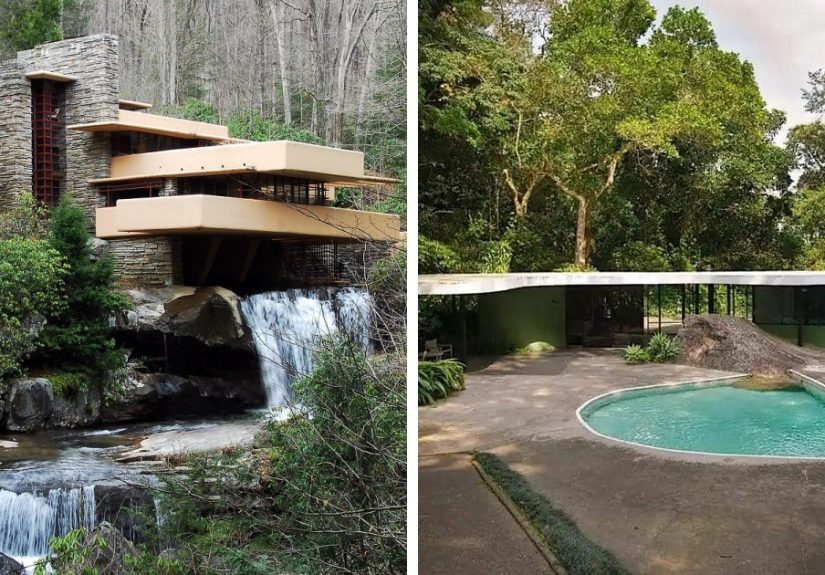
Fallingwater is probably the most famous house in Americaand for good reason. Wright designed it to extend over a waterfall rather than merely face it, creating a dramatic union of architecture and landscape. It remains the gold standard for organic architecture.
24) Martin House (New York)
The Martin House complex in Buffalo is one of Wright’s most important Prairie-era achievements. More than a single home, it’s a carefully orchestrated residential composition that shows how Wright thought in systemsbuildings, circulation, and visual rhythm all working together.
25) Graycliff (New York)
Graycliff, overlooking Lake Erie, captures a different side of Wright: lighter, more open, and deeply connected to water, views, and breezes. It is often celebrated as a bridge between Prairie design and the more organic architecture he would later fully develop.
26) Kentuck Knob (Pennsylvania)
Kentuck Knob is a smaller Wright house than Fallingwater, but it punches way above its size in design significance. Built for the Hagan family, it shows Wright’s later residential thinkingcompact planning, strong geometry, and a home that settles naturally into its hillside site.
27) Herbert Jacobs House (Jacobs I) (Wisconsin)
The Herbert Jacobs House became the prototype for Wright’s Usonian ideal: affordable, efficient, and beautifully designed homes for ordinary American families. That idea was revolutionary. It shifted modern residential architecture away from elite showpieces and toward democratic, everyday living.
28) Pope-Leighey House (Virginia)
Pope-Leighey House is one of the clearest expressions of Usonian design in practice. Wright used compact planning, corner windows, and cantilevered forms to create a modest home with surprising openness. It remains influential because it proves innovation doesn’t require a mansion-sized budget.
29) Zimmerman House (New Hampshire)
The Zimmerman House shows how Wright’s Usonian ideas matured into a complete, carefully crafted lifestyle environment. The home is often described as a total work of art, where architecture, furnishings, and daily life fit together with unusual discipline and warmth.
30) Meyer May House (Michigan)
The Meyer May House is often called “Michigan’s Prairie masterpiece,” and that’s not just museum gift-shop poetry. Its long eaves, lean masonry, and restored interiors make it one of the best places to understand how Wright translated Prairie principles into a sophisticated family home.
What These Architectural Icons Teach Us About Great Residential Design
Looking across all 30 homes, a few patterns become obvious. First, the most influential houses are rarely the most cluttered. They are clear in purpose. Whether it’s the symmetry of a historic estate or the minimalism of a glass pavilion, iconic homes know what they’re trying to say.
Second, materials matter. Wood, stone, steel, plaster, and glass aren’t just finishes in these homesthey are part of the architectural argument. The best houses use materials honestly, letting texture, weight, and light do the visual heavy lifting.
Third, the relationship between house and landscape is everything. The homes that endure in public memory don’t feel dropped onto their lots. They feel anchored to them. That may mean a hilltop composition, a desert plan, a riverfront frame, or a garden-centered layout, but the principle is the same: the site is part of the design.
Finally, groundbreaking homes are not always the biggest. Some of the most influential houses on this list are surprisingly compact. What makes them iconic is not square footageit’s the quality of ideas packed into every square foot.
Experiences and Impressions From Exploring Architectural Icon Homes
If you ever get the chance to visit even a handful of these houses, you’ll notice something funny: photos are great, but they lie a little. A famous house can look perfect in a magazine spread, yet the real experience is much richer. You feel the slope under your feet at Fallingwater. You notice how a low ceiling makes the next room feel taller at a Wright house. You realize that glass walls in the Farnsworth House or the Glass House are not just a visual trickthey change your sense of privacy, weather, and time.
One of the best experiences is paying attention to the approach, not just the destination. Architectural icons are often designed like a story. At The Breakers or Biltmore, the sequence builds drama and status. At homes like the Eames House or Neutra VDL, the approach is more intimate, almost quiet, like the house is asking you to slow down and look carefully. That change in rhythm is part of the design, and it’s one of the easiest details to miss when you only see the “hero shot” online.
Another memorable part of touring these homes is seeing how architects solved ordinary problems. Where does the coat go? How do people move from kitchen to dining room? Where does sunlight get too harsh in summer? The truly groundbreaking homes answer those questions elegantly. The result is that even highly experimental houses often feel strangely practical. That’s the secret sauce: they are not weird for the sake of being weird. They’re bold because the designers had a strong idea of how people should live.
There’s also a huge lesson in preservation. Many of these homes survive because someone decided they were worth protecting before it was too late. When you visit a restored house, you start noticing the craftsmanship that everyday life usually hidesjoinery, hardware, built-ins, art glass, plaster transitions, custom sightlines. It makes you appreciate how much thought went into residential design before mass production flattened everything into lookalike boxes and “good enough” finishes.
Even if you’re not an architect, exploring these homes can change the way you think about your own space. You start noticing natural light at different times of day. You care more about window placement than paint colors. You realize a home feels better when circulation is clear and furniture placement supports the architecture instead of fighting it. In other words, these iconic houses don’t just tell architectural historythey train your eye.
And yes, they’re inspiring in the most dangerous way possible: they make you want to rearrange your living room at midnight, remove three unnecessary side tables, and start saying things like “This corner needs better spatial flow.” That may not make you famous, but it does mean the icons are doing their job. Great houses keep teaching long after they’re built.
Conclusion
The homes on this list became architectural icons because they did more than look impressivethey changed how people understand domestic space. Some introduced new styles. Others refined old traditions. Many proved that innovation can be both beautiful and livable. Together, they form a living timeline of residential architecture, from national symbols and Gilded Age showpieces to modernist experiments and human-centered design breakthroughs.
If you’re studying architecture, planning a renovation, or just love exceptional homes, these 30 landmarks are worth revisiting again and again. They remind us that the best houses are not only built for the present. They are built to influence the future.