Table of Contents >> Show >> Hide
- First: Are we talking about the flower spike or the plant stem?
- Quick 60-second diagnosis checklist
- Reason 1: It’s finishing its bloom cycle (the “normal retirement” of a flower spike)
- Reason 2: Roots are staying too wet (root rot or root suffocation)
- Reason 3: Light or temperature stress is “cooking” (or chilling) the spike
- Reason 4: Fertilizer salts or hard-water buildup are burning tissue (and quietly annoying the roots)
- When yellow means “uh-oh”: red flags you shouldn’t ignore
- Long-term habits that keep spikes healthier and blooms coming back
- Common Experiences Orchid Owners Share (and what you can learn from them)
- Experience #1: “It bloomed for months… then the spike started yellowing and I panicked”
- Experience #2: “I watered it more because it looked sad… and it got sadder”
- Experience #3: “My orchid was thriving until I put it in the ‘best’ sunny spot”
- Experience #4: “I fed it like a champion athlete… and it acted offended”
- Conclusion
- SEO Tags
Your orchid was living its best lifeposing on the windowsill, soaking up compliments, making you feel like a plant wizard.
Then you notice it: the “stem” (more on that in a second) is turning yellow. Cue the dramatic music.
Here’s the good news: a yellow orchid stem is often totally normal, especially if you’re talking about the flower spike after blooming.
The tricky part is telling the difference between “natural fade-out” and “SOS, something’s off.”
This guide will walk you through four common reasons orchid stems/spikes turn yellowand exactly what to do so your plant can get back to its glamorous routine.
First: Are we talking about the flower spike or the plant stem?
Most people say “orchid stem” when they mean the flower spikethe long stalk that holds the blooms (especially on Phalaenopsis, aka moth orchids).
The actual plant “stem” on many common orchids is short and mostly hidden by leaves. So if the yellow part is the tall stalk that carried flowers, you’re likely dealing with a spike issue.
Why this matters: a yellowing flower spike after blooming is usually normal. A yellowing base, crown, or main plant tissue can be more serious.
Let’s do a quick check so you don’t accidentally “fix” the wrong thing.
Quick 60-second diagnosis checklist
- Did the orchid recently finish blooming? If yes, a yellowing spike often means the show is over (and that’s okay).
- Is the spike yellowing from the tip downward? That pattern frequently points to normal spike aging.
- Are leaves limp or wrinkled, or roots brown and mushy? That leans toward watering/root problems.
- Is the plant sitting in hot sun or near a heater/AC vent? Light/temperature stress can trigger yellowing and bud blast.
- Do you see white crust on the potting mix or pot? That’s often fertilizer or mineral salt buildup.
- Is the crown (center where leaves emerge) soft, dark, or smelly? That’s a red flagskip to the “When yellow means trouble” section.
Reason 1: It’s finishing its bloom cycle (the “normal retirement” of a flower spike)
What’s happening
Orchid flowers don’t last forever, even if they try to convince you they’re immortal. Once blooming ends, the plant decides what to do with the spike:
keep it for a possible side-bloom, or shut it down and redirect energy into leaves and roots.
When the spike is no longer useful, it often turns yellow, then tan, then brown and dry.
Signs this is the normal kind of yellow
- The orchid has recently dropped its last flower.
- The spike is yellowing gradually, often from the tip down.
- Leaves look reasonably firm and healthy.
- Roots look mostly firm (silvery when dry, green when freshly watered), not soggy.
How to fix it
“Fix” is a funny word here because nothing is broken. Your goal is to help the orchid tidy up and move on.
-
Decide whether to cut the spike or leave it.
- If the spike is fully yellow/brown, it’s done. Cutting it usually helps the plant focus on new growth.
-
If the spike is still green and only the flowers are gone, some growers trim it to encourage a secondary bloom.
This can work, but it can also produce smaller flowersand not every orchid feels like performing an encore.
-
If you cut: use clean, sharp tools.
Snip with sterilized scissors/pruners to reduce disease risk. -
Where to cut:
- Option A (rest-and-rebuild): Cut the spike close to the base once it’s yellow/brown.
- Option B (try for a side bloom): If it’s still green, cut above a node (a small bump on the spike). Many people cut above a lower node to encourage branching.
After pruning, keep care steady: bright indirect light, consistent watering, and patience.
Orchids don’t rush. They’re the slow-cooked brisket of the plant world.
Reason 2: Roots are staying too wet (root rot or root suffocation)
What’s happening
Many popular orchids are epiphytesthey naturally cling to trees and breathe around their roots.
In a pot, they still want airflow. When the mix stays wet too long, roots can’t get enough oxygen.
Over time, roots may rot, and the plant can’t move water and nutrients properly.
The flower spike may yellow early, and the rest of the plant can start to look tired.
Common causes
- Watering on a schedule instead of watering based on dryness (the calendar is not your orchid’s boss).
- Potting media that stays soggy (old, broken-down bark; tightly packed moss; or no airflow).
- A decorative outer pot (cachepot) holding standing water at the bottom.
- Not enough drainage holes.
Clues it’s a root issue
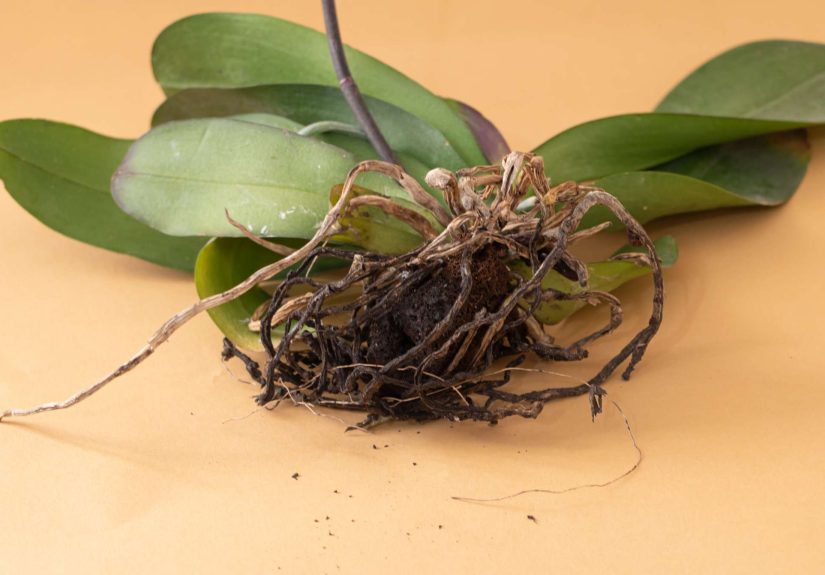
- Roots are brown/black and mushy instead of firm.
- The pot smells sour or swampy.
- Leaves look limp, floppy, or wrinkled (yes, overwatering can cause “thirsty” symptoms because roots stop working).
- The spike yellows even while the plant is “still blooming” or soon after a new spike forms.
How to fix it (step-by-step rescue plan)
-
Unpot and inspect the roots.
Gently remove old media. Rinse roots with lukewarm water so you can see what’s going on. -
Trim dead roots.
Use sterilized scissors to cut away mushy, hollow, or blackened roots. Keep firm roots. -
Repot into fresh orchid mix.
Choose an orchid bark blend (or a mix designed for your orchid type). Avoid regular potting soil.
Use a pot with plenty of drainageclear pots can help because you can actually see the roots. -
Adjust watering to “orchid logic.”
Water thoroughly, then let it drain completely. Water again when the mix is approaching dry and roots look silvery, not bright green.
In many homes, that’s roughly every 7–10 days, but temperature, humidity, and media change everything. -
Improve airflow and drying time.
A spot with gentle air movement helps the mix dry evenly. (No need for a hurricanejust avoid stagnant corners.)
If the spike is already yellowing because the plant is stressed, it may not be worth saving the spike.
It’s okay to cut it and let the orchid focus on growing healthy roots and leaves.
Reason 3: Light or temperature stress is “cooking” (or chilling) the spike
What’s happening
Orchids like bright light, but most common indoor types (especially Phalaenopsis) prefer bright, indirect light.
Too much direct sun can scorch tissue. Sudden temperature swingscold drafts, blasting heat, AC ventscan stress spikes and buds.
Stress often shows up as yellowing, drying tips, or buds dropping before opening (bud blast).
Signs of too much light
- Yellowing spike paired with leaves that look faded, bleached, or slightly red-tinged.
- Dry, crisp patches on the spike where sun hits.
- The orchid sits in direct midday sun, especially in a south- or west-facing window without a sheer curtain.
Signs of temperature stress
- The spike yellows quickly after you moved the plant.
- Buds drop suddenly.
- The orchid is near a drafty door, a cold window at night, or directly under/over an HVAC vent.
How to fix it
-
Move it to bright, indirect light.
Think “I can read a book here, but the sun isn’t punching me in the face.” An east window is often great; west can work with filtering. -
Use a sheer curtain for intense windows.
You’re basically giving your orchid sunglasses. -
Stabilize temperatures.
Aim for typical comfortable-home ranges. Avoid cold drafts and hot air blowing directly on the plant. -
Don’t keep relocating it.
Orchids like consistency. If you move it every week, it may respond with: “I quit,” and the spike goes yellow.
If the spike is stressed and yellowing, you may not be able to “green it up” again.
The win is preventing the same problem on the next spike by dialing in light and temperature.
Reason 4: Fertilizer salts or hard-water buildup are burning tissue (and quietly annoying the roots)
What’s happening
Orchids usually prefer light feeding, not heavy meals. Over-fertilizingor fertilizing when the mix is drycan burn roots and stress the plant.
Minerals from hard water and leftover fertilizer salts can build up in the pot over time, especially if the plant is watered lightly (like “a few ice cubes” or a tiny splash).
That buildup can dehydrate roots, interfere with nutrient uptake, and contribute to yellowing spikes and weak growth.
Clues this is the issue
- White crust on the potting mix, pot rim, or roots.
- Leaf tips look a bit crispy.
- You fertilize often at full strength, or you fertilize a bone-dry pot.
- The orchid hasn’t been flushed or repotted in a long time.
How to fix it
-
Flush the pot.
Take the orchid to the sink and run lukewarm water through the potting mix for 30–60 seconds.
Let it drain completely. This helps wash out accumulated salts. -
Switch to “weakly, weekly” (or monthly) feeding.
Use an orchid fertilizer at diluted strength during active growth, and back off when the plant slows down.
Always water first (or fertilize with a very dilute solution) so roots aren’t hit with concentrated salts. -
Consider water quality.
If your tap water is very hard, occasional use of filtered or rainwater (where safe and practical) can reduce mineral buildup. -
Repot if the mix is old.
Bark breaks down over time, holding more moisture and trapping more salts. Repotting refreshes airflow and resets the pot environment.
If your spike is yellowing while the rest of the plant looks fine, salt buildup may not be the sole cause.
But it’s a common “background stressor” that makes everything else harder for your orchid.
When yellow means “uh-oh”: red flags you shouldn’t ignore
Most yellow spikes are not emergencies. But if you see any of the following, treat it as a plant health issuenot just a post-bloom haircut.
Red flag symptoms
- Soft, dark, or mushy tissue at the crown (center of the plant) or where the spike meets the plant.
- Bad smell coming from the crown or base.
- Rapid collapse of leaves or a watery, spreading dark spot.
- Multiple parts yellowing fast: spike, leaves, and base all declining at once.
What to do if you suspect rot or infection
- Isolate the orchid from other plants.
- Stop getting water in the crown or leaf joints. Water the potting mix only, preferably in the morning.
- Remove severely affected tissue with sterilized tools if it’s localized (and you’re comfortable doing so).
- Improve airflow and drying around the plant.
-
Be realistic.
If rot has reached the crown extensively, recovery can be difficult.
Saving your other plants may be the priority.
Long-term habits that keep spikes healthier and blooms coming back
Orchids aren’t “hard.” They’re just extremely honest about their preferences. Try these habits to reduce yellow-spike drama:
1) Water deeply, then let it breathe
- Water thoroughly so all media is moistened, then drain completely.
- Wait until the mix is approaching dry and roots look silvery before watering again.
- Never let the pot sit in water inside a decorative container.
2) Keep light bright but gentle
- Bright, indirect light is the sweet spot for many beginner orchids.
- If you use a sunny window, filter harsh midday rays with a sheer curtain.
3) Feed lightly and flush salts
- Dilute fertilizer during active growth.
- Flush with plain water periodically to prevent salt buildup.
4) Repot before the mix becomes “compost soup”
- Old, broken-down media holds too much moisture and reduces airflow.
- Repot when the mix decomposes, the pot is packed with roots, or the plant dries too slowly.
5) Respect the crown
- Avoid letting water sit in the crown or between leaves.
- If water splashes there, dab it dry with a paper towel.
Common Experiences Orchid Owners Share (and what you can learn from them)
To make this feel less like a textbook and more like real life, here are some classic orchid-owner moments.
These are composite experiences based on common scenarios people run into when a spike turns yellowbecause orchids love teaching us patience the hard way.
Experience #1: “It bloomed for months… then the spike started yellowing and I panicked”
This is the most wholesome scenario. Your orchid finishes blooming, the last flower drops, and a week later the spike starts yellowing at the tip.
It feels like betrayallike the plant is breaking up with you via color change. But it’s often normal spike senescence.
The best “fix” is accepting that the show ended and choosing a tidy prune.
What helps in this moment is having a simple rule: if the spike is clearly yellow/brown and drying, it’s donecut it near the base with clean tools.
Then shift your focus to what the plant does next: roots and leaves.
Many orchids take a rest period after blooming, and that “boring” phase is where the next round of flowers is earned.
Experience #2: “I watered it more because it looked sad… and it got sadder”
This one is painfully common because it makes logical sense… until it doesn’t.
Leaves look limp, so you water. Leaves look limp again, so you water again.
Suddenly the spike yellows, buds drop, and you’re standing there like, “How is MORE love making this worse?”
The lesson: limp leaves don’t always mean thirst. With orchids, limp can mean the roots are stressed or rotting and can’t deliver water.
The breakthrough moment for most people is unpotting the orchid and realizing the roots are mushy.
After repotting into a breathable orchid mix and watering based on dryness (not anxiety), the plant often stabilizessometimes slowly, but steadily.
Experience #3: “My orchid was thriving until I put it in the ‘best’ sunny spot”
Many orchid owners upgrade their plant’s location like they’re moving it into a penthouse suite: “Look at all this sun! You’ll love it!”
And the orchid responds by getting scorched, yellowing a spike, or blasting buds.
Bright light is good; harsh direct sun is not always friendlyespecially afternoon sun through glass, which can be intense.
The fix is usually simple: shift the plant back from the window, add a sheer curtain, or choose an east-facing spot.
Once you find a location that stays consistent (not hot one day, cold the next), orchids tend to calm down.
They’re not high-maintenancethey’re just anti-chaos.
Experience #4: “I fed it like a champion athlete… and it acted offended”
Fertilizer is where good intentions go to get misunderstood.
People hear “orchids need fertilizer” and go full buffet mode: full-strength feedings, frequent applications, and maybe a little extra “for encouragement.”
Add hard water and a pot that never gets flushed, and you can end up with mineral crust and stressed roots.
The spike may yellow earlier than expected because the plant is juggling salt stress.
Orchid owners often notice improvement after they start flushing the pot, cutting fertilizer strength, and repotting into fresh mix.
It’s like the plant finally gets a clean kitchen instead of living in a salty casserole dish.
The key takeaway: orchids generally do better with gentle consistency than dramatic interventions.
Conclusion
When an orchid “stem” turns yellow, it usually means one of two things: your orchid is gracefully wrapping up a bloom cycle,
or it’s responding to stress from water, light, temperature, or salt buildup.
The difference comes down to timing and symptoms.
If the spike is yellowing after the last flower drops and the rest of the plant looks healthy, you can breathe.
Trim the spent spike, keep care steady, and let the orchid recharge.
If the plant looks limp, roots are mushy, or you see signs of scorch or buildup, make a small, targeted change:
repot if needed, adjust watering based on dryness, soften the light, stabilize temperatures, and flush salts.
Orchids reward calm, consistent carenot panic.
And yes, that’s also advice for humans.