Table of Contents >> Show >> Hide
- What You’ll Learn
- What Is an Antique Lavar Kerman Rug?
- Why Collectors Love Lavar Kermans (and Why Your Living Room Will Too)
- Design Hallmarks: What Antique Lavar Kerman Rugs Usually Look Like
- Materials, Dyes, and Construction: Why These Rugs Age So Beautifully
- How to Buy an Antique Lavar Kerman Rug (and Keep Your Sanity)
- Care, Cleaning, and Preservation (Museum Advice You Can Actually Use)
- How to Style an Antique Lavar Kerman Rug in a Modern Home
- The Lavar Experience: of What It’s Really Like
- Final Thoughts
Some rugs are floor coverings. Antique Lavar Kerman rugs are floor coverings that behave like
artquietly, elegantly, and with the kind of confidence that doesn’t need to shout. They’re the Persian rug world’s
equivalent of a perfectly tailored blazer: refined up close, flattering from across the room, and mysteriously able
to make everything around them look more expensive (including your “temporary” coffee table you swear you’ll replace).
If you’ve ever seen a Kerman with delicate florals so crisp they look drawn with a fountain penand colors that feel
soft without being sleepyyou’ve already met the vibe. “Lavar” (often linked to Ravar, also spelled
Lavar/Laver) generally points to finer workshop pieces within the broader Kerman tradition, prized for
lyrical drawing, silky wool, and a pile that can feel almost fabric-like in the best examples.
What Is an Antique Lavar Kerman Rug?
Let’s untangle the name, because the rug market loves a good spelling bee. Kerman (also spelled
Kirman) refers to a historic weaving region in southeastern Iran. Within that umbrella, “Lavar”
(often associated with Ravar) is commonly used in the trade to indicate finer, more intricate
workshop rugsthe ones with smaller-scale patterning, cleaner curvilinear drawing, and that refined, romantic
look Kerman is famous for.
“Antique” is another word that depends on who’s holding the price tag. Many dealers use it for rugs roughly
80–100+ years old, while some reserve it for pre-1920 or pre-WWII pieces. For this article, “antique”
means: a rug old enough to have lived through at least one design era, one move, and one family argument about whether
shoes are allowed in the living room.
Bottom line: a true antique Lavar Kerman isn’t just “a Persian rug with flowers.” It’s a high-grade expression of the
Kerman traditionoften with finer weave, more nuanced color, and a level of drawing that can make other rugs look like
they were designed during a bumpy car ride.
Why Collectors Love Lavar Kermans (and Why Your Living Room Will Too)
1) The drawing is fluid, not fussy
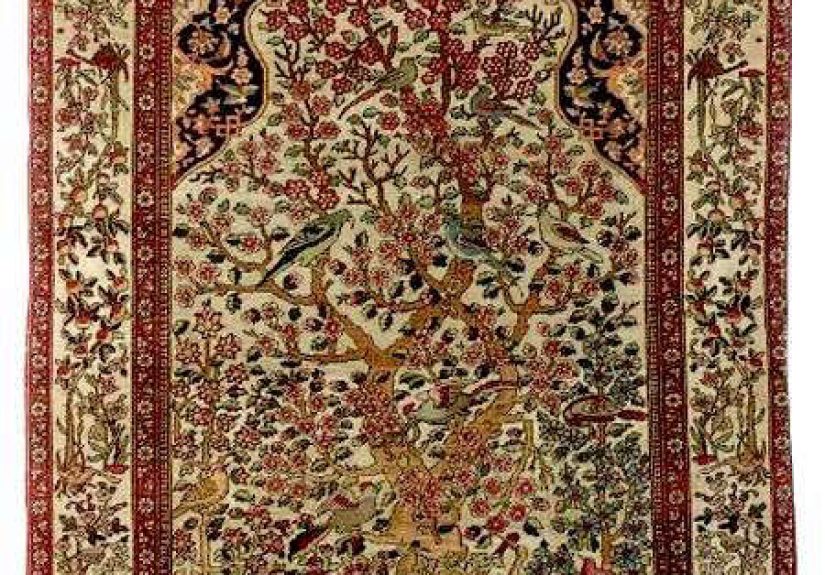
Great Lavar Kermans tend to have a lyrical, flowing line quality. Floral motifspalmettes, rosettes,
vine scrolls, bouquetsfeel intentional rather than crowded. Even when the design is dense (and it often is),
the composition stays readable: your eye can travel through the field without getting lost in decorative traffic.
2) The wool can feel “fabric-like”
In top examples, the pile is often closely shorn and the wool is high quality, giving the rug a
soft, almost textile-like handle. That close shearing is not a flawit’s a flex. It’s the rug version of “Yes, this
was made carefully on purpose.”
3) The palette is decorative in a grown-up way
Lavar Kermans are famous for a soft, elegant palette: ivories, sand tones, gentle golds, soft blues,
pinks, greens, and reds that can read “Renaissance” rather than “emergency stop sign.” They’re often surprisingly easy
to live with because they harmonize instead of bossing your furniture around.
4) They’re historically tied to a serious weaving center
Kerman’s carpet industry expanded significantly in the late 19th century, supported by skilled weavers, quality wool,
and master dyers. That matters because it explains why so many antique Kermans look “worked out”the design systems,
color knowledge, and workshop discipline were genuinely strong.
Design Hallmarks: What Antique Lavar Kerman Rugs Usually Look Like
Classic formats
-
Central medallion designs with layered floral architecture: medallion, corner spandrels, and borders
with a clear hierarchy. -
All-over botanical fields where vines and blossoms repeat with a garden-like rhythm (busy, but
controlled busy). - Vase-and-bouquet language in various formssometimes subtle, sometimes unmistakably “yes, that is a vase.”
Motifs you’ll see again and again
Expect a greatest-hits album of Persian ornament: palmettes, rosettes, scrolling vines, serrated leaves,
arabesques, cartouches, and floral sprays that look like they were arranged by someone with both artistic talent
and infinite patience.
Pictorial and “export-era” surprises
One of the most charming subplots in the Lavar story is how adaptable these workshops could be. There are pictorial
Lavar carpets depicting historic scenes and landmarkssometimes tailored to Western tastes or events. A famous example
sold through a major auction house depicts the World’s Columbian Exposition (Chicago, 1893), complete
with detailed architecture and portrait roundels. It’s proof that Kerman workshops weren’t weaving in a vacuum; they
were paying attention to the wider world, then translating it into wool.
Signatures and cartouches
Some Lavar Kermans include signature cartouchesnames of weavers, workshops, or patrons. This isn’t a
universal rule, and signatures can be added later, so treat them as a clue, not a guarantee. But when a signature
appears alongside consistent age, materials, and top-tier drawing, it can add both interest and credibility.
Materials, Dyes, and Construction: Why These Rugs Age So Beautifully
Wool and foundation
Many Kerman-family rugs use a cotton foundation with a wool pile. The wool can have
a natural sheen, and in finer pieces you’ll sometimes see especially supple fleece (occasionally described as lambswool
in the trade). What you want is not “thick” but “responsive”: wool that looks alive, not plasticky.
Knots and structure (without turning this into a textbook)
Kerman rugs are generally associated with the asymmetrical (Persian) knot, supporting the curvilinear
precision Kerman is known for. Construction details vary by period and workshop, so a reputable seller should be able
to describe structure, foundation, and any restorations with clarity.
Color: natural dye romance vs. chemical dye chaos
Antique Kermans are celebrated for color sophistication. Historically, Persian carpet weaving relied heavily on local
fibers and traditional dye practices for centuries, and even after synthetic dyes arrived, natural dyes remained common
well into the 20th century in many contexts. In the marketplace, you’ll often hear about rich reds (including cochineal
in some traditions), elegant blues (often indigo-based in classic dyeing), and nuanced pastels.
Practical takeaway: antique color should feel layered. Even when it’s bright, it should have depth.
If the palette screams like a highlighter set, proceed with cautionor at least with a return policy.
How to Buy an Antique Lavar Kerman Rug (and Keep Your Sanity)
Step 1: Decide what you actually want
- Room-ready size (the rug can’t be “perfect” if it’s 18 inches too small)
- Palette direction (ivory-ground romance? deep red drama? airy blues?)
- Design density (medallion and structure vs. all-over botanical)
- Use level (museum-ish showpiece vs. everyday luxury)
Step 2: Learn the value drivers (so you’re not pricing by vibes)
Price is shaped by a bundle of factors, and the rug world is unapologetically picky:
- Authenticity and attribution (true Kerman/Lavar vs. “Kerman-style”)
- Age (older isn’t automatically better, but it can matter)
- Quality of drawing (fluid lines, balanced spacing, coherent borders)
- Materials and color harmony (wool quality and dye character)
- Condition (foundation stability, edges/ends, wear pattern, repairs)
- Size (large room-size pieces often command premiums)
- Provenance (documented history, strong dealer credibility)
To put Kerman prestige in perspective: the record-setting, early-17th-century “vase-technique” Kerman carpet that sold
for $33.7 million at a New York auction is not a typical Lavar Kerman you’ll place under a sectional.
But it’s a useful reminder that Kerman weaving includes both highly collectible court-level masterpieces and later,
workshop-driven rugs that still deliver extraordinary beauty at livable scales.
Step 3: Ask the questions that matter
- What’s the structure? (knot type, foundation material, any notable features)
- What’s the condition? (edges, ends, foundation, wear, holes, thinning, stains)
- What’s been restored? (reweaving, recoloring, over-dye, replacement fringes)
- Any dye issues? (bleeding, fading, uneven color shifts that aren’t natural abrash)
- What’s the return policy? (your future self will thank you)
Step 4: Train your eye with a simple “Lavar checklist”
- Drawing quality: do curves look confident and continuous, or wobbly and hesitant?
- Detail clarity: are small motifs crisp, or do they blur together like a watercolor left in the rain?
- Palette restraint: do colors feel coordinated, or like they’re competing for attention?
- Border hierarchy: does the border frame the field elegantly, or fight it?
- Handle and pile: does it feel refined and well-finished, or overly chunky for this style?
Care, Cleaning, and Preservation (Museum Advice You Can Actually Use)
Antique rugs are tougher than they look, but they’re not invincible. The goal is simple:
prevent damage before it becomes “an interesting story.”
Light is the silent villain
Prolonged sunlight can fade dyes and weaken fibers. Use curtains, UV-filtering window film, and rotate the rug if it
lives in a bright room. If you want the rug to look great in ten years, treat sunlight like hot sauce: fine in small
amounts, but don’t soak the whole dish.
Vacuuming: yes, but gently
Museums often recommend vacuuming textiles through a protective screen and using low suction. At home, the key is to
avoid aggressive beater bars and harsh brushing. Think “dust removal,” not “power-wash your problems away.”
When in doubt, roll it (correctly)
If you need to store an antique rug, rolling is usually safer than folding to avoid hard creases. Use a clean tube,
a protective layer of cotton, and cover the roll to protect it from dust and light. Label it so you’re not unrolling
your living room masterpiece just to find the “spare hallway runner.”
Cleaning and restoration: hire specialists
Wet cleaning antique textiles can be risky because dyes and fibers may react unpredictably. A reputable rug cleaner
experienced with older Persian rugs should test for dye stability and handle the process conservatively. Restoration,
when appropriate, should be structure-led and minimalmore “careful repair” than “make it look brand new.”
How to Style an Antique Lavar Kerman Rug in a Modern Home
The secret to decorating with a Lavar Kerman is to let it do what it does best: add elegance without turning the room
into a themed restaurant. These rugs often play nicely with:
- Modern interiors (clean lines + refined ornament = balance)
- Traditional rooms (they reinforce architecture and warmth)
- Transitional spaces (their palettes act like a bridge between eras)
Three styling tricks that always work
- Pull one quiet color from the rug (ivory, soft blue, muted gold) and repeat it in textiles or art.
-
Let the rug set the “temperature” of the room: warm Kermans love warm woods; cooler palettes pop
against crisp whites and charcoal. -
Keep surrounding patterns simpler if the rug is intricate. Your rug already brought the poetry; your
sofa can speak in complete sentences.
The Lavar Experience: of What It’s Really Like
Buying an antique Lavar Kerman is a little like adopting a very elegant, very quiet roommate. It will improve your life,
but it will also make you suddenly care about things you didn’t think were “your personality”like UV exposure, proper
underlay, and whether your dog has “a favorite corner.”
Most collectors describe the first in-person viewing as the moment the internet loses its grip. Photos can show pattern;
they rarely capture surface. When you see a great Lavar up close, the details feel almost impossibly precise:
vine scrolls that stay graceful, tiny blossoms that remain distinct, outlines that look chiseled rather than fuzzy.
People tend to do the same thing without meaning to: they lean in, then they run a hand lightly over the pile, as if the
rug might reveal a secret. (It won’t, but it does make you feel sophisticated for trying.)
Then comes the “unrolling ceremony” at home. This is not a small event. A room-size antique rug changes the atmosphere
in about ten secondslike someone turned the lighting warmer and the furniture more confident. The rug doesn’t just fill
space; it organizes space. The sofa and chairs look like they belong together, and your coffee table suddenly
stops apologizing for itself. Friends will comment, even the ones who normally only notice the snacks.
Living with one is equal parts joy and mild responsible-adult energy. You learn to rotate it occasionallypartly for
even wear, partly because the rug quietly deserves fairness. You notice that direct sun is not “cozy,” it’s “slow damage
with excellent marketing.” You start using a good pad, not because you’re precious, but because it reduces movement and
helps the rug wear more gracefully. If you have pets, you discover that antique rugs are surprisingly forgivinguntil a
claw catches a loop or a “little accident” turns into a dye-test you didn’t ask for. (This is when you learn the value
of specialists and the danger of DIY heroics.)
The best part, though, is how an antique Lavar Kerman ages alongside you. These rugs don’t need perfection; they need
honest care. Small signs of timegentle wear, a softened palette, a patina of usecan read as character rather than
damage when the underlying structure is solid. Owners often say the rug becomes a kind of anchor piece: it survives
trends, moves, and furniture swaps, while still making the room feel finished. And on days when the world is loud, an
antique Lavar has a strange calming effect. It’s intricate, but not chaotic. Decorative, but not frantic. It reminds you
that beauty can be detailed, disciplined, and built to lastwithout ever needing to raise its voice.