Table of Contents >> Show >> Hide
- Why This Clinton Hill Brownstone Feels Different
- A Design Conversation Between Brooklyn and 19th-Century Shanghai
- How Bespoke Only Restored Order to a Once-Generic Condo
- The Materials Do the Storytelling
- Room by Room, the Brownstone Builds Its Case
- What This Home Teaches About Cross-Cultural Interior Design
- The Experience of Living in a Home Like This
- Final Thoughts
Some homes whisper. Some homes shout. And then there are homes like this Clinton Hill brownstone by Bespoke Only, which somehow manage to do both at once: quiet in palette, bold in personality, and clever enough to make you stop mid-scroll and mutter, “Okay, now that is good.” This Brooklyn duplex does not lean on flashy tricks or social-media bait. There is no chandelier swinging from the rafters screaming for attention. Instead, the design earns its drama the old-fashioned way: through proportion, texture, history, and a point of view that actually has a pulse.
At the center of the project is a deceptively simple idea. Rather than treating the apartment as just another polished brownstone renovation, Bespoke Only used it as a place to connect two architectural worlds: late-19th-century Brooklyn and late-19th-century Shanghai. That might sound like an academic thesis in velvet loafers, but in practice it feels warm, personal, and deeply livable. The result is a home that honors the clients’ Chinese heritage without turning it into a stage set, while also restoring a sense of architectural soul to a space that had drifted too close to generic condo territory.
Why This Clinton Hill Brownstone Feels Different
Brooklyn has no shortage of brownstones, and design media has no shortage of ways to photograph them. We have all seen the formula: original mantel, pale plaster, one moody lamp, one sculptural chair, and a bowl that looks too expensive to hold fruit. What makes this project stand out is that Bespoke Only did not stop at styling. The firm went deeper, asking what kind of identity this duplex should have and what kind of story its rooms should tell.
The home sits inside an 1878 Neo-Grec brownstone in Clinton Hill, a neighborhood famous for its richly layered streetscape. Victorian, Beaux-Arts, Queen Anne, and Neo-Grec architecture all mingle here without feeling confused. That eclectic backdrop gave designer Melissa Lee a compelling framework. If Clinton Hill already thrives on stylistic overlap, why not let the interior do the same? Why not create a home where Brooklyn’s historic shell and Chinese architectural language can meet, trade notes, and have a very chic conversation?
That is the magic trick here. The apartment does not chase trendiness. It chases resonance. And resonance lasts a lot longer than whatever micro-trend currently has the internet buying mushroom lamps at 2 a.m.
A Design Conversation Between Brooklyn and 19th-Century Shanghai
The most interesting design stories usually begin with a strong comparison, and this one has a particularly good one. Bespoke Only looked to 19th-century Shanghai, a period shaped by cultural exchange, layered influences, and a blend of Chinese traditions with Western classical forms. That made it an unexpectedly apt reference point for Clinton Hill, where the neighborhood fabric is similarly built from overlap rather than purity.
In other words, this is not a case of importing “Asian style” as decoration. It is a much smarter move than that. The studio identified a shared architectural logic between two places shaped by cultural intersection. That is a big reason the home feels thoughtful rather than theme-y. There are no heavy-handed gestures here, no wink-wink faux-historic cosplay, and thankfully no “oriental-inspired” nonsense from the design dark ages. Instead, the references appear through structure, materials, silhouettes, and rhythm.
Traditional carved wooden doors, timber-framed elements, lattice-like detailing, and decorative glass all bring in Chinese inflections, but they do so with restraint. These pieces are not dropped in as souvenirs. They are integrated into the architecture of the home. They divide space, filter light, and create layers of privacy. In that sense, they behave like good design should: they work hard while looking effortless.
How Bespoke Only Restored Order to a Once-Generic Condo
Before the redesign, the apartment had solid bones but lacked the hierarchy and character expected from a historic brownstone. Over time, previous renovations had stripped out much of the millwork and detail, leaving the home feeling more like a standard condo than a residence with roots. Bespoke Only’s solution was not to over-reconstruct the past. Instead, the firm rebuilt the feeling of the past.
That distinction matters. Good restoration is not costume design. It is about restoring logic, proportion, and atmosphere. In this duplex, the floor plan was rethought to better support the owners’ daily life. The kitchen was repositioned so it could become the social center of the lower level, which is exactly where a modern home wants its energy to gather. Upstairs, the layout was reconfigured to include two bedrooms and two bathrooms, creating a more intuitive sense of privacy and sequence.
This is one of the smartest aspects of the project. Bespoke Only understood that flow is emotional. A home can be beautiful and still feel mildly annoying if the rooms do not relate to one another properly. Here, circulation becomes part of the design story. Public and private areas feel more distinct. Thresholds have meaning. Corners have purpose. Nothing reads as leftover space.
The upper floor is especially notable because it begins to feel like a boutique hotel suite without becoming sterile. That balance is hard to pull off. Too much “hotel energy” and a home starts feeling like you should call the front desk for extra towels. Too little, and the promise of quiet luxury falls flat. This project lands in the sweet spot: refined, restful, and personal.
The Materials Do the Storytelling
If this home had a secret weapon, it would be materiality. Bespoke Only folded in the clients’ Chinese heritage not through obvious symbols, but through tactile choices and architectural detailing. Vintage chicken-wire glass adds age and atmosphere. Lattice woodwork creates visual texture while softening boundaries. Timber-framed components introduce a structural language that nods to traditional Chinese building methods. Fringe, wooden beads, and patterned textiles add softer ornamental layers, giving the rooms depth without clutter.
And then there is the color story, which deserves applause. Green runs through the home as a unifying thread, shifting from earthy to retro to quietly elegant depending on the room and the light. It is not a one-note green either. It behaves more like a family of greens, which keeps the palette from feeling flat. In the powder room and coffee station, it reads fresh and grounded. In the bedroom and bath, it becomes moody and intimate.
The ensuite bathroom is one of the best examples of the home’s cross-cultural approach. Inspired by carved wooden room dividers and timber frameworks found across historic buildings in China and broader Asia, the bath is slotted into the corner of the primary bedroom in a way that feels both architectural and intimate. The jade-and-maroon palette gives it a strong identity. It is rooted, memorable, and just unusual enough to keep the room from drifting into spa-catalog blandness.
Room by Room, the Brownstone Builds Its Case
Living Room
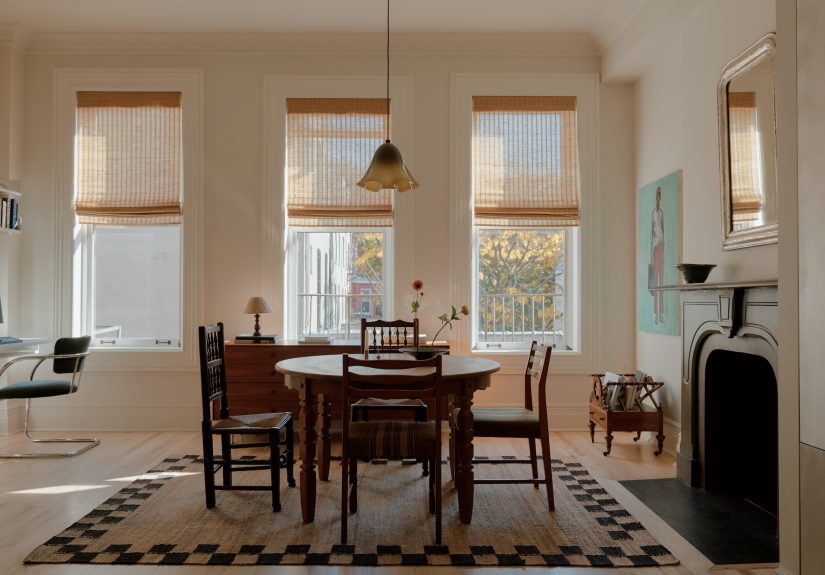
The living room sets the tone with a mix of vintage and contemporary pieces. High ceilings and oversized windows keep the space airy, while restored fireplace elements help reconnect the room to the building’s age. Vintage furniture and soft modern upholstery prevent the home from feeling locked into one era. This blend is essential. The room is layered, not cluttered; curated, not precious.
Kitchen and Dining Area
Moving the kitchen to the center of the lower level was a practical decision, but it also changed the emotional center of the home. Kitchens today are less backstage workspaces and more social arenas, and this one embraces that shift. Cabinetry remains restrained, allowing materials and lighting to do the heavy lifting. Nearby, the dining area mixes vintage oak with mid-century chairs, proving once again that rigid matching is overrated. A little tension in a room is a good thing. It keeps the eye awake.
Office Nook
Even the work zone feels integrated rather than improvised. That matters in a compact home. A good office nook should not look like it wandered in from another apartment with its laptop and emotional baggage. Here, it belongs to the whole composition, continuing the home’s emphasis on utility wrapped in elegance.
Primary Bedroom and Bath
Upstairs, the primary suite becomes the project’s clearest expression of privacy, softness, and cultural layering. Lower wall color adds a cocooning effect, the lighting stays gentle, and the room divider logic becomes especially meaningful. The bath tucked into the suite is not merely an amenity. It is part of the architecture of retreat.
What This Home Teaches About Cross-Cultural Interior Design
The phrase “cross-cultural design” gets used a lot, and sometimes it ends up meaning little more than buying the right vintage screen and calling it a day. This brownstone offers a more serious lesson. Cultural reference works best when it moves beyond image and into spatial thinking. Bespoke Only did not simply decorate around the clients’ heritage; the firm built that heritage into the way the home is organized, filtered, and experienced.
That is why the project feels respectful and contemporary at the same time. It does not flatten Chinese design into motif. It engages with ideas of framework, permeability, craft, layering, and sequence. It also lets Brooklyn remain Brooklyn. The brownstone’s historic DNA is still present, but it is now enriched by another design vocabulary rather than overwritten by it.
For homeowners and designers alike, there is a useful takeaway here: the strongest interiors are rarely monocultural, monoperiod, or monolithic. They are edited conversations between histories, habits, and aesthetics. The trick is knowing when to speak and when to let the materials do the talking.
The Experience of Living in a Home Like This
Imagine coming home to this brownstone on a cold Brooklyn evening, when Clinton Hill’s streets are doing that cinematic thing they do so well and every stoop looks like it belongs in a novel. You open the door and the apartment does not hit you with one loud “design moment.” It unfolds. That is the first pleasure of a home like this: it understands pacing.
You step into the lower level and notice how the rooms talk to one another without giving everything away at once. The kitchen is central, but it does not dominate. The living room feels open, yet held. Light moves across glass, wood, textiles, and painted surfaces in a way that changes the mood hour by hour. Morning would probably feel crisp and forgiving here. Late afternoon would stretch the shadows and make the wood glow. At night, the place would become all intimacy and silhouette, with the carved details turning a little mysterious in the best way.
There is also a specific emotional pleasure in a home that uses heritage as atmosphere rather than announcement. You would not need a plaque on the wall explaining the Chinese references. You would feel them in the thresholds, in the filtered views, in the layering of privacy, and in the way decorative elements seem built into the architecture rather than applied after the fact. It is a more sophisticated kind of storytelling. It trusts the resident to notice. It trusts the guest to ask questions.
That makes daily life richer. Making coffee at the green-toned station would feel slightly ceremonial, not because the task is complicated, but because the setting gives it dignity. Sitting at the dining table would feel casual and composed at once, like the room expects real dinners and not just staged fruit bowls. Working at the desk nook would be easier because the space does not feel like punishment. It feels connected. Even the powder room, often the smallest room with the biggest ego, seems to understand the value of restraint.
Then there is the bedroom level, where the experience shifts from social to private. A lot of homes claim to create serenity, but what they usually create is beige. This project aims higher. Serenity here comes from enclosure, rhythm, and material warmth. The divider details make the suite feel layered rather than exposed. The color palette settles the eye. The bath, with its jade and maroon accents, likely feels especially transportive at the end of a long day. Not “transportive” in the fake-resort sense, but in the sense that the room truly separates you from the rest of the apartment and the noise outside.
Perhaps the best part is that nothing seems to be trying too hard. That is rare. So many high-design homes look like they are waiting to be admired instead of lived in. This one seems ready for both. It can handle a dinner party, a rainy Sunday, three dogs racing through the hall, or a quiet hour with a book and a lamp on low. It has enough intelligence to impress you and enough softness to let you exhale. Honestly, that may be the real luxury here. Not the vintage finds. Not the layered references. Not even the beautiful woodwork. It is the feeling that the home understands life as it is actually lived, and has chosen to make that life feel just a little more poetic.
Final Thoughts
A Clinton Hill Brownstone with Chinese Inflections by Bespoke Only succeeds because it understands that great interior design is not about stacking beautiful things in a room and hoping they become meaningful. It is about building meaning through space, memory, and use. This project restores architectural character to a once-generic duplex, connects Brooklyn and Shanghai through a shared history of cultural layering, and turns the owners’ heritage into an integral part of the home’s structure and mood.
Most of all, it proves that subtle design can still be unforgettable. Bespoke Only did not shout. It edited, tuned, and layered. The result is a brownstone that feels historically aware, emotionally intelligent, and refreshingly free of gimmicks. In a world full of interiors begging to be posted, this one deserves something better: to be lived in, noticed slowly, and remembered for a very long time.