Table of Contents >> Show >> Hide
- Why Baseball Was the Perfect Playground for The Naked Gun
- The Brewers, the Twins, and the First Round of Rejections
- The Dodgers Said Yes to the Stadium, No to the Vibe
- So Why the Angels and Mariners?
- Why the Filmmakers Insisted on Real Teams
- The Broadcasters Were In on the Joke Without Overplaying It
- Reggie Jackson, Joe West, and the Power of Familiar Faces
- The Teams Were Nervous. The Movie Became a Classic Anyway.
- The Experience of Watching the Scene Now
- Conclusion
- SEO Tags
There are movie endings, and then there is The Naked Gun, which closes with a baseball game, a royal assassination plot, an undercover cop masquerading as an umpire, and enough chaos to make a bullpen cart look emotionally stable. It is one of the funniest sports-adjacent sequences ever put on film, and that is exactly what makes its backstory so delicious: a surprising number of real baseball teams wanted absolutely nothing to do with it.
That irony is the whole charm of this story. The movie’s baseball finale is now treated like a pop-culture heirloom, the kind of scene fans quote from memory and broadcasters still grin about decades later. But back when the filmmakers were trying to make it happen, Major League Baseball and several clubs were a lot less enchanted by the idea of their sport being turned into a deadpan slapstick circus. The teams saw risk. The filmmakers saw comic gold. History, as it turns out, sided with the people who let Leslie Nielsen moonwalk behind home plate.
Why Baseball Was the Perfect Playground for The Naked Gun
The genius of the baseball sequence was not that it mocked the sport from a distance. It worked because the people behind the movie clearly understood baseball’s rhythms, rituals, and tiny absurdities. They knew the game has its own sacred language, its own unwritten rules, its own broadcast tone, and its own peculiar ability to treat deeply silly things with cathedral-level seriousness. In other words, baseball was practically begging to be spoofed.
That creative instinct fit perfectly with the Zucker-Abrahams-Zucker style. Their comedy never depended on stand-up punchlines or wink-at-the-camera sarcasm. Instead, it treated nonsense as if it were perfectly reasonable. A baseball game, with its solemn anthem, ceremonial first-pitch energy, elaborate broadcaster chatter, and official-looking umpire theatrics, gave them a giant sandbox full of straight-faced traditions they could lovingly blow to pieces.
And that loving part matters. One of the reasons the scene still lands is because it does not feel mean. It feels affectionate. The filmmakers were not saying baseball is dumb. They were saying baseball is wonderfully theatrical, and if you crank the theatrics up to eleven, you get a masterpiece of comic mayhem.
The Brewers, the Twins, and the First Round of Rejections
The production did not originally set out to stage a Mariners-Angels game. That pairing was more compromise than destiny. David Zucker wanted the Milwaukee Brewers, which made perfect sense for a filmmaker with Wisconsin roots and a clear affection for that franchise. The baseball finale was supposed to carry at least a little hometown flavor, not just generic stadium energy.
But MLB had other ideas. The filmmakers were reportedly steered away from the Brewers and toward the Seattle Mariners, a club that at the time did not exactly radiate powerhouse prestige. If that sounds odd, it probably sounded odd then too. Yet it also captures the strange, bureaucratic tug-of-war that can happen when a movie wants the flavor of real sports without surrendering creative control to real sports institutions.
Then there was the Minnesota Twins. Co-writer Pat Proft, being a fan, tried to get his preferred team involved as well. That effort went nowhere. So before the cameras rolled, The Naked Gun had already collected a small bouquet of baseball rejections. Not because the filmmakers lacked ambition, but because ballclubs and league officials were not thrilled by the idea of lending their brands to a finale that involved a near-riot, a hypnotized Reggie Jackson, and an umpire who treated the strike zone like a personal mood board.
The Dodgers Said Yes to the Stadium, No to the Vibe
The biggest near-miss was the Dodgers. Since the story takes place in Los Angeles, the most natural choice would have been to use Dodger Stadium and let the Dodgers simply be the Dodgers. Clean. Logical. Easy for the audience. Naturally, Hollywood chose the road with more banana peels.
The team did allow the production to use the stadium, but that cooperation appears to have come with boundaries. The Dodgers did not want to be identified as one of the teams in the game, and by the filmmakers’ account, there was broader hesitation about being attached to the on-field brawl at the end of the sequence. That caution is understandable from a brand-management perspective. Baseball teams are not usually eager to become accessories to slapstick felony energy.
Still, it is hard not to laugh at the result. The movie was allowed to stage its climax in one of the most recognizable ballparks in America, but without fully embracing the identity of the club that played there. It is the cinematic equivalent of borrowing someone’s living room but pretending you have never met their couch.
So Why the Angels and Mariners?
Once the Dodgers were effectively out as named participants, the filmmakers turned to the Angels to preserve some Southern California logic. That choice at least kept the home-team side of the equation locally plausible. The Mariners stayed in the script as the league-approved opponent, and just like that, The Naked Gun became the proud owner of one of the strangest geography lessons in sports-movie history.
On screen, the game is presented as an Angels-Mariners showdown. In practice, much of it is unmistakably shot in Dodger Stadium. There is also a brief establishing shot tied to Angel Stadium, plus a famous visual hiccup involving footage from Wrigley Field. Rather than hurting the movie, this accidental patchwork somehow makes it funnier. The scene already behaves like it was assembled by a police sketch artist who had only been given coffee, chaos, and a box of baseball cards.
What could have been a continuity problem instead became part of the scene’s mythology. Fans still notice it. Fans still bring it up. And that is because the sequence is so funny that the visual mismatch stops feeling like a flaw and starts feeling like an uninvited bonus joke.
Why the Filmmakers Insisted on Real Teams
One of the smartest choices the filmmakers made was refusing to hide behind fake franchise names. They understood that baseball people can smell phoniness from the parking lot. If the game had featured the Los Angeles Comets against the Seattle Lumberjacks, the whole thing would have lost texture immediately. Real team names gave the scene stakes, familiarity, and that tiny extra spark of absurdity that comes from seeing official-looking sports culture collide with utter nonsense.
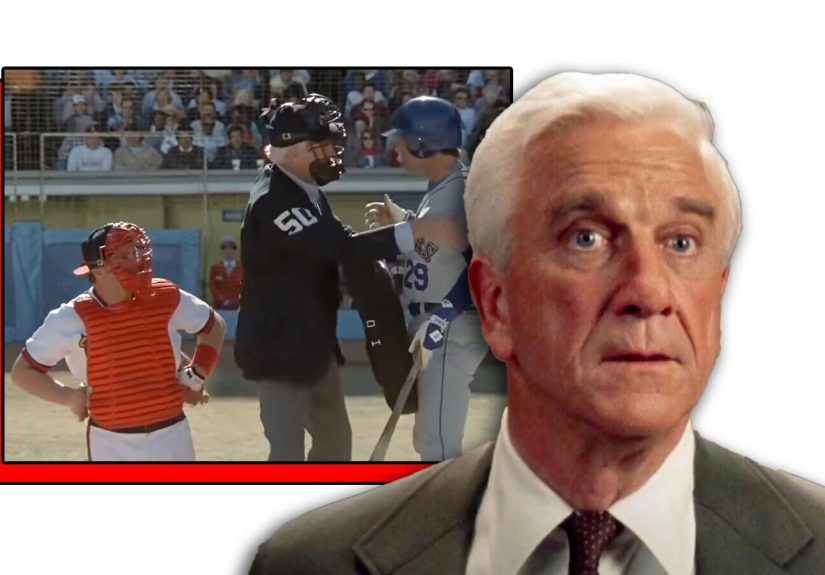
That insistence on authenticity extended beyond logos. The production used real baseball people wherever possible. Minor league players helped make the action on the field look credible. Real baseball broadcasters appeared in the booth. Real MLB umpire Joe West popped up in the now-legendary argument scene. Reggie Jackson, one of the most recognizable stars in the sport, did not just cameo for a wave and a smile. He became the would-be royal assassin.
That blend of legitimacy and lunacy is the secret sauce. The Naked Gun did not spoof baseball by making it look fake. It spoofed baseball by making it look real enough that the insanity felt like a violation of the natural order. That tension is what makes the whole sequence sing.
The Broadcasters Were In on the Joke Without Overplaying It
One of the most underrated parts of the finale is the broadcast booth. The movie loaded it with recognizable names, including Curt Gowdy, Dick Enberg, Jim Palmer, Mel Allen, Tim McCarver, Dick Vitale, and Dr. Joyce Brothers. On paper, that lineup sounds like a joke before anyone even opens their mouth. In execution, it becomes even funnier because most of them do not perform like comedians at all.
They play it straight. They sound like people calling a ballgame. That restraint matters. If the announcers had acted like sketch-comedy performers, the scene would have tipped too far into self-conscious silliness. Instead, they deliver the tone baseball fans know so well: measured, professional, faintly authoritative, and occasionally bewildered by the absurd images in front of them. It is exactly the right comic choice.
That is also why the sequence feels oddly respectful. It sends up baseball television culture while also honoring its texture. Even the jokes about too many voices in the booth feel ahead of their time. The movie recognized that sports broadcasts can sometimes resemble a family reunion where everyone brought a microphone.
Reggie Jackson, Joe West, and the Power of Familiar Faces
Reggie Jackson was the perfect choice for the climax because he looked like a baseball star even to people who did not watch baseball. He carried celebrity naturally. That mattered in a comedy that depended on immediate recognition. When he steps into the plot as the hypnotized threat, the joke works on two levels: he is both a real athlete and an absurd movie villain, and the film asks the audience to accept both truths at once.
Joe West’s brief appearance adds another layer of insider texture. Baseball fans know how much theater lives inside umpiring, even when nobody wants to admit it. To have a real umpire tangled in a scene where an umpire throws out other umpires is exactly the kind of escalation this movie thrives on. It feels impossible, which is why it feels perfect.
These cameos also explain why the scene aged so well. It was never just random sports wallpaper. It was built with enough real baseball DNA that fans kept returning to it, quoting it, and passing it down like a ridiculous oral tradition. Some people inherit family recipes. Baseball fans inherit “Hey, it’s Enrico Pallazzo!”
The Teams Were Nervous. The Movie Became a Classic Anyway.
From the teams’ perspective, the reluctance makes sense. In the late 1980s, clubs were not nearly as fluent in modern cross-promotional culture as they are now. Today, sports franchises jump into memes, alternate identities, mascot bits, celebrity collabs, and social-media stunts with the enthusiasm of toddlers near a drum set. Back then, the instinct was more protective. A club’s image was something to guard, not something to lend to a scene involving pratfalls and public disorder.
But that caution missed the bigger opportunity. The Naked Gun did not diminish baseball. It immortalized it. The film turned ordinary baseball details into iconic comic language. It made the anthem, the broadcasters, the strike call, the dugout, the scoreboard, the star player, and even the umpire mask part of an enduring cultural memory. Plenty of teams would kill for that kind of pop-culture permanence. Probably not with a dart gun from a cufflink, but still.
Commercially, the movie did just fine too. It became a hit, grossed strongly at the domestic box office, and helped turn a canceled TV concept into a lasting comedy franchise. So the clubs that passed on it did not avoid embarrassment. They mostly avoided bragging rights.
The Experience of Watching the Scene Now
Watching the baseball finale of The Naked Gun now is a strangely specific pleasure, because it hits different depending on what kind of viewer you are. If you are a comedy fan, it plays like a barrage of gags delivered with military timing. You admire the density of the jokes, the deadpan commitment, the fact that every ten seconds something else is happening in the frame. You laugh at the strike calls, the anthem disaster, the riot energy, the visual chaos. It is mechanical in the best possible way, like a Swiss watch assembled by clowns.
If you are a baseball fan, though, the experience becomes even richer. You notice the little things first. The stance of the batter. The posture of the catcher. The choreography of the rundown. The solemnity of the announcers. The way the scene understands how much baseball depends on pauses, glances, rituals, and self-importance. It knows that one delayed strike call can feel like a constitutional crisis. It knows broadcasters can sound calm while describing absolute madness. It knows stadium spectacle is already theatrical before Frank Drebin even arrives to make it legally questionable.
And if you are both a baseball fan and a comedy fan, the scene becomes one of those rare pop-culture intersections that feels custom-built for your brain. It is not just funny because the jokes are funny. It is funny because the movie understands exactly what it is bending. It knows the sport well enough to exaggerate it with precision. That is a different kind of laugh. It is the laugh of recognition.
There is also a nostalgic experience attached to it now. The ballpark looks like an older version of itself. The broadcast voices belong to another era. Reggie Jackson is not just Reggie Jackson in the scene; he is a bridge to a whole generation of baseball memory. The sequence plays like a time capsule that somehow refuses to become dusty. Instead of aging into irrelevance, it has aged into ritual. Fans still trade clips. Broadcasters still reference it. Writers still rank it. Viewers who were not alive when it was released still discover it and immediately understand why older fans speak about it with the reverence normally reserved for pennant races and playoff legends.
That, more than anything, is the final joke on the teams that declined. They were trying to protect the dignity of baseball. What actually happened was better: baseball ended up looking eternal, theatrical, ridiculous, and lovable all at once. The scene captures the feeling of a ballgame as public ceremony, comic opera, and barely controlled nonsense. Which, to be fair, is not a terrible description of baseball in general.
So yes, a lot of baseball teams wanted no part of The Naked Gun. They flinched at the premise, hesitated at the branding, and likely assumed the whole thing would be too weird to help anybody. Instead, the movie delivered one of the most enduring baseball scenes ever filmed. The clubs that said no preserved their caution. The filmmakers who pushed ahead captured immortality. And somewhere in the distance, you can still hear a crowd discovering the truth one more time: it’s Enrico Pallazzo.
Conclusion
The backstory behind The Naked Gun proves that the safest branding decision is not always the smartest cultural one. Several baseball teams passed, MLB steered the production in different directions, and the Dodgers kept the movie at arm’s length even while lending the stadium. Yet all those hesitations only make the final result more impressive. Against the odds, the film created a baseball comedy sequence so sharp, so specific, and so weirdly affectionate that it outlived the anxieties surrounding it.
That is why this story still matters. It is not just trivia about which teams said no. It is a reminder that great comedy often comes from people who understand a subject well enough to exaggerate it without breaking it. The Naked Gun did not ruin baseball’s image. It gave baseball one of its funniest and most durable moments on screen. Not bad for a movie several teams wanted no part of.