Table of Contents >> Show >> Hide
- Quick Specs (Because You’re Busy)
- What’s New in the “Plus” Version?
- Design & Portability: It Rolls… But It Doesn’t Float
- Ports & Power Output: Built for Real Appliances
- Charging the F3800 Plus: Where the “Plus” Earns Its Name
- Home Backup Mode: Great Power, Requires Adult Supervision
- Real-World Performance: What Can It Actually Run?
- App, Display, and Daily Usability
- Noise, Heat, and Maintenance (The Unsexy Stuff That Matters)
- Pros and Cons
- Who Should Buy the Anker SOLIX F3800 Plus?
- Alternatives Worth Considering
- Final Verdict
- Field Notes: of Real-World Experience (The Stuff You Actually Care About)
Portable power stations have gotten weirdly impressive over the last couple of years. What started as “a big battery for camping”
has turned into “a rolling, app-controlled, solar-guzzling box that can keep your fridge, internet, and sanity alive during an outage.”
The Anker SOLIX F3800 Plus sits right at that turning point: it’s not a cute little weekend gadget, but it’s also not a
permanently mounted home battery. It’s the “I want serious backup power, but I still want wheels” option.
This review breaks down what the F3800 Plus does well, where it’s still a little ridiculous (spoiler: your staircases will file a complaint),
and who should actually buy one instead of just daydreaming about it during the next blackout.
Quick Specs (Because You’re Busy)
- Battery capacity: 3,840Wh (3.84kWh) base
- Battery chemistry: LiFePO4 (LFP) for long cycle life
- AC output: Up to 6,000W (with 120V + 240V options)
- Solar input: Up to 3,200W total, with higher-voltage solar support (dual inputs)
- Expandable: Works with expansion batteries; can scale into “whole-home ambitions” territory
- Portability: Wheels + handles, but “portable” is doing some heavy lifting here
What’s New in the “Plus” Version?
The original F3800 already had the big headline features: huge output, 120V/240V capability, and the ability to play nice with home backup
accessories. The F3800 Plus is basically Anker admitting, “Okay, fine, people really do want faster solar charging and better generator support.”
1) Solar charging got a major quality-of-life upgrade
The biggest practical improvement is that solar input is now friendlier to real-world panel setups. The F3800 Plus supports
higher-voltage solar input on its solar ports, which makes it easier to wire panels in series and hit higher charging rates
without needing an overly complicated “parallel spaghetti” situation.
2) Generator charging compatibility is more serious
The F3800 Plus adds a clearer path to charging from a gas generator through dedicated hardware/accessories and ports designed for that purpose.
If you live somewhere that gets multi-day outages, this matters because the best battery in the world eventually becomes a very expensive coffee table
unless you can refill it.
3) More “system thinking,” less “single box hero fantasy”
The F3800 Plus makes the most sense as the core of a modular setup: power station + solar + optional expansion batteries + optional home integration.
As a standalone unit, it’s still strongbut it’s clearly designed to scale.
Design & Portability: It Rolls… But It Doesn’t Float
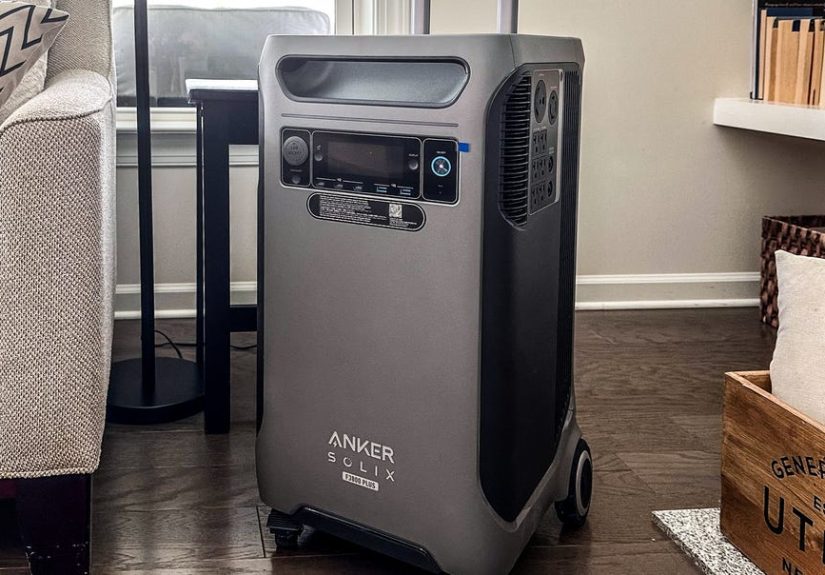
The F3800 Plus looks like a mini-fridge that studied industrial design and decided to be handsome about it. You get a big screen, big wheels,
and handles that make it possible to move on flat surfaces without immediately regretting your life choices.
Let’s talk about the elephant in the roomexcept the elephant is on wheels and wants to live in your garage. This is a heavy unit (well over
100 pounds depending on configuration). Rolling it across a smooth floor? Totally manageable. Lifting it into a truck bed solo? That’s how you end up
with a new chiropractor and a new respect for physics.
Ports & Power Output: Built for Real Appliances
Where smaller stations focus on USB ports and vibes, the F3800 Plus is built for the stuff you actually care about when the lights go out:
refrigerators, freezers, sump pumps, microwaves, power tools, and even some bigger 240V applianceswithin reason.
120V outlets for everyday essentials
Multiple standard 120V outlets make it easy to run a “power outage cluster” in one place: fridge + router + lamps + phone chargers + fan
without turning your living room into a cable-management escape room.
240V output for bigger loads
The 240V capability is the headline for many buyers, because it opens the door to running select heavy appliances and supporting home backup configurations.
In plain English: you can power more than just the “small stuff.”
RV-friendly and road-trip friendly
If you’re an RV user, having an RV-oriented outlet is a big deal. It can simplify hookups for dry camping and let the station behave more like a practical
RV power source rather than a “pile of adapters” situation.
EV charging: technically possible, practically situational
Yes, EV charging is part of the pitch. No, you’re not going to refill a big EV battery like you’re running a tiny Supercharger in your driveway.
The real value is emergency top-upsthe kind that gets you a few extra miles to reach a real charger, not the kind that replaces your home EVSE.
Think “life raft,” not “cruise ship.”
Charging the F3800 Plus: Where the “Plus” Earns Its Name
AC wall charging
Plugging it into the wall is still the simplest way to recharge. For many households, this is the default: keep it topped off, and you’re ready for outages.
Wall charging speeds are strong for a unit this size, and in real testing contexts, getting to 80% in a couple hours is a realistic expectation
(your mileage varies with temperature, settings, and whether you’re powering loads at the same time).
Solar charging: higher voltage, fewer headaches
Solar is where the F3800 Plus separates itself from a lot of “big battery” competitors. With up to 3,200W of solar input available across
two solar input ports, you can build a serious solar setup that refills the battery far faster than older designs that bottleneck at lower voltage ranges.
Practically, higher-voltage solar input means it’s easier to use common panel configurations and longer cable runs without bleeding efficiency.
It’s still critical to stay within the unit’s voltage and current limitssolar wiring is not the place to “guess and check.”
Generator charging: the outage “infinite loop” workaround
Solar is great… until it’s cloudy for three days. Generator charging is the backup to the backup. With the right adapter/accessory setup,
the F3800 Plus can recharge from a generator at meaningful power levels. Some configurations can also act like a bypass/throughput path,
letting generator power support loads while also feeding the batteryuseful when you’re trying to run essentials without constantly babysitting fuel.
One important “real life” note: in some generator-charging configurations, certain outlets are disabled while charging through that path.
That’s not a dealbreakerit’s just the kind of gotcha you want to know before you’re standing in the dark asking, “Why did my outlet stop working?”
Home Backup Mode: Great Power, Requires Adult Supervision
If you want the F3800 Plus to behave like a true home backup solution, you’re entering “system” territory. That typically involves a home integration
accessory (like a home power panel / backup panel) and professional installation. Once installed, the magic is that the system can detect an outage quickly
and switch supported circuits to battery power fast enough that it feels close to seamless for many devices.
How to think about circuits (without needing an engineering degree)
The goal is not to power your entire house exactly as normal. The goal is to power the circuits you care about:
refrigeration, internet, lights, outlets for charging, maybe a furnace blower, maybe a small window ACdepending on your home’s loads.
Big resistive loads (like certain electric heaters) can drain even a huge battery faster than you’d expect, because watts add up like laundry.
One-unit vs two-unit setups
A single F3800 Plus is a beast, but two units plus expansion batteries is where you start approaching “extended outage confidence.”
Just remember: scaling up power and capacity also scales up cost, space needs, and the number of boxes you’ll explain to visitors like,
“No, I’m not starting a tech cult in the garage. It’s just backup power.”
Real-World Performance: What Can It Actually Run?
Here’s a practical way to estimate runtime without falling for marketing fantasies:
- Start with 3.84kWh base capacity.
- Assume usable energy is lower after inverter losses (often ~10–15% depending on load).
- Divide usable watt-hours by the average watt draw of your device.
Example: If you assume ~3,300Wh usable and your fridge averages 150W (it cycles), that’s about
22 hours in a simplified estimate. If your fridge averages 300W, runtime is closer to 11 hours.
If you add other loads (router, lights, TV), subtract accordingly.
In testing-based reports, the F3800 Plus has been used successfully for typical outage essentials like refrigeration, electronics charging,
and mixed appliance use. Where people get tripped up is assuming they can run everything at once. The station has high output, but your home’s
“everything mode” is usually a bigger monster than you thinkespecially when motors start and HVAC kicks on.
App, Display, and Daily Usability
A great power station can still be a pain if it’s annoying to control. The F3800 Plus experience is generally strong here:
clear on-device info (battery percent, input/output watts) plus app monitoring and control.
The app becomes especially useful when you’re doing anything beyond “plug stuff in.” If you’re time-shifting power (charging off-peak, discharging on-peak),
coordinating solar input, or running a home backup configuration, having visibility into what’s happening matters.
Noise, Heat, and Maintenance (The Unsexy Stuff That Matters)
Under light loads, big battery stations are usually quiet enough to forget about. Under heavy loads, fans show up and do their job.
Expect the sound profile to move from “library” to “box fan on medium” as you push wattage higher.
For long-term ownership, the basics are straightforward:
- Store in a cool, dry place.
- Don’t leave it at a very low state of charge for months.
- Cycle it occasionally so you don’t discover a problem during an emergency.
Pros and Cons
Pros
- Serious output: Built to run real appliances, not just gadgets.
- Better solar flexibility: Higher-voltage solar support makes practical solar setups easier.
- Modular ecosystem: Expansion batteries and home integration options exist for scaling up.
- Useful port variety: Mix of AC, 240V/RV-style options, USB-C, USB-A, and DC.
- Cleaner than gas: Quiet, indoor-safe operation compared to generators (no fumes).
Cons
- It’s heavy: Wheels help, but stairs do not care about your feelings.
- Not cheap: A full “home backup” setup can get expensive quickly.
- EV charging is limited: Helpful for emergencies, not a daily charging solution.
- Some modes disable some ports: Certain charging/connection paths can change which outlets are active.
Who Should Buy the Anker SOLIX F3800 Plus?
You’ll get the most value if you’re in one of these camps:
- Home backup planners: You want fridge + internet + key circuits running during outages, potentially with home integration.
- Solar-forward users: You have panels (or plan to) and want a battery that can actually keep up with meaningful solar input.
- RV/off-grid comfort seekers: You want a power solution that can handle larger loads without babysitting a gas generator.
- People who hate generator noise/fumes: You want clean backup power, and you’re willing to pay for it.
You should probably skip it if you need something you can lift easily, if your backup needs are just phones + laptops, or if you want whole-home power
without any planning (that’s more “permanent home battery” territory).
Alternatives Worth Considering
The F3800 Plus competes in a “big, premium, expandable” bracket. Depending on your priorities, you might also consider
comparable systems from brands like EcoFlow, BLUETTI, Goal Zero, and Jackery. In general:
- If you want maximum expandability: compare ecosystem size, battery module pricing, and home integration options.
- If you want faster charging: compare solar input limits, AC input rates, and whether pass-through behavior fits your use.
- If you want easier portability: consider smaller capacity stations, even if it means fewer “big appliance” moments.
Final Verdict
The Anker SOLIX F3800 Plus is not trying to be everyone’s portable power station. It’s trying to be the one you buy when you’re done with
“cute backup” and ready for “my fridge stays on, period.” The Plus upgrade is meaningful because it improves real-world charging flexibilityespecially for solar
and tightens up the system approach for generator and home backup use.
If you want a high-output, expandable, solar-capable power station that can realistically support home backup plans and heavier loads, the F3800 Plus deserves a
spot at the top of your shortlist. Just make sure your plan includes where it will live, how you’ll recharge it during long outages, and whether you’re building
a full system or just buying the world’s most capable “rolling battery.”
Field Notes: of Real-World Experience (The Stuff You Actually Care About)
Let’s talk about the lived reality of owning something like the F3800 Plusbecause the spec sheet doesn’t mention the moment you realize your “portable” battery
has a better travel routine than you do.
Experience #1: The first roll is euphoric. You unbox it, you extend the handle, you glide it across the floor, and you think,
“Wow. This is easy. I am prepared. I am unstoppable.” Then you meet the first step. Suddenly your confidence turns into a quiet negotiation with gravity.
The F3800 Plus is happiest living on one levelgarage, basement, utility roomsomewhere it can roll like it owns the place.
Experience #2: The first outage feels like a magic trick. Your neighbors go dark. Your fridge hums along. Your Wi-Fi stays alive.
You plug in a lamp and it’s oddly emotional, like civilization is a houseplant and you just remembered to water it. This is where the “big capacity” matters:
you stop doing desperate phone-charging triage and start running the essentials like a normal human.
Experience #3: You learn what “average watts” means. A fridge that sips power most of the day still has compressor start-ups.
A space heater that says “1,500W” is not joking. Once you watch real-time output numbers climb, you start thinking in watts automatically.
It’s a weird superpower: you’ll look at a toaster like it personally owes you money.
Experience #4: Solar becomes a strategy game. With the F3800 Plus, people tend to go from “I might buy a panel someday” to
“Okay, how many panels can I realistically place, wire, and angle without turning my yard into a sci-fi movie set?” Higher-voltage solar support makes the
setup easier for many common configurations, but the real-world lesson is that sunlight is moody. Clouds, winter angles, shade, and short days can cut output fast.
Owners who are happiest long-term usually treat solar as “fuel” and plan around it: charge hard when the sun is good, conserve when it isn’t.
Experience #5: Generator support is your long-outage insurance. The most relaxed owners are the ones with a two-path plan:
solar when possible, generator when necessary. That combination is what keeps a big battery from becoming a countdown timer in a multi-day blackout.
And the first time you realize you can keep essentials running while also refilling the battery, it feels less like “survival mode” and more like “annoying inconvenience.”
Experience #6: The “whole-home dream” turns into “whole-home priorities.” Most people don’t truly need every circuit. They need the ones that keep food cold,
phones charged, lights usable, and maybe heating/cooling workable. The F3800 Plus shines when you treat it like a precision tool: pick your critical loads, then let it do its job.
Experience #7: It becomes part of your household rhythm. You top it up, you check it before storm season, you keep the cables organized,
and you quietly enjoy the fact that your emergency plan isn’t “panic.” It’s “roll the battery, plug the fridge, carry on.”