Table of Contents >> Show >> Hide
- What a Cornice Is (and Why Cardboard Isn’t as Wild as It Sounds)
- Planning a Corner Cornice: Measure First, Cry Less
- Materials and Tools for a Cardboard-First Build
- Step-by-Step: How to Build a Cardboard Corner Window Cornice
- Mounting Options That Don’t End in “Why Is It Crooked?”
- Style Ideas for a Corner Cornice That Looks Custom
- Common Mistakes and Easy Fixes
- Care, Longevity, and When to Upgrade to Wood
- Real-World Experiences: What You’ll Probably Run Into (and How to Win Anyway)
- Conclusion
Corner windows are gorgeous. They’re also the interior-design equivalent of a cat knocking a glass off the counter:
tricky, dramatic, and guaranteed to test your patience. Curtain rods don’t always meet neatly at the corner, valances
can look lopsided, and suddenly your “simple refresh” turns into a full-blown geometry reunion.
Enter the cardboard corner window cornice: a lightweight, budget-friendly, surprisingly polished way to top off
two windows that meet at a corner. Done right, it looks custom. Done wrong… well, it still looks better than a naked
rod and a prayer. This guide walks you through planning, building, finishing, and mounting a corner cornice so it looks
intentionallike you definitely meant to do that.
What a Cornice Is (and Why Cardboard Isn’t as Wild as It Sounds)
A window cornice is a structured, box-like top treatment that sits above the window. Unlike soft valances that drape,
cornices keep a crisp shape and can hide curtain rods, shade hardware, and that slightly uneven trim you swear you’ll fix “one day.”
They also add architectural presencelike eyebrows for your windows, but less judgmental.
Traditionally, cornices are made from wood or MDF. But for many roomsespecially rentals, guest rooms, playrooms,
or anywhere you want a high-end look without a high-end commitmentheavy corrugated cardboard (or foam board)
can be a smart substitute. It’s:
- Lightweight (easier to mount, easier to remove, easier on drywall)
- Cheap (often free if you’ve got a sturdy shipping box)
- Easy to cut (no sawdust, no angry neighbors)
- Finish-friendly (fabric, paint, wallpaper, even faux trim)
The key is reinforcement and mounting strategy. Cardboard is strong in compression but not thrilled about point loads
(translation: it doesn’t love one screw doing all the work). Build like you’re expecting gravity to audition for the role
of villainand you’ll win.
Planning a Corner Cornice: Measure First, Cry Less
1) Decide what you’re covering
A corner cornice typically wraps around a 90-degree corner where two windows meet. It can cover:
- Two separate rods that meet at the corner
- A corner connector/angled rod setup
- Two separate shades/blinds you want to “top off” for a cleaner look
2) Pick your “three magic dimensions”
Cornices are basically boxes, so you’ll plan:
- Height (drop): how tall the face looks from the front
- Projection: how far it sticks out from the wall
- Return: the side pieces that go back to the wall (or to the corner seam)
For proportion, many DIYers like a cornice height around 10–20% of the window height (or simply 8–12 inches for
most standard rooms). For projection, 3–5 inches often clears standard rods; go deeper if you’re covering bulky hardware
or layering curtains over shades. When in doubt, tape a cardboard “test strip” to the wall and step back. Your eyes will tell you
if it feels too skimpy or too “top hat.”
3) Corner joinery: choose your adventure
You have two reliable ways to form the corner:
- Butt joint (simplest): One face panel runs into the other at 90 degrees. Easy to cut, easy to reinforce, great for fabric-covered builds.
-
Mitered corner (cleanest line): Each face panel is cut at 45 degrees so they meet neatly. Looks sharp under paint or wallpaper,
but requires more precise cutting and reinforcement.
If this is your first cornice, pick the butt joint. You can still make it look seamless with fabric, trim, or a decorative corner detail.
Materials and Tools for a Cardboard-First Build
Best cardboard choices
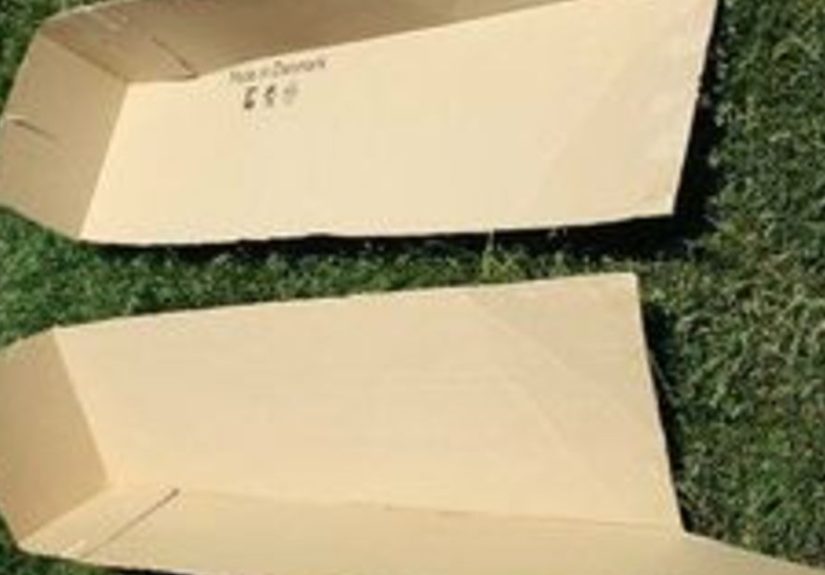
- Double-wall corrugated shipping boxes (sturdier, less “floppy”)
- Appliance boxes for large spans (cut down and reinforced)
- Foam board as an alternate for crisp edges (light but can dent)
Reinforcement options (highly recommended)
- Wood paint stir sticks
- 1×2 furring strips (cut short and used like ribs)
- Thin plywood or hardboard strips
- Extra cardboard laminated in multiple layers
Adhesives & finishing supplies
- Hot glue (fast tack) + PVA/wood glue (strength)
- Painter’s tape or masking tape (temporary holds)
- Batting (optional, for a softer upholstered look)
- Fabric, wallpaper, or paint
- Staple gun (helpful if you add a thin wood strip inside for stapling)
- Utility knife + fresh blades (a dull blade is how cardboard gets revenge)
Mounting hardware (pick one method)
- L-brackets + screws + wall anchors (common and secure)
- A simple cleat system (wood strip on wall, matching strip in cornice)
- Heavy-duty hook-and-loop (only for very lightweight cornices and smooth walls)
Step-by-Step: How to Build a Cardboard Corner Window Cornice
Step 1: Measure and mock up
- Measure each window’s width. Decide how far past the trim you want the cornice to extend (often 1–3 inches per side).
- Measure how far your rod/brackets project from the wall. Add at least 1 inch of clearance so fabric doesn’t rub.
- Mark the desired cornice height on the wall with painter’s tape. Step back and confirm the proportions.
Corner tip: If the windows share the same corner, plan whether you want the cornice faces to meet exactly at the corner
or whether you’ll stop each face short and add a small “corner cap” piece. A cap can hide sins and look like a design choice.
Step 2: Cut your panels
You’ll typically need:
- Face panel A (for Window A)
- Face panel B (for Window B)
- Top panels (one per face, same lengths as each face)
- Returns (end panels that go back to the wall at the outer ends)
- Corner connector (depends on butt joint vs miter)
Keep cuts straight by scoring lightly first, then cutting deeper on the second pass. Cardboard cuts cleaner when you let the blade do the work
instead of forcing it like you’re auditioning for a survival show.
Step 3: Build the L-shape and reinforce it
For a butt joint:
- Glue Face A and Face B together at 90 degrees (hot glue to tack, then PVA for strength).
- Add an interior “corner gusset” (a triangular piece of cardboard) across the inside corner like a brace.
- Laminate extra cardboard strips along the inside edges (think of them as support ribs).
For a mitered corner:
- Cut both face ends at 45 degrees so they meet cleanly.
- Glue and tape the seam while it dries.
- Add a wide reinforcement strip spanning the inside of the miter seam.
Next, attach the top panels so the cornice becomes a true box. Then attach the returns at the outer ends so the piece looks finished
from the side. If you’re covering a rod, make sure the interior space clears your hardware with room to spare.
Step 4: Optional shaped bottom edge (scallops, arches, angles)
Want it to look custom? Shape the bottom edge of the face panels before you wrap or paint:
- Scallops: trace a repeating half-circle template
- Gentle arch: trace a single curve across the center
- Modern angle: cut a shallow diagonal at each end
If you’re doing a corner cornice, keep the design consistent across both faces so it reads as one intentional element, not two separate projects
that met awkwardly at a party.
Step 5: Finish it (fabric-covered, wallpapered, or painted)
Option A: Fabric-covered (most forgiving)
- Add batting to the face (and sides if desired) for a slightly padded look.
- Wrap fabric around the outside, pulling it taut like you’re wrapping a present for someone you actually like.
- Secure fabric on the inside edges with glue, or staple into internal wood strips if you added them for structure.
- Neaten corners by folding like hospital-sheet corners (tidy is the vibe).
Option B: Wallpapered (sharp and modern)
- Seal cardboard first with a thin coat of craft glue + water or primer to reduce warping.
- Apply wallpaper smoothly from center outward to avoid bubbles.
- Wrap edges to the inside for a clean finish.
Option C: Painted (best with clean edges)
- Fill seams with lightweight spackle if needed (especially for mitered corners).
- Prime to prevent cardboard fuzzing and paint absorption.
- Use two thin coats of paint for a smoother finish.
Mounting Options That Don’t End in “Why Is It Crooked?”
Because cardboard is light, you have flexibilitybut don’t confuse “light” with “immune to gravity.” The safest approach is always to mount into studs when possible,
and use proper anchors when not.
Method 1: L-brackets (solid and straightforward)
- Mark your cornice height line (use a level).
- Install L-brackets on the wall under where the top of the cornice will sit.
- Set the cornice on top of brackets and screw up into a reinforced interior strip (wood rib or laminated cardboard).
Pro move: Glue a thin wood strip inside the top edges of your cornice where screws will go. That turns “cardboard + screw” into
“wood + screw,” which is dramatically less stressful.
Method 2: Cleat system (great for corner alignment)
A simple cleat (a wood strip anchored to the wall) can help your corner cornice sit level across both window faces. Add a matching strip inside the cornice,
then slide it into place and secure discreetly. This is especially helpful when your corner isn’t a perfect 90 degrees (older homes love personality).
Method 3: Heavy-duty hook-and-loop (only for ultra-light builds)
If your cornice is very lightweight (think foam board + thin fabric) and your walls are smooth, heavy-duty hook-and-loop can work. But follow weight ratings,
avoid textured walls, and understand: humidity, heat, and paint sheen can affect adhesion. If the cornice is above a bed or crib, skip this method and use
mechanical fasteners.
Style Ideas for a Corner Cornice That Looks Custom
Make the corner a feature
- Corner medallion: a small decorative piece where the two faces meet
- Trim wrap: ribbon, nailhead tape, or faux welt cord along the bottom edge
- Two-tone finish: one color on top, another on the face (adds depth)
Use pattern like a grown-up
Wallpaper or patterned fabric can make a cardboard cornice look intentionally high-end. If your room already has a lot going on,
keep the cornice solid. If the room is calm, let the cornice bring the personality (without screaming).
Layer with other treatments
Cornices look especially polished when layered over shades or paired with side panels. The structured top anchors the window visually and helps corner windows
feel “finished,” not “still waiting for the other half of the plan.”
Common Mistakes and Easy Fixes
Mistake: The cornice sags in the middle
Fix: Add internal ribs (wood strips or laminated cardboard) and keep spans reasonable. For wide faces, reinforce the top panel like a bridge:
multiple supports beat one heroic support.
Mistake: The corner seam looks messy
Fix: Choose fabric coverage, add a corner cap, or hide it with trim. Seams don’t have to disappearthey just have to look deliberate.
Mistake: It rubs the curtains/shades
Fix: Increase projection, or trim the inside top edge. You want clearance so curtains glide without snagging like they’re catching on drama.
Mistake: The mounting feels sketchy
Fix: Upgrade your anchors, mount into studs when possible, and reinforce screw locations internally. Cardboard can be strong, but it needs a good partnership.
Like any reality-show couple, it fails under pressure without support.
Care, Longevity, and When to Upgrade to Wood
A well-made cardboard corner cornice can last years in a low-abuse zone (living room, dining room, guest room). Avoid placing it where steam and humidity are constant
(some bathrooms) unless you’ve sealed it thoroughly. Dust it with a vacuum brush attachment or microfiber cloth.
If you want something heirloom-levelor you have kids/pets who treat window treatments like parkour equipmentconsider upgrading the same design to thin plywood or MDF later.
The good news: your cardboard version becomes the perfect template. That’s not a failed project. That’s “version one.”
Real-World Experiences: What You’ll Probably Run Into (and How to Win Anyway)
Let’s talk about the “experience” partthe stuff no one mentions until you’re standing in your living room holding an L-shaped cardboard box and wondering
if you’ve invented modern art by accident. Here are the most common, very normal things DIYers tend to run into when making a cardboard corner window cornice,
plus how to handle them without spiraling into a full home-reno identity crisis.
First: corners are rarely perfectly square. Even in newer homes, the angle might be 89 degrees or 92 degreesjust enough to make your cornice feel slightly “off”
when you try to fit it tight to the wall. The fix is simple and oddly satisfying: make your corner seam forgiving. A fabric-covered cornice hides tiny gaps.
A painted cornice needs a little extra careeither scribe the edge (trim it to match the wall) or use a narrow piece of trim as a purposeful corner detail.
Once you accept that the house is allowed to have imperfections, your project gets easier.
Second: cardboard has opinions about humidity and glue. If you lay on a lot of wet glue or paint too fast, cardboard can warp like it’s trying to become a potato chip.
This is why thin coats, sealing/priming, and letting things dry flat matter. A common workaround is “tack with hot glue, strengthen with a thin layer of PVA,” then
weigh the piece down while it cures. People also learn (often the hard way) that rushing the drying step is the quickest path to a cornice that looks like it’s sighing.
Give it time. Future-you will be smugly grateful.
Third: the moment you mount it, you notice something you didn’t notice on the floorlike the rod bracket is slightly higher on one side, or the trim isn’t level.
This is normal. Cornices are visual highlighters, so they reveal what was already there. The best “experience-based” trick is to level the cornice to the room,
not the trim. Use a level, set the cornice line, and let it become the new visual reference point. Most people’s eyes forgive trim; they don’t forgive a top treatment
that looks like it’s sliding into the weekend.
Fourth: pattern matching is a whole personality type. If you use striped fabric or bold wallpaper, you may find yourself obsessing over whether the pattern lines up at
the corner seam. Here’s what typically works: treat the corner like a break in the design and use trim to “frame” each face panel, or choose a pattern that’s less
directional (textured solids, small repeats). If you really want stripes, plan for it: cut panels so the stripe alignment is intentional and symmetrical. It’s doable,
but it’s also the moment you realize why custom workrooms charge what they charge.
Finally: the biggest win DIYers report is how “expensive” the result looks compared to the effort. Corner windows often feel unfinished because your eye doesn’t know
where to land. A cornice gives the window area a clean top boundary and makes the whole corner feel designedlike you planned it from the beginning instead of
discovering corner windows exist five minutes after buying curtains. Expect a few tweaks, a couple of re-cuts, and at least one moment where you whisper,
“Why is this so complicated?” Then expect the payoff: a tailored look that makes the room feel pulled together, without the cost (or the sawdust) of a wood build.
Conclusion
A cardboard corner window cornice is one of the best “high impact, low drama” upgrades you can makeassuming you build it like a lightweight box,
reinforce smartly, and mount it like you respect gravity. Measure carefully, mock up your proportions, choose a forgiving finish, and don’t be afraid to make the corner
seam part of the design. Your windows will look taller, cleaner, and far more intentionalwithout you needing a full workshop or a second mortgage.