Table of Contents >> Show >> Hide
If you grew up holding a hammer that was probably too big for your hands, balancing on a ladder that was definitely too wobbly, and nailing scrap boards into the nearest tree, this one’s for you. Classic tree houses are backnot just as Pinterest fantasies, but as real backyard projects, vacation rentals, and full-on lifestyle choices. And yes, there is still sawdust. There are just more safety rails and fewer rusty nails now.
Across the United States, families are rediscovering the charm of old-school tree forts, while adults are booking luxury treehouse stays that feel like childhood, but with better mattresses and hot tubs. From modern designs featured by home and garden editors to sprawling treehouse resorts in the mountains, the humble tree house has officially graduated from “kid project” to “multi-generational obsession.”
So what exactly is driving this nostalgia-fueled comebackand how can you tap into it in your own backyard? Let’s climb the ladder and find out.
Why Classic Tree Houses Are Back in a Big Way
The pull of childhood memories
For many adults, just seeing a wooden platform tucked into branches triggers a flood of memories: secret club meetings, snacks smuggled from the kitchen, and hours spent making up complicated “no grown-ups allowed” rules. Vintage photos and stories of old-fashioned treehousessimple platforms, A-frame roofs, and rope laddershave been circulating widely online, stoking that sense of “we had it good, didn’t we?”
That emotional pull is powerful. Building or booking a tree house today isn’t just about having a fun space. It’s a way to reconnect with your younger self and give your kids (or grandkids) the same sense of freedom you once felt, just with helmets and building codes.
Screen fatigue and the craving for real-world adventure
Another big driver behind the treehouse revival: everyone is tired of staring at screens. Parents are especially concerned about getting kids outside, moving, and using their imagination again. Child development experts have long emphasized the importance of outdoor and unstructured playthings like climbing, balancing, and inventing games in naturefor physical health, coordination, problem-solving skills, and emotional resilience.
A classic tree house checks all those boxes. Kids run up and down ladders, test boundaries in a semi-risky (but controlled) space, and turn a simple wooden box into a spaceship, castle, pirate ship, or dragon lair depending on the day. No subscription required.
Tree houses as grown-up escapes
The nostalgia isn’t limited to the daycare set. Around the U.S., luxury treehouse resorts have been popping up everywherefrom Ohio and Virginia to Tennessee, North Carolina, and the Smoky Mountains. These elevated retreats offer king-sized beds, soaking tubs, panoramic windows, Wi-Fi, and sometimes even saunas and hot tubs, all perched in or among the trees.
In other words, it’s the same “I live in a magical house in the woods” feelingbut now there’s climate control, good coffee, and a plush robe.
What Makes a Tree House Feel “Classic”?
Not every elevated structure qualifies as a classic tree house. A sleek steel-and-glass pavilion cantilevered off a cliff is amazing, but it doesn’t quite hit the same nostalgic buttons as a simple wood fort where the paint is slightly uneven because small people helped.
Simple materials and a DIY spirit
Classic tree houses are usually built from basic lumberthink pine or similar budget-friendly softwoodswith visible joists, simple railings, and maybe a slightly crooked railing board that everyone secretly loves. Modern DIYers still lean on these straightforward materials, mixing them with pressure-treated supports or naturally rot-resistant posts for durability.
The look is more “lovingly handmade” than “architectural showpiece.” It’s the kind of project you can imagine a determined parent and a couple of kids building over a few weekends, pausing only for pizza and arguments over where to put the trapdoor.
Kid-sized, but not too perfect
Classic tree houses are usually scaled for kids but welcoming to adults. The door might be a little short, the railing a little low, and the interior small enough that two beanbags and a crate for board games pretty much fill the space. That’s part of the charm.
On inspiration boards and social platforms, you’ll see timeless details like rope ladders, tire swings, and little shutters that actually open and close. A chalkboard sign on the door that reads “NO PARENTS” (even though adults definitely built the thing) is always on-brand.
Vintage vibes, updated safety
Here’s where the modern twist comes in. Those old-school treehouses of decades past? Many would absolutely fail a safety inspection today. They were often nailed directly into a single tree, teetering on questionable supports, and surrounded by nothing but grass and blind optimism.
Contemporary treehouse builders, including professional outfits that design both backyard structures and full-on resorts, focus heavily on safe attachment systems, proper load distribution, and sturdy railings. They use engineered hardware to protect both the trees and the humans climbing into them.
The result: you still get that “high up in the canopy” feeling, but with fewer splinters and a lot more peace of mind.
Why Tree Houses Are Good for Kids and Adults
Benefits for kids: movement, confidence, and imagination
Tree houses aren’t just cute. They’re tiny engines of child development. Studies and expert guidance on outdoor and unstructured play highlight benefits like improved balance, stronger muscles, better cardiovascular health, and lower stress levels when kids spend more time moving and exploring in nature.
Climbing a ladder, ducking under beams, peeking through railings, and navigating levels inside the tree house all help kids develop spatial awareness and problem-solving skills. They also get to take small, measured riskslike conquering a slightly scary ladderwhich can build confidence and resilience.
Then there’s imagination. A bare wooden box is a spaceship, bakery, fairy cottage, spy headquarters, or veterinary clinic depending on the day’s storyline. No app can compete with that kind of open-ended inventiveness.
Benefits for adults: stress relief, reconnection, and perspective
Adults might not be hosting stuffed animal tea parties in the tree house (no judgment if you are), but they still benefit from having an elevated hideaway. Getting physically above everyday lifeeven just one story upcan create a literal and mental shift in perspective.
Spending time in nature has been linked to lower stress, improved mood, and increased focus. Add in the cozy atmosphere of a small, contained retreat, and you have the perfect spot for journaling, reading, meditating, working remotely, or doing absolutely nothing at all.
For many adults, a tree house is also a tangible way to reclaim play. When you climb up to a deck with string lights, a couple of chairs, and maybe a telescope or two, it suddenly becomes socially acceptable to lie on your back and stare at the branches for an hour. That’s wellness, treehouse-style.
Classic Design, Modern Twists
Luxury treehouse getaways
If building your own structure isn’t in the cards, you can still get your nostalgia fix by booking a treehouse stay. Around the U.S., you’ll find resorts and standalone rentals that pair classic “house in the trees” silhouettes with hotel-level comfortthink oversized windows framing forest views, private decks, hot tubs, and plush bedding. Some destinations even advertise themselves as the “largest” or “most interactive” treehouse resort, with dozens of units spread across forested hillsides.
These stays are popular for anniversaries, honeymoons, and family trips where parents want the magic of a treehouse without the risk of someone stepping on a nail. Guests get the thrill of sleeping in the trees while still enjoying Wi-Fi, heating, cooling, and sometimes even concierge-level service.
Backyard forts that grown-ups love, too
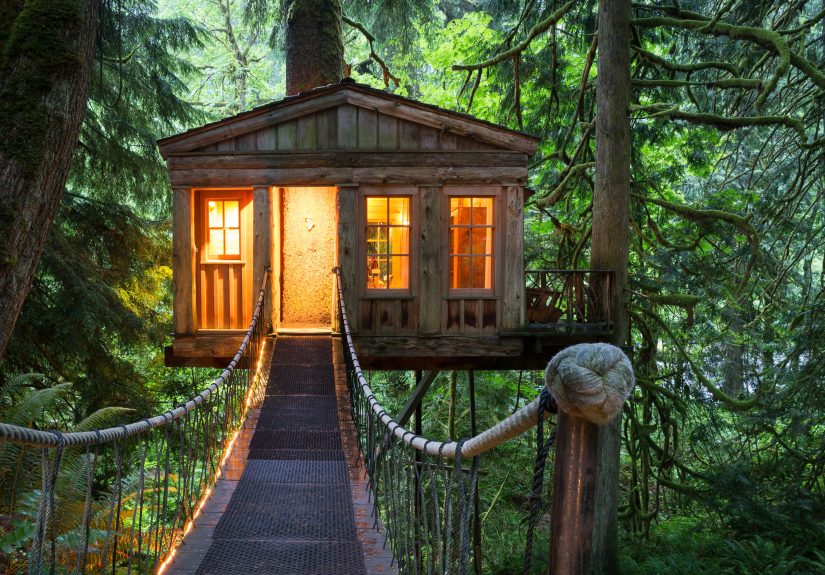
On the home front, designers and DIY enthusiasts are creating backyard tree houses and forts with both kids and adults in mind. Think classic wood structures with playful detailsturrets, flags, rope bridgesbut also appealing finishes, integrated seating, and shade so that grown-ups actually want to hang out there.
Some families build multi-level decks that connect a small fort-style tree house with a ground-level lounge area, creating one unified outdoor “campus” where everyone finds their favorite nook. Others keep it super simple: a snug little box with a railing, reachable by a sturdy ladder or ramp, but with a view good enough to make it feel like a tiny vacation spot right in the backyard.
Thinking About Building Your Own Classic Tree House?
Good news: you don’t need a full construction crew or a reality show to build a small, safe, nostalgic tree house. But you do need a plan. Here are some key considerations before you start hauling lumber into the canopy.
1. Choose the right tree and location
Look for a healthy, mature tree (or trees) with a strong trunk and branches. Many builders recommend species like oak or maple, depending on your region, because they offer dense wood and solid branching structure. Avoid trees with visible disease, large dead branches, or significant lean.
Also think about your yard layout: you want a spot that’s visible enough to supervise kids but not so close to property lines or power lines that it causes safety or neighbor issues.
2. Prioritize safety from day one
While vintage treehouses often relied on “hope and a few nails,” modern best practices focus on load-bearing supports, balanced platforms, and secure railings. Many professional treehouse builders and arborists recommend using specialized hardware that allows the tree to move and grow while still supporting the structure.
Some basic safety checks:
- Include sturdy railings around all edges.
- Use slip-resistant treads on stairs or ladders.
- Keep entry points away from windows and hard obstacles.
- Lay out a soft landing zone underneath (mulch, wood chips, or other impact-absorbing materials).
3. Check permits and local rules
Depending on your city or HOA, a tree house might count as an accessory structure, which means you may have to follow height limits, setback rules, or other building codes. It’s not the most fun part of the project, but it’s better than having to take the tree house down later because it’s technically a “three-story guest suite with a slide.”
4. Design for nostalgiaand the future
Start with classic elements: lots of wood, a simple rectangular footprint, a ladder or stairs, and maybe a small deck. Then layer in details that matter to your family: a periscope, a chalkboard, flower boxes, solar-powered string lights, or a simple pulley system for snacks and books.
Consider building a structure that can evolve over time. When kids are small, the tree house might be a play fort. Later, you can add a more comfortable chair, better lighting, and maybe a folding desk to turn it into a reading nook or remote-work hideaway. Nostalgia plus practicality is a powerful combo.
5. Keep the tree (and environment) in mind
Healthy trees = long-lasting tree houses. Avoid excessive cutting or drilling, and consider consulting an arborist if you’re planning something more complex than a small platform. Many modern builder guides emphasize using eco-conscious finishes and integrating tree houses into their surroundings rather than overwhelming them.
of Real-World Tree House Magic
Statistics and design ideas are great, but to really understand why classic tree houses are making a comeback, you have to picture an actual afternoon in one.
Imagine a mid-size suburban backyard. There’s a maple tree that’s been there longer than the house, and about eight feet up, tucked into its branches, is a simple wooden tree house with a small deck. Nothing fancy: a couple of windows, a railing that’s sturdy but plainly homemade, and a sign the kids painted that says “SKY CLUB.” The Y in “SKY” is backwards, which everyone agrees makes it more official.
On a Saturday afternoon, the tree house is the busiest “room” in the house. Two kids and a neighbor are up there with a stack of graphic novels, binoculars, and a plastic storage bin full of mismatched toys. They’re running a highly complex game that involves spies, dragons, and a weather station. Down below, a parent is on the deck with a cup of coffee, listening to the muffled shouts and occasional thumps of small feet overhead.
Every so often, the pulley system squeaks as someone sends down a handwritten note: “More snacks plz.” A few minutes later, a bag of popcorn and some fruit make their way back up, clipped to a clothespin. No one has asked for a tablet in hours.
Later that evening, the same tree house puts on a different outfit. The kids drag out a battery-powered lantern and a pile of blankets. Parents bring up a Bluetooth speaker and a thermos of hot chocolate. Suddenly, the tree house transforms into a tiny, open-air theater balcony. Fireflies blink. Crickets provide background audio. Someone notices that the tree branches frame a surprisingly good view of the sunset.
In that moment, the tree house isn’t just a kid’s toy. It’s a shared memory being built in real time. The adults remember forts from their own childhoodsthe lopsided platform, the rope swing over the patch of dirt, the thrill of being just out of sight. The kids will remember this, too: the feeling of being occasionally cold, occasionally sticky with sap, and totally free.
Experiences like this help explain why tree houses keep showing up as both DIY projects and high-end vacation splurges. A luxury treehouse resort might add spa-quality linens, panoramic windows, and a hot tub under the stars, but at its core, it’s still selling the same feeling: elevation, separation, and a little bit of magic.
Backyard or boutique resort, classic-style tree houses offer something rare in a world of constant notifications: the chance to be suspendedliterally and figurativelybetween everyday life and something a little more enchanted. Whether you’re eight, thirty-eight, or eighty, climbing that ladder is an invitation to remember that play, curiosity, and a good view never really go out of style.
So if you’ve been feeling that itch of nostalgia every time you see a photo of a wooden fort wrapped in branches, it might be time to embrace the moment. Start sketching. Start planning. Or start browsing for a weekend stay among the treetops. Classic tree houses are back, and they’re more than a trendthey’re a reminder that some of the best places in life are a little bit hard to reach and totally worth the climb.
SEO JSON