Table of Contents >> Show >> Hide
- What “Whimsical Fabric With Paint” Actually Means
- Tools & Materials
- Step 1: Pick the Right Dresser (So Your Flip Doesn’t Become a Soap Opera)
- Step 2: Prep Like You Want the Paint to Stay Put
- Step 3: Prime for Adhesion (and for “Surprise Stains”)
- Step 4: Base CoatYour “Canvas Fabric” Color
- Step 5: Create the Faux Fabric Texture (Linen or Grasscloth)
- Step 6: Add WhimsyPaint a “Fabric Print” Pattern
- Step 7: Seal It So It Can Handle Real Life
- Step 8: Finishing Touches That Make It Look Boutique
- Common Mistakes (So You Don’t Learn Them the Hard Way)
- A Realistic Timeline (So This Doesn’t Become a Month-Long “Art Installation”)
- FAQ
- Conclusion
- Workshop Stories: of Real-World Experience From This Kind of Flip
Every outdated dresser has the same problem: it’s trying its best. The bulky silhouette. The tired oak tone.
The hardware that screams “I came free with a landline phone plan.” But here’s the fun partdressers are basically
big wooden canvases with built-in storage. And when you combine paint with a faux-fabric effect, you can give
a thrift-store rescue a whimsical, boutique-worthy glow-up… without stapling a single inch of actual upholstery.
In this tutorial, you’ll learn how to flip a dated dresser into a piece that looks like it’s wrapped in playful,
patterned fabricusing paint, simple tools, and a couple of technique tricks (linen/grasscloth texture + “print”
patterns like stripes, gingham, or confetti dots). It’s a DIY that photographs beautifully, holds up in real life,
and gives your room that “yes, I definitely meant to do that” energy.
What “Whimsical Fabric With Paint” Actually Means
The goal is to mimic two things fabric gives you:
texture (the woven look) and pattern (the print). We’ll build that in layers:
- Texture layer: a faux linen/grasscloth effect created with a glaze mix and a brush drag.
- Pattern layer: “fabric print” details (ticking stripe, gingham, dots, scallops, florals) added with tape, stencils, or a steady-ish hand.
- Protection layer: a durable topcoat so your masterpiece doesn’t chip the first time a sock drawer gets feisty.
Tools & Materials
You don’t need a full woodshop. You need the right basics, and the wisdom to not paint over mystery grease.
Must-haves
- Screwdriver (for hardware removal)
- Cleaner/degreaser (dish soap + warm water works; stronger degreaser is great for old furniture)
- Sandpaper or sanding sponge (150–220 grit for scuff sanding; 320 grit for between coats)
- Tack cloth or damp microfiber cloth (for dust removal)
- Primer (bonding primer for slick surfaces; stain/tannin blocking primer if needed)
- Paint (quality acrylic or furniture paint; satin/eggshell is a forgiving sheen)
- Foam roller (for smooth flats) + angled brush (for edges)
- Painter’s tape (good tape matterscheap tape is a prank)
- Clear topcoat (water-based polyurethane/polycrylic is common for furniture)
For the faux-fabric effect
- Glaze or paint extender (helps the “fabric” layer stay workable longer)
- Chip brush (for linen/strié-style brush dragging)
- Optional: stencil(s) for repeats (florals, dots, geometric)
Optional upgrades (high impact, low effort)
- Wood filler + putty knife (fill chips or old hardware holes)
- New knobs/pulls
- Drawer liner (paper) or fabric + Fabric Mod Podge (if you want real fabric inside drawers)
- Felt pads for the feet
Step 1: Pick the Right Dresser (So Your Flip Doesn’t Become a Soap Opera)
The best candidates are sturdy, square-ish, and not secretly collapsing. Open and close drawers. If they stick,
that’s finewood swells, runners get cranky, and DIY is partly about negotiating with inanimate objects.
But avoid:
- Severe water damage (swollen particle board that crumbles like a cookie)
- Major structural wobble (unless you’re ready to reglue/brace)
- Peeling veneer everywhere (small patches are okay; widespread peeling is a time vortex)
- Strong odors that won’t quit (smoke/mildew can be managed, but pick your battles)
Step 2: Prep Like You Want the Paint to Stay Put
Prep is the difference between “professional finish” and “why is my paint scratching off like a lottery ticket?”
Your job: remove grime, create gentle tooth for adhesion, and make the surface boring (paint loves boring).
2A) Remove hardware + label parts
Take off knobs/pulls. If drawers are removable, pull them out and label the bottoms with tape (A, B, C…).
This prevents the classic DIY moment of “Why does Drawer 3 suddenly hate this dresser?”
2B) Clean thoroughly
Wash with a degreaser or soap and water, especially around handles and drawer fronts (the “hand jam” zones).
Rinse, then let everything dry fully. Paint + moisture = bubbling, and nobody wants foam where foam shouldn’t be.
2C) Repair + smooth
Fill dents, chips, and old hardware holes with wood filler. Once dry, sand smooth. If you’re adding new hardware,
measure twice, drill once, and avoid eyeballing unless you enjoy asymmetry as a lifestyle.
2D) Sand (or degloss) for grip
You usually don’t need to sand to bare wood. You do need to scuff sand glossy finishes so primer can lock in.
Use 150–220 grit lightly on flat surfaces. For detailed trim, sanding sponges are your best friend.
Remove dust with a vacuum and tack cloth (or a slightly damp microfiber).
2E) Quick safety note for older pieces
If the dresser is very old or you’re working in a pre-1978 home environment, treat old finishes with caution.
Lead-safe practices matteravoid creating dust, contain your work area, and clean thoroughly. When in doubt,
test and use safer methods (wet sanding, HEPA vacuuming, proper containment).
Step 3: Prime for Adhesion (and for “Surprise Stains”)
Primer does two big jobs: it helps paint stick and it blocks stains/wood tannins that can bleed through
(especially on certain woods or knots).
Choose your primer based on the surface
- Slick laminate or factory-finished surfaces: use a bonding primer designed for adhesion.
- Stain/tannin risk (yellowing, knots, old finishes): use a stain-blocking primer.
- Already painted, lightly worn piece: a good bonding primer still helps for durability.
Apply primer in a thin, even coat (foam roller for flats, brush for edges). Let it dry as directed, then lightly
sand with 320 grit to knock down texture. Wipe off dust. You’re building a smooth runway for paint, not a gravel road.
Step 4: Base CoatYour “Canvas Fabric” Color
Think of your base coat as the background cloth. Light neutrals read “linen.” Soft mid-tones read “denim.”
Pastels read “storybook picnic.” Choose what fits your room or your resale audience.
How to apply paint smoothly
- Roll large flat surfaces with a foam roller.
- “Tip off” edges with a brush (light strokes, don’t overwork it).
- Do 2 thin coats instead of 1 thick coat.
- Let coats dry fully; lightly sand between coats if needed for a silky finish.
Step 5: Create the Faux Fabric Texture (Linen or Grasscloth)
This is the magic trick: a subtle texture layer that mimics woven fibers. Practice on cardboard or a scrap board first.
The technique is simple, but timing mattersyou’re working while the glaze layer is still wet.
Option A: Faux Linen (subtle, classic, works on almost any style)
- Mix your glaze coat: Combine a small amount of paint (your “thread color”) with glaze or extender until it’s semi-transparent and slow-drying.
- Apply thinly: Work in sections (one drawer front at a time). Brush on a thin glaze layer.
- Pull lines: While wet, drag a chip brush gently in one direction to create fine “threads.” Keep your pressure consistent.
- Crosshatch (optional): After a minute or two (still workable, not sticky), lightly pull lines the other direction for a woven effect.
- Stop before you’re tempted: Overworking = mud. Fabric is subtle. Let the brush do the talking.
Option B: Faux Grasscloth (bolder texture, playful, perfect for whimsical vibes)
- Use a slightly thicker glaze mix so the texture shows more.
- Drag the brush in longer strokes, leaving tiny variations like woven strands.
- Add a few faint horizontal “breaks” (very lightly) to mimic grasscloth panels.
- Step back oftenthis texture reads best from a few feet away.
Pro tip: Do the faux-fabric texture on the dresser body, the drawer fronts, or both.
If you want maximum whimsy with minimal chaos, keep texture on the body and put bold “prints” on the drawers.
Step 6: Add WhimsyPaint a “Fabric Print” Pattern
Now we give your faux fabric a “print,” like you’d see on real textiles. Pick one pattern and commit
(unless your aesthetic is “eccentric art teacher,” in which case: carry on).
Pattern idea 1: Ticking Stripe (classic, looks expensive, tape does the hard work)
- Measure or eyeball stripe spacing (slightly imperfect can feel more handmade).
- Apply painter’s tape for the negative space. Press edges firmly.
- Seal tape edges with your base color first (this helps prevent bleeding).
- Paint stripe color in thin coats. Remove tape while paint is still slightly wet for crisp lines.
Pattern idea 2: Gingham (the picnic blanket effect)
Gingham is basically stripes that decided to socialize. Make a grid with tape:
paint vertical bands, let dry, retape for horizontal bands. Use the same color
but slightly thinned for the second pass so overlap areas look “darker,” like woven checks.
Pattern idea 3: Confetti Dots (cute, modern, forgiving)
Use a small round stencil sponge, the end of a dowel, or a stencil brush.
Vary dot size slightly. Cluster more in corners and fade toward the center
for that whimsical, floating look. It’s like your dresser is celebrating… quietly… in your bedroom.
Pattern idea 4: Patchwork Drawers (maximum whimsy, minimal precision)
Paint each drawer front a different “fabric” color, then add a subtle linen texture over all.
Finish with a single unifying detail (same hardware, same stripe placement, or a thin border).
Patchwork is ideal if you love color but don’t love measuring.
Step 7: Seal It So It Can Handle Real Life
Once your paint is fully dry, protect it. Dressers get touched constantlydrawer pulls, corners,
the top surface where keys and perfume bottles do their daily aerobics.
Topcoat choices
- Water-based clear topcoat: popular for painted furniture because it dries clear and is easy to clean up.
- Matte vs satin: matte hides imperfections; satin wipes clean more easily and looks “finished.”
- Wax: pretty, but less durable for high-use surfaces (and it can be temperamental under heat/water).
Apply 2–3 thin coats. Lightly sand with 320 grit between coats for a smooth feel, then wipe dust away.
Give your piece time to cure before heavy usepaint and topcoats often feel dry long before they’re fully hardened.
Step 8: Finishing Touches That Make It Look Boutique
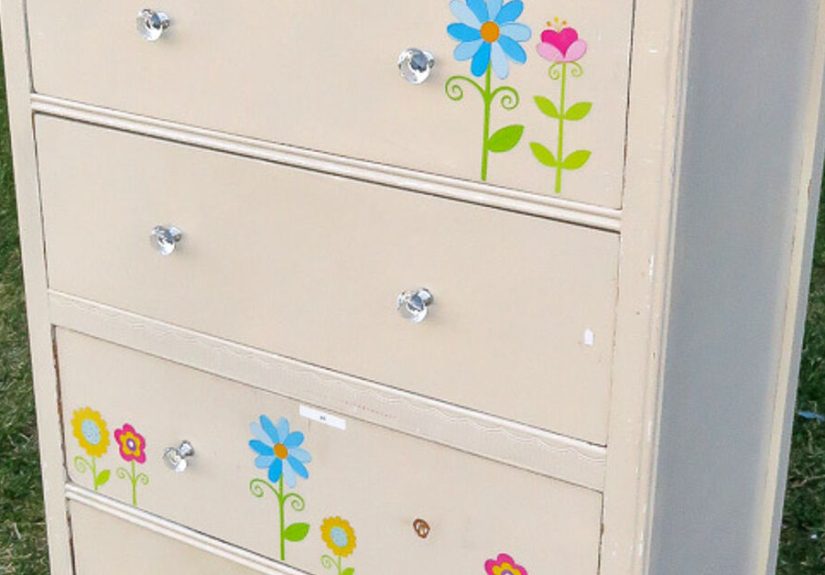
- Hardware upgrade: matte black for modern, brass for vintage glam, glass knobs for storybook charm.
- Paint the inside lip: a contrasting color when drawers open = instant “custom.”
- Line drawers (optional): paper liners or fabric attached with Fabric Mod Podge for a surprise pop.
- Add feet or legs: even a small lift can turn “heavy” into “mid-century inspired.”
Common Mistakes (So You Don’t Learn Them the Hard Way)
- Skipping cleaning: paint won’t bond to waxy grime. It will simply… leave.
- Too much texture: faux fabric should whisper, not shout through a megaphone.
- Overworking glaze: once it starts drying, stop touching it.
- Removing tape too late: crisp lines love early tape removal.
- Using the dresser immediately: let it cure. Your future self will thank you.
A Realistic Timeline (So This Doesn’t Become a Month-Long “Art Installation”)
- Day 1: Clean, repair, sand, dust.
- Day 2: Prime + light sand.
- Day 3: Base coat (1–2 coats).
- Day 4: Faux fabric texture + pattern layer.
- Day 5: Topcoat (2–3 thin coats with dry time).
- After: Gentle use for the first week; full durability comes with cure time.
FAQ
Do I have to sand?
You usually don’t need to strip to bare wood, but you do need scuff sanding (or deglossing) so primer and paint can grip.
Think “dull the shine,” not “sand until you meet your ancestors.”
Can I do this on laminate or veneer?
Yesjust use the right primer. Laminate needs a bonding primer for adhesion. Veneer is fine if it’s secure; avoid aggressive sanding that cuts through thin veneer.
Do I need a topcoat if I use furniture paint or chalk-style paint?
For a dresser that gets daily use, a protective topcoat is a smart moveespecially on the top surface and drawer fronts.
If you love a chalky matte look, choose a matte clear topcoat rather than skipping protection.
How do I fix bleed-through or yellow stains?
Stop painting more color over itthat’s like trying to solve a leak with extra towels. Use a stain-blocking primer on the problem areas, then repaint.
Conclusion
Flipping an outdated dresser into a whimsical faux-fabric statement piece is all about layering:
prep for durability, a smooth base coat, a subtle woven texture, and a playful “print” pattern that looks like fabric
all sealed so it can handle everyday life. The end result is charming, custom, and wildly more interesting than
another plain painted dresser. Plus, you get the satisfaction of turning “blah” into “where did you buy that?”
with the power of tape, patience, and a little paint confidence.
Workshop Stories: of Real-World Experience From This Kind of Flip
If you’ve never done a faux-fabric finish before, the first experience most DIYers have is a split-second identity crisis:
“Is this gorgeous? Or did I just invent a new kind of streak?” The good news is that faux linen and grasscloth effects
are meant to be imperfect. Real fabric has variation. Threads aren’t laser-straight. The goal is “handmade textile,”
not “printed spreadsheet.”
One common moment: you finish dragging the chip brush, step back, and it looks… underwhelming. That’s normal.
Up close, the texture can feel subtle. From across the roomwhere furniture is actually seenit suddenly reads like
woven depth. This is why “step back often” is not just advice; it’s a lifestyle choice that prevents you from
overworking the glaze into a sad puddle. If you’re tempted to keep brushing because it’s not dramatic enough,
pause and let it dry first. You can always add a second whisper-thin texture layer later. You cannot un-muddy mud.
Another real-world lesson: tape is either your best friend or your most passive-aggressive enemy. Crisp stripes are
magical, but bleeding happens when tape edges aren’t burnished down or when thick paint gets shoved against the tape
like a toddler testing boundaries. The trick that changes the game is sealing the tape edge with the base color first.
It feels like an extra step, but it’s basically insurance for sharp linesespecially on textured “fabric” layers.
Many people also discover the “dry vs cured” surprise the hard way. Paint can feel dry in hours and still be soft enough
to scratch for days (or longer). The experience usually goes like this: you proudly reinstall hardware, slide in the drawers,
and then notice a tiny mark near the pull. Suddenly you’re whispering apologies to your dresser like it’s a houseplant
you forgot to water. Treat the piece gently at first. If you’re flipping it to sell, build cure time into your schedule
so the finish feels truly durable when the buyer opens drawers and inevitably does the “hmm” inspection.
The most fun experience, though, is watching the “fabric print” come alive. The faux linen texture sets a sophisticated
backdrop, and then a whimsical patternticking stripes, gingham checks, confetti dotsturns the whole piece into
personality furniture. Even better: patterns distract from minor flaws. A small dent you missed? Suddenly nobody cares,
because their eyes are following the playful stripes. That’s not cheating. That’s design.
Finally, a truth universally acknowledged: new hardware is the glow-up multiplier. You can do everything right with paint,
but swapping dated pulls for something fresh makes the dresser look intentionally designed. It’s the equivalent of putting
on a great pair of shoes. Same outfit. Completely different energy.