Table of Contents >> Show >> Hide
- Why Math Shows Up on the Felt (Even If You Hated Algebra)
- The Geometry of Pocketing: Stop Aiming at the Pocket
- Ghost Ball Aiming: The Invisible Buddy Who’s Always Right
- Cut Angles: A Quick Mental Ruler for “How Thin Is Thin?”
- The Tangent Line and the 90° Rule: Your Default Cue-Ball Escape Route
- The 30° Rule: Natural Angles for Rolling Cue Balls
- Bank Shots and the Diamond System: Geometry With Training Wheels
- English, Spin, and the Sneaky Physics (AKA: Why Your “Perfect Aim” Missed)
- Pattern Play: Turn the Table Into a Graph
- Probability and Shot Selection: Expected Value Beats Ego
- Practice Drills That Build Mathematical Intuition
- Conclusion: Be the Person Who Brings a Calculator to a Bar (Metaphorically)
- Extra: Real-World Experiences When You Start Thinking Like a Mathematician (About )
Pool is the only place where it’s socially acceptable to whisper “angle of incidence” while holding a stick in public.
And honestly? That’s a shamebecause once you start thinking like a mathematician, the table stops feeling like chaos
and starts feeling like a solvable (and highly satisfying) geometry problem with snacks nearby.
This isn’t about turning you into a robot who calculates three decimal places before every shot. It’s about using a few
reliable “math shortcuts” that pros lean on: clean aiming references, predictable cue-ball routes, and smarter decisions
under pressure. You’ll miss fewer “how did that not go?” shots, and you’ll start leaving the cue ball where you meant to.
Why Math Shows Up on the Felt (Even If You Hated Algebra)
Pool looks like art, but it behaves like physics. Balls collide, energy transfers, friction changes outcomes, and tiny
errors compound fast. Math doesn’t remove feelit gives your feel a map.
- Geometry helps you see the correct contact point and cut angle.
- Vectors explain cue-ball direction after contact (especially on stun shots).
- Systems (like diamond kicking) turn “hope” into “plan.”
- Probability helps you choose the smartest shot, not just the flashiest one.
The Geometry of Pocketing: Stop Aiming at the Pocket
A classic beginner mistake is aiming the object ball (OB) at the pocket and then… also aiming the cue ball at the pocket,
as if the universe will negotiate the rest. Mathematicians don’t negotiate with geometry.
Think “object ball line” first
Imagine a straight line from the object ball to the center of the pocket. That’s the target line.
Your job is to hit the object ball so it travels on that line.
Then find the contact point
Once you know the object ball’s target line, the required contact point on the object ball is determined. You’re not
“shooting at the pocket”you’re delivering the cue ball to the correct collision geometry.
Ghost Ball Aiming: The Invisible Buddy Who’s Always Right
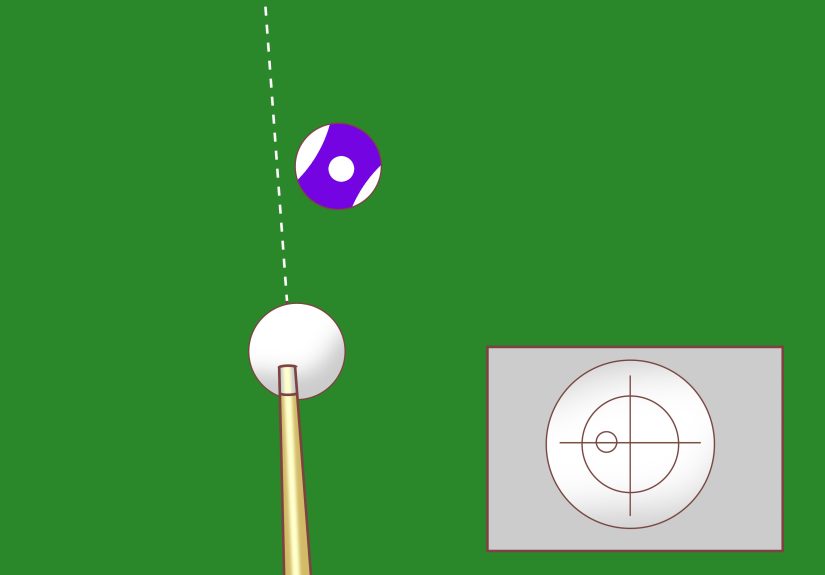
The ghost ball concept is one of the cleanest geometric hacks in pool: picture an imaginary cue ball
frozen at the exact spot where the real cue ball must be at impact to send the object ball down the target line.
How to use it without summoning actual ghosts
- Pick the pocket and draw the object ball’s target line.
- Imagine a “ghost” cue ball touching the object ball on the side opposite the pocket.
- The center of the ghost ball is where the center of your real cue ball needs to be at contact.
- Align your cue through the cue ball’s center toward that ghost-ball center (center-ball hit first).
This method shines because it’s consistent: it turns “I think I see it” into “I can reproduce it.”
It also makes it easier to practice, because you can check yourself: did you actually deliver the cue ball to that spot?
Cut Angles: A Quick Mental Ruler for “How Thin Is Thin?”
You don’t need trigonometry at the table, but you do need a feel for how much of the object ball you’re hitting.
One useful way to think is in “fractions of the ball”: full, 3/4, 1/2, 1/4 hits. Those overlaps correspond to
common cut-angle ranges and cue-ball behaviors.
The fun part: when you estimate the hit thickness well, cue-ball paths become predictable. And predictable is basically
the official love language of mathematicians.
The Tangent Line and the 90° Rule: Your Default Cue-Ball Escape Route
If there’s one “math fact” that instantly improves position play, it’s this:
on a stun shot (cue ball sliding with no top/bottom spin at impact), the cue ball leaves on the
tangent line, which is perpendicular to the object ball’s path.
How to actually use it
- Visualize where the object ball must go (to the pocket).
- Now imagine a line 90° to that direction at the contact point: that’s the cue ball’s “stun path.”
- Plan position by choosing speed and slight follow/draw to bend away from or toward that tangent baseline.
A handy “human measuring tool”
A popular way to visualize the tangent direction is to use a simple physical reference: the approximate width of a pool
ball (2.25 inches) is close to the width of many people’s three middle fingers together, which can help you project
the cue ball’s path more realistically than imagining only a thin centerline.
Important nuance: real tables and real balls aren’t perfect physics demos. Energy loss and friction can shift the “pure”
90° behavior a bit, especially with speed and cut thickness. But as a baseline, it’s one of the best rules in the game.
The 30° Rule: Natural Angles for Rolling Cue Balls
When the cue ball is rolling (topspin at impact), it tends to “open up” off the object ball at a fairly
stable deflection angle over a wide range of cutsoften close to about 30° from its original direction.
Players call this the natural angle.
Why you should care
The 30° idea gives you a fast prediction tool. Instead of guessing where the cue ball will wander after contact, you get
a default path you can build patterns aroundespecially in rotation games and in 8-ball when you need tidy shape.
Speed changes the “end point,” not the idea
The direction cue ball wants to take can stay similar while the distance traveled changes with speed and how much energy
the cue ball retains. If you treat the 30° line as a lane and speed as “how far down the lane,” you’re thinking the right way.
Bank Shots and the Diamond System: Geometry With Training Wheels
Banks and kicks scare people because rails feel like randomness. Mathematicians disagree (politely) and bring receipts:
diamond systems use the table’s diamond markers as a coordinate grid to estimate predictable rebound paths.
Start with the simplest “mirror” concept
For many one-rail banks, you can treat the rail like a mirror: reflect the target across the cushion and aim as if you’re
shooting straight to the reflected point. It’s not perfect (spin and speed matter), but it’s a strong first model.
Then level up to diamond counting
Diamond systems assign numbers to rail diamonds and use those values to align your cue-ball path. Two-rail and three-rail
kick systems (like the well-known Corner-5 family and “Plus” style approaches) are essentially structured ways to solve
“where do I need to hit the first rail to reach that final rail target?”
Here’s the mathematician mindset: you don’t need a perfect systemyou need a repeatable baseline you can calibrate.
Use the system, then adjust for your table speed, your ball set, and your chosen english. That’s not “breaking the math.”
That’s doing applied math, which is just math wearing jeans.
English, Spin, and the Sneaky Physics (AKA: Why Your “Perfect Aim” Missed)
Once you add sidespin (english), the cue ball becomes a tiny chaos machine. Not eviljust complicated. Three main effects
matter most:
1) Squirt (cue-ball deflection)
Hit off-center and the cue ball initially deflects slightly in the opposite direction of the spin you applied. More off-center,
stiffer shafts, and firmer hits generally increase this effect.
2) Swerve
Because your cue is usually a bit elevated (rails exist, tables are rude), the spinning cue ball can curve during travel.
Swerve tends to grow with slower speeds and longer distances.
3) Throw
At the moment of ball-to-ball contact, friction can “throw” the object ball off the pure geometric line, especially on slower shots
or with certain spin/cut combinations.
The takeaway is wonderfully mathematical: add variables and the model needs correction. That’s why many great players build patterns
with center ball and simple follow/draw whenever possible. It reduces uncertainty, and uncertainty is the enemy of run-outs.
Pattern Play: Turn the Table Into a Graph
A mathematician doesn’t run balls one at a timethey solve the whole rack like a routing problem.
Think of each object ball as a “node” and each easy positional route as an “edge.”
Your goal is to choose an order that keeps the next shot high-percentage.
Use zones, not perfect points
Beginners try to land the cue ball on a dime. Strong players target a position zonea softball-sized area that still gives an
easy cut. Zones are more realistic, and they make your game more stable under pressure.
Identify “problem balls” early
Clusters, balls tied up on a rail, and balls blocking pockets should be handled while you still have insurance balls available.
That’s basically a math principle: solve constraints early, while you have options.
Probability and Shot Selection: Expected Value Beats Ego
If you want to play like a mathematician, stop asking: “Can I make this?”
Start asking: “What happens if I miss?”
Two quick questions that change everything
- What’s my make rate? (Be honest. Your pride is not a valid statistic.)
- What’s my sell-out rate? If a miss hands over an easy run, the “cool shot” might be the wrong shot.
Sometimes the best move is a safety that leaves your opponent a low-percentage shot. That’s not “playing scared.”
That’s optimizing outcomesaka, doing math with style.
Practice Drills That Build Mathematical Intuition
Drill 1: Ghost-ball verification
Set up the same cut shot five times. Each time, explicitly visualize the ghost ball and contact point. Track how often your misses
are “thick” vs. “thin.” The goal is calibration: your eyes learn what the correct overlap looks like.
Drill 2: Tangent-line ladder
Set a simple cut and shoot stun at three speeds (soft/medium/firm). Watch how the cue ball stays on the tangent direction while the
distance changes. You’re training a model: direction vs. distance.
Drill 3: One-rail kick with diamonds
Pick an object ball and kick the cue ball one rail to hit it. Use the diamonds to choose a starting contact on the rail, then adjust
systematically (not emotionally). Write down what works on your table speed.
Conclusion: Be the Person Who Brings a Calculator to a Bar (Metaphorically)
Playing pool like a mathematician doesn’t mean you’re doing equations between shots. It means you’re using reliable references:
ghost ball and contact points for aiming, tangent lines and natural angles for cue-ball prediction, diamond systems for banks and kicks,
and probability thinking for smarter decisions.
The surprising result is that the game feels more creative, not less. Once the outcomes are predictable, you can plan patterns,
design breakouts, and choose shots with intention. And when someone asks how you got so consistent, you can smile and say:
“Pure talent.” (And also geometry.)
Extra: Real-World Experiences When You Start Thinking Like a Mathematician (About )
The first “experience” most players notice is that the table gets quieter. Not literallypool halls are not known for monastic silence
but mentally. When you stop relying on vibes and start relying on references, your brain stops spinning on every shot. A common moment is
lining up a mid-range cut you used to fear, seeing the ghost-ball position clearly, and realizing the shot is… normal. Not magical. Just normal.
It feels like someone turned the difficulty slider down one notch.
Then comes the tangent-line phase: you start predicting cue-ball paths like you’re calling your shot to the universe. Players often report
a weird satisfaction the first time they play position on purpose with a stun shotpocket the object ball, watch the cue ball travel exactly
along the tangent line, and land in a “zone” you picked ahead of time. It’s the pool equivalent of hitting “send” on an email you actually proofread.
After that, you become suspicious of english. This is healthy. Many improving players go through a stretch where they intentionally reduce
sidespin and suddenly their pocketing percentage jumps. It’s not that english is bad; it’s that english adds variables (squirt, swerve, throw),
and variables require compensation. The experience is almost comedic: you’ll swear the table is “playing different today,” when the real difference
is you’re no longer asking the cue ball to do interpretive dance mid-shot.
Another common experience shows up in 8-ball: pattern play starts to feel like solving a puzzle instead of improvising a poem. You’ll walk around
the table and notice “problem balls” immediatelyclusters, blocked pockets, a ball that only goes to one hole. And you’ll feel a mild urge to
address it early, while you still have insurance balls. This often leads to your first intentional breakout that works: you choose a shot not because
it’s easy, but because it opens the table and keeps you in control. That moment is addictive.
The diamond-system experience is different: it’s humbling at first. You’ll try a one-rail kick, miss by a diamond, and feel personally attacked by
basic geometry. But then you adjust systematicallysame speed, same spin, move the aim point one small unitand suddenly you start getting hits
reliably. Players often describe this as “unlocking a secret level” because kicks and banks stop being desperate guesses and start being repeatable tools.
Finally, the most “mathematician” experience of all: you begin choosing shots based on outcomes, not ego. You’ll pass on a hero cut that sells out
and play a simple containing safety instead. Your opponent will groan. You will feel oddly peaceful. That’s optimization. And it’s also the moment
you realize pool isn’t just about making ballsit’s about controlling the future.