Table of Contents >> Show >> Hide
- What Exactly Is “Menna”?
- Why the Trend Feels Fresh Even Though Henna Is Ancient
- Henna Has History—And Men Have Always Been Part of It
- What Makes Henna on Men Look So Striking?
- The Cultural Respect Question You Cannot Skip
- Safety Matters More Than the Aesthetic
- Why Men Are Drawn to Henna Right Now
- Will “Menna” Last?
- The Human Side of Menna: What the Experience Feels Like
- Conclusion
For years, henna sat in the American imagination inside a very small box: bridal hands, festival photos, and that one friend who came back from vacation with a temporary design and a suspicious amount of confidence. Then the internet did what the internet does best—it gave an old idea a catchy new nickname. Enter “menna,” a cheeky mash-up of men and henna used online to describe men wearing intricate mehndi-inspired body art.
Now, let’s clear something up before the comment section warms up its engines: men wearing henna is not the new part. Henna itself is ancient, culturally rich, and deeply tied to traditions across South Asia, the Middle East, and North Africa. What feels new is the packaging. The “menna” label reframes henna for modern tattoo-curious men who want the look of body art without the forever part, the buzzing needle, or the future laser-removal budget.
That’s why this trend matters. It sits at the intersection of fashion, masculinity, temporary tattoo culture, and cultural conversation. It also raises smart questions: Why are more men drawn to intricate henna tattoos? What makes the style visually compelling? And how do you appreciate the art form without treating it like a disposable costume? The answer, as usual, is a little style, a little history, and a little common sense.
What Exactly Is “Menna”?
“Menna” is not a traditional cultural term. It is an internet-born nickname used in online galleries and social media posts to describe henna designs worn by men. In other words, it’s branding, not heritage. That distinction matters.
The appeal is obvious. Henna offers a way to experiment with ornate body art that feels bold but low-risk. Unlike permanent tattoos, henna fades. Unlike sticker-style temporary tattoos, it has texture, tradition, and a handmade quality that feels personal. And unlike the average impulse tattoo done at 1:17 a.m. after two energy drinks and one bad decision, henna gives you room to admire the art, enjoy the attention, and walk away with your future employment options largely intact.
For some men, “menna” is a style statement. For others, it is a cultural practice, a wedding ritual, a religious or family-linked tradition, or simply a beautiful form of adornment. That range is part of why the trend is interesting. It is not just about aesthetics. It is also about who gets to wear intricate design, how masculinity is expanding, and why softness, detail, and decoration are no longer automatically coded as “not for men.”
Why the Trend Feels Fresh Even Though Henna Is Ancient
1. It flips old assumptions about masculinity
Western style has long given men permission to be decorated, but only in approved ways: a watch, a chain, a suit with expensive buttons, maybe a tattoo sleeve if you want to announce that you own at least one black T-shirt. Henna complicates that formula. It is detailed. It is ornamental. It can be floral, geometric, symbolic, or delicate. And somehow, on the male body, that detail doesn’t weaken the look. It often sharpens it.
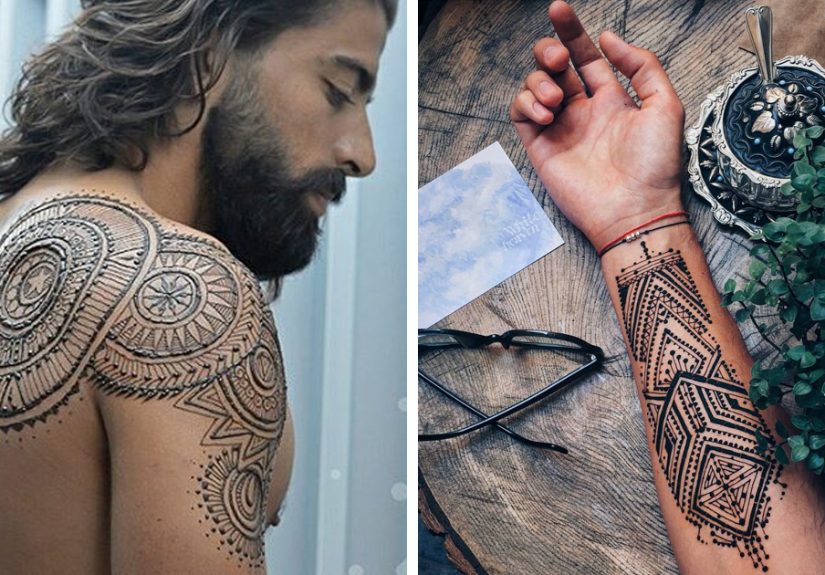
That is part of the reason the “menna” trend catches the eye. It proves that intricate design does not have to cancel out masculinity. A shoulder piece, chest motif, hand design, or geometric forearm pattern can look ceremonial, artistic, spiritual, or fashion-forward without looking costume-like. The result is less “temporary tattoo for guys” and more “body art with actual point of view.”
2. It offers tattoo energy without tattoo consequences
Temporary body art has always had a certain magic: all the drama, none of the lifelong paperwork. Henna fits especially well in a culture where tattoos are broadly accepted, but many people still hesitate before committing. That hesitation is understandable. A permanent tattoo is a relationship. Henna is a really good first date.
In the United States, tattoos have become mainstream, which helps explain why temporary alternatives also feel more appealing. Once body art becomes socially normal, people start experimenting with style, placement, symbolism, and commitment level. Henna meets that moment perfectly. It lets men try the visual language of tattoos without the permanence, the pain, or the possibility of waking up one day and realizing their ankle quote sounded wiser in 2014.
3. Social media loves visual complexity
Henna photographs beautifully. The lines are precise. The patterns wrap the body in a way that flatters muscle, movement, and bone structure. Designs can climb over shoulders, follow collarbones, circle wrists, or spread across the back in a way that feels both ancient and editorial. That makes henna naturally shareable.
And once images of men wearing elaborate henna started circulating online, the effect was immediate. What many people associated mainly with women’s wedding traditions suddenly appeared on male chests, hands, shoulders, scalps, and arms. The surprise factor did the rest. “Menna” became a visual shorthand for stereotype-breaking style.
Henna Has History—And Men Have Always Been Part of It
One of the biggest misconceptions around the “menna” conversation is the idea that men wearing henna is somehow invented by Instagram. It isn’t. Henna has a long history across multiple regions and communities, and male participation is not some modern glitch in the system.
Historically, henna has been used for body adornment, cooling the skin, coloring hair, and marking rituals and celebrations. It has roots reaching back thousands of years. In some Muslim communities, men have traditionally used henna to dye beards. In many cultural contexts, henna belongs to a wider decorative and ceremonial world, not a strict girls-only club guarded by floral gatekeepers.
What is true is that many Americans first encountered henna through images of brides’ hands and feet, especially in South Asian wedding culture. That narrow exposure can make male henna look surprising even when it is not historically unusual. The “menna” trend, then, is less about creating something new and more about broadening public awareness of what was already there.
What Makes Henna on Men Look So Striking?
Placement changes everything
Henna on men often appears in placements more commonly associated with tattoo culture than bridal mehndi. Think shoulders, upper arms, forearms, chest panels, backs, necks, and even shaved heads. That shift in placement changes the visual language right away. A paisley-style hand design reads one way. A sweeping shoulder-and-chest composition reads entirely differently.
Many of the most compelling designs blend traditional henna vocabulary with tattoo-style placement. The result feels familiar and unfamiliar at the same time. It can be geometric, tribal-influenced, botanical, or highly ornamental, yet still read as distinctly masculine depending on scale, spacing, and placement.
Detail creates a luxury effect
Henna has what a lot of modern body art wants: precision. The lines can be lace-like or architectural. Even simple motifs look considered. That level of detail gives henna a luxury feel. It does not scream. It draws people in.
On men, that detail can be especially effective because it contrasts with the expectation that male style should be blunt, minimal, or aggressively practical. Henna says the opposite. It says detail is allowed. Beauty is allowed. Ornament is allowed. You can be decorated without becoming less yourself.
The Cultural Respect Question You Cannot Skip
This is where the conversation gets smarter—and honestly, more useful. Henna is not just a trend board aesthetic. It carries meaning in many communities, especially around weddings, celebrations, faith, family, and regional identity. So if you are interested in “menna,” the goal is not simply to wear it. The goal is to wear it thoughtfully.
Respect starts with learning. Know that mehndi is more than decoration in many South Asian and Middle Eastern contexts. Understand that specific motifs, ceremonies, and placements can carry cultural or religious significance. If you are borrowing from an art form with deep roots, do the homework. Appreciation has context; appropriation skips the reading and heads straight for the selfie.
That does not mean henna is off-limits unless your family tree comes with a wedding playlist and a spice cabinet that means business. It does mean intention matters. Work with artists who know the tradition. Ask questions. Avoid treating sacred or ceremonial designs like random Pinterest wallpaper. And if you are choosing symbols you do not understand, pause. The body is a lousy place for guesswork.
Safety Matters More Than the Aesthetic
Let’s talk about the least glamorous but most important part of this topic: safety. Natural henna is one thing. Black henna is another story entirely. Many health experts and regulators warn that products sold as black henna may contain chemicals such as PPD, which can trigger severe allergic reactions, burns, swelling, itching, blistering, and long-term skin issues.
That means the phrase “temporary tattoo” should not lull anyone into assuming zero risk. A design that fades is still something you are putting on your skin. Look for artists who use fresh, natural henna paste and can explain exactly what is in it. If the product smells sharply chemical, skip it. If the artist cannot answer basic ingredient questions, also skip it. If someone says, “Trust me, bro,” absolutely skip it.
It is also worth remembering that in the United States, henna itself occupies a somewhat tricky regulatory space. So the smartest move is to treat application like you would any other body-based service: vet the artist, ask about ingredients, consider a patch test, and do not let urgency or trend-chasing outrun common sense.
Why Men Are Drawn to Henna Right Now
The rise of “menna” makes sense in a broader culture that increasingly values personal expression without rigid gender rules. Men paint nails, wear pearls, carry statement bags, and experiment with beauty in ways that would have been treated as shocking not that long ago. Henna fits neatly into that shift.
It also appeals because it offers multiple identities at once. It can feel spiritual without being preachy, stylish without being loud, and artistic without being permanent. For men who are curious about tattoos but not committed, henna is a rehearsal. For men already invested in body art, it is another medium. For men with cultural ties to henna, it can be a reclaiming, a continuation, or simply a visible form of pride.
And for the average guy who just wants to look cool for a wedding, shoot, festival, or vacation? Henna is frankly a strong option. It is temporary, high-impact, conversation-starting, and much more original than the usual last-minute style decisions. Which is to say: better than buying another short-sleeve shirt with leaves on it and pretending that counts as risk.
Will “Menna” Last?
The nickname may or may not survive. Internet terms are fragile little creatures. But the idea behind it is more durable. Men are increasingly open to body art that is intricate, meaningful, and visually expressive. Henna offers all of that while carrying centuries of artistic heritage behind it.
So even if the word “menna” fades, the broader shift probably will not. Men wearing henna is unlikely to disappear just because the internet eventually moves on to another oddly named aesthetic. The better takeaway is this: male adornment is getting more expansive, and people are rediscovering older art forms through newer eyes.
That is a good thing—as long as the rediscovery comes with respect. Henna deserves more than trend-chasing. It deserves context, care, and a little humility from anyone lucky enough to wear it.
The Human Side of Menna: What the Experience Feels Like
One of the most interesting things about men trying henna for the first time is how quickly the experience stops being about trend and starts being about sensation, ritual, and attention. A lot of men approach it expecting something casual—basically a cool temporary tattoo with a little extra flair. Then the process begins, and the whole thing slows down. Henna is applied by hand. It takes patience. You have to sit still. You have to let someone build detail on your skin line by line. That alone changes the mood. It feels less like consumption and more like collaboration.
Many men are also surprised by how intimate the design becomes once it is actually on the body. A shoulder piece does not just sit there looking decorative; it follows muscle. A hand design changes how you gesture. A forearm motif suddenly turns ordinary movement—reaching for a coffee, opening a door, scrolling your phone—into something visually deliberate. Henna has a way of making the wearer more aware of posture, movement, and presence. People tend to look at their hands more. They slow down a little. They become conscious of the body as surface and storytelling tool.
There is also the social side. Men who wear henna often become instant conversation magnets. Friends ask if it is real. Strangers ask how long it lasts. Somebody almost always says, “Wait, that actually looks amazing.” That reaction matters because it reveals what the trend is really doing: it is expanding what people think men can wear on their bodies. The wearer is not just trying a design. He is testing the room. And more often than not, the room responds with curiosity rather than resistance.
For men with cultural ties to henna, the experience can feel even deeper. It may reconnect them with weddings, family rituals, Eid celebrations, community gatherings, or childhood memories of seeing older relatives prepare for major events. In that context, henna is not a novelty at all. It is a return. Wearing it publicly can feel affirming, even quietly powerful, especially in spaces where cultural practices have been flattened into stereotypes.
For men without that background, the experience can still be meaningful—if approached respectfully. Many describe henna as a low-pressure way to try body art while learning about a tradition larger than themselves. It can be an entry point into asking better questions: Who created this style? What do these patterns mean? What is the right context for wearing it? Those questions are part of the experience too, and they often end up being more valuable than the compliment count on Instagram.
Then there is the temporary nature of it, which changes the emotional tone completely. Because henna fades, people often feel freer while wearing it. They are bolder. More playful. More experimental. A man who would never commit to a permanent chest tattoo might happily wear an elaborate henna panel for a wedding weekend, a beach trip, or a photo shoot. That freedom is part of the charm. Henna lets men try on a different version of themselves without promising to stay there forever. And sometimes that is exactly the kind of beauty experiment people need: not a permanent reinvention, just a vivid, thoughtful, memorable one.
Conclusion
The “menna” trend may sound like a playful internet invention, but the story behind it is much richer. Henna is ancient. Male participation is not new. What is changing is visibility. More people are seeing men wear intricate henna tattoos and realizing the obvious: ornament, symbolism, and body art never belonged to one gender in the first place.
The smartest way to engage with the trend is to enjoy the beauty without stripping away the context. Henna can be expressive, stylish, and deeply personal. It can also be cultural, ceremonial, and meaningful far beyond aesthetics. When approached with respect—and with a healthy distrust of black henna—it offers something rare in modern style: body art that is temporary, visually rich, and rooted in long artistic traditions.
So yes, men can absolutely wear intricate henna tattoos. The better question is not whether they can. It is whether they are willing to wear them with curiosity, care, and enough humility to understand that this art form was never waiting around for the internet to discover it. The internet just gave it a nickname and showed up late.