Table of Contents >> Show >> Hide
- Why This Barcelona Home Still Feels Fresh
- The Minim Philosophy: Restoration Before Decoration
- Room by Room: How the Apartment Builds Its Midcentury Mood
- Why Barcelona Is the Perfect Backdrop for Midcentury Modern
- Design Lessons You Can Borrow From This Home
- Experience the Mood: Living With Midcentury Modern in Barcelona
- Conclusion
- SEO Tags
Some homes whisper. This one makes eye contact, offers you an espresso, and casually reminds you that good taste never has to raise its voice. The Barcelona home of Elina Vila and Agnès Blanch of Minim is one of those interiors that feels instantly composed, but not in a fussy, “please don’t sit there” kind of way. It is elegant without being cold, modern without being sterile, and deeply rooted in the architectural soul of Barcelona while flirting shamelessly with midcentury modern classics.
That balance is what makes the project so memorable. Vila and Blanch, the design duo behind Minim, are known for treating old spaces with respect rather than bulldozing history in the name of trendiness. Their philosophy is simple but powerful: keep what matters, edit what doesn’t, and let new additions sharpen the beauty of what was already there. In this apartment, that means original stained glass windows and patterned floors get to keep their starring roles, while iconic midcentury furniture steps in like a brilliantly cast supporting ensemble.
The result is not just a stylish Barcelona apartment. It is a master class in how to blend eras without turning your home into a museum gift shop. If you love midcentury modern interiors, historic apartments, or the idea of a home that looks collected instead of copied, this place deserves a long look. Possibly with dramatic sighing.
Why This Barcelona Home Still Feels Fresh
What makes this home so compelling is not that it is packed with famous design names, although it certainly is. The apartment includes pieces associated with giants of midcentury design, including Hans Wegner, Arne Jacobsen, Poul Henningsen, Charles and Ray Eames, Eero Saarinen, and Vico Magistretti. But the home does not feel like a showroom or a greatest-hits album. It feels lived in, edited, and very sure of itself.
That confidence comes from contrast. Minim pairs modernist furniture with the apartment’s original architectural bones: stained glass windows, patterned cement or hydraulic tile floors, and the kind of inherited detail that gives Barcelona interiors their romance. Instead of trying to make everything match, Vila and Blanch let each period do what it does best. The old architecture brings texture, memory, and gravity. The midcentury pieces bring clarity, silhouette, and rhythm. Together, they create a conversation rather than a costume.
That idea matters because midcentury modern design works best when it is treated as a language, not a uniform. The style is famous for clean lines, functional furniture, warm woods, mixed materials, natural light, and a less-is-more mindset. But in the wrong hands, it can feel formulaic fast. Walnut credenza, check. Sputnik lamp, check. Random abstract print, check. Suddenly the room looks like it was decorated by an algorithm with a crush on 1962.
Minim avoids that trap by using midcentury design as a foil for the apartment’s historic character. That is why the home still feels relevant today. It is not chasing nostalgia. It is using design history to sharpen the present.
The Minim Philosophy: Restoration Before Decoration
Founded in 1999, Minim built its reputation around maximizing each space while preserving original elements with historical or contextual value. That approach explains why this apartment feels so grounded. Vila and Blanch are not decorators who sweep into a room and erase everything that came before. They are interpreters. They read the building first, then respond.
That might sound poetic, but it has real design consequences. In cities like Barcelona, older flats often contain features that newer construction cannot fake convincingly: stained glass, hydraulic tile, tall openings, thick walls, and subtle craftsmanship that turns ordinary circulation into a visual experience. Once those features are stripped out, a home may become more generic, but it rarely becomes more interesting.
Minim understands that history is not clutter. It is content. The original details are what give the apartment emotional range. They also prevent the midcentury furniture from feeling overly slick. A Swan Chair in a blank white box is nice. A Swan Chair beside stained glass and patterned flooring is a whole story.
This is one of the most useful lessons from the project: the smartest renovation is often subtraction with judgment, not demolition with enthusiasm. Keep the windows. Keep the tile. Keep the marks of place. Then bring in modern elements that clarify the room rather than overpower it.
Room by Room: How the Apartment Builds Its Midcentury Mood
The Living Room: Symmetry With a Pulse
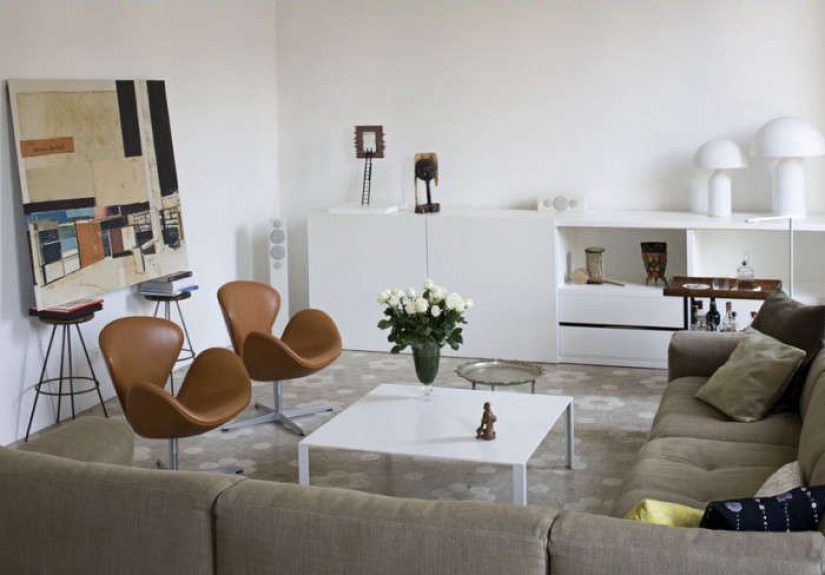
In the living room, a pair of leather Arne Jacobsen Swan Chairs and Vico Magistretti Atollo lamps create a sense of order and symmetry. That combination is pure midcentury confidence: sculptural seating, iconic lighting, and enough visual discipline to keep the room feeling intentional. But because the apartment still has its original stained glass windows, the composition does not become too pristine. Light moves through old glass; modern forms sit beneath it. The room feels balanced, not staged.
There is also a black leather Eames Lounge Chair paired with a Saarinen side table, which is basically the design equivalent of inviting several legends to dinner and somehow avoiding awkward small talk. These are famous pieces, yes, but here they are used with restraint. They do not scream for attention. They simply hold the room with authority.
That is a big reason the apartment works: every object seems to know its job. Midcentury interiors are often celebrated for function over ornament, and this room gets that exactly right. Nothing appears random. Nothing looks like filler. It is a room where visual calm is created through proportion, not emptiness.
The Dining Room: A Modern Note, Not a Time Capsule
The dining room introduces Wishbone Chairs by Hans Wegner, an e15 Japan Table, and a PH5 pendant by Poul Henningsen. On paper, that sounds like a dream lineup for any design obsessive. In person, what likely makes it sing is the restraint. The furniture is crisp and modern, but the historic apartment shell keeps the room from tipping into retro cosplay.
That tension between precision and patina is one of the most appealing things about midcentury modern interiors in older European apartments. The furniture’s lean lines and thoughtful forms feel even more elegant when they are not competing with generic finishes. Put simply, good chairs look better when the room has a memory.
The dining room also shows why midcentury pieces remain so enduring: they are deeply practical. A Wishbone Chair is beautiful, but it is also light, usable, and never too visually heavy. The PH5 pendant provides a modern punctuation mark without flattening the space. This is not design for admiring from the hallway. It is design for actual meals, actual conversation, and probably one person saying, “Wait, where did you get that lamp?”
The Kitchen: Stainless Steel Meets Barcelona Grace
One of the sharpest gestures in the apartment is the sleek stainless and white lacquered kitchen. This is where Minim’s discipline really shows. Rather than mimic the old bones with faux nostalgia, the kitchen goes clean and contemporary. It is unapologetically new, which is exactly why it works.
Historic apartments often suffer when kitchens try too hard to “blend in.” They wind up looking timid, or worse, fake-old. Here, the new kitchen creates contrast. Its cool surfaces and crisp finish draw a clean line against the warmer, more ornamental backdrop of the apartment. That makes the older details feel more precious and the newer elements feel more purposeful.
There is a broader Barcelona context here too. Many renovated homes in the city celebrate original features such as hydraulic tiles and Catalan vaulted ceilings while reworking layouts and kitchens for modern life. That rhythm of preservation plus practical reinvention has become one of the city’s most appealing design signatures. Vila and Blanch’s home fits beautifully into that conversation while still feeling personal rather than formulaic.
The Bedroom: Quiet, Warm, and Unshowy
In the bedroom, an AJ Table Lamp provides bedside light, and solid oak stools and bedside tables bring in warmth. That material choice matters. Midcentury modern style has always leaned on wood to soften its clean lines, and in this apartment the oak pieces likely help bridge the distance between the coolness of iconic modern design and the softer atmosphere needed in a private room.
The best bedrooms never perform too hard. They should not feel like a catalog spread that forgot people need sleep. This space, from the details available, seems to understand that. It is spare but not severe, refined but not self-important. In other words, the room knows that calm is a luxury too.
Why Barcelona Is the Perfect Backdrop for Midcentury Modern
Barcelona has an unusual gift for making design history feel alive at the same time. The city’s apartments often layer Catalan modernism, twentieth-century renovation, contemporary interventions, and deeply local materials in a way that gives interiors extraordinary visual depth. Patterned hydraulic tiles, vaulted ceilings, and old stained glass are not decorative afterthoughts there; they are part of the city’s domestic DNA.
That is why midcentury modern sits so beautifully in Barcelona. The style’s clean lines and functional forms do not erase local character; they frame it. Warm woods, sculptural chairs, and disciplined silhouettes bring order to the rich texture of older interiors. Meanwhile, Barcelona’s architectural details prevent midcentury modern from drifting into minimal blandness. Each side saves the other from cliché.
This apartment proves the point. The original windows and floors provide visual complexity. The furniture provides rhythm and composure. The kitchen provides modern efficiency. It all adds up to a home that feels international, but unmistakably rooted in place.
Design Lessons You Can Borrow From This Home
If you are trying to recreate this look, do not start by shopping. Start by looking. What original elements in your home deserve to stay? A wood floor with age? Old trim? Interesting doors? A weird but wonderful window? Midcentury modern interiors become more convincing when they respond to architecture instead of bulldozing it.
Next, choose fewer pieces with stronger shapes. One Swan Chair can do more work than three anonymous accent chairs. One great pendant can organize a dining room better than a dozen decorative accessories. Midcentury style rewards confidence and editing.
Then think in materials, not just objects. Warm wood, leather, glass, metal, and stone all play well together when the palette stays disciplined. This apartment uses contrast brilliantly: soft versus sleek, historic versus modern, patterned versus plain, warm oak versus cool stainless steel. That is the real trick. Not copying the exact furniture list, but understanding how opposites make each other more beautiful.
Finally, let the room breathe. Midcentury modern design is deeply connected to function and clarity. It likes negative space. It appreciates light. It does not need every wall filled or every corner explained. A little restraint can make a home feel more luxurious than another cartload of decor ever will.
Experience the Mood: Living With Midcentury Modern in Barcelona
To really understand why this home resonates, it helps to imagine the daily experience of moving through it. Morning light filters through stained glass instead of plain untreated windows, which means the day does not simply begin; it arrives with atmosphere. You walk across patterned floors that have already lived several design lives before your coffee is even ready. Then the eye lands on a chair by Arne Jacobsen or Hans Wegner, and suddenly the room feels less like a collection of things and more like a beautifully edited essay on how people live with time.
That is the emotional power of a home like this. It does not rely on spectacle. There is no oversized statement staircase trying to go viral. No neon sign reminding you to “gather,” as if the dining table had not already figured that out. Instead, the pleasure comes from nuance: the soft glow of a lamp, the measured curve of a chair, the cool honesty of stainless steel beside an old floor with a little visual swagger.
Barcelona adds another layer to that experience. This is a city where the streets themselves teach you to notice details. You look up and see balconies, tile, stone, and ornament; you walk into buildings where past and present are constantly negotiating. So when a home reflects that same mix of discipline and romance, it feels less like an aesthetic exercise and more like a natural continuation of the city outside. The apartment becomes a private version of Barcelona’s public charm.
There is also something refreshing about the way this interior handles beauty. It does not chase perfection in the glossy, untouchable sense. It prefers harmony. The original architectural details are not treated as flaws to be corrected, and the modern furniture is not used as a status parade. Everything seems chosen to make daily life better: better to sit in, better to look at, better to wake up in, better to cook in. That sounds obvious, but a shocking number of stylish homes forget to be enjoyable.
And maybe that is why the project still feels relevant years after it was first published. Trends come and go. One season wants boucle on every surface, the next wants chrome, the next wants your living room to look like a sleepy monastery with a very healthy budget. This home sidesteps trend panic because it is anchored in principles that age well: respect the architecture, use great materials, buy shapes with integrity, and do not confuse more with better.
There is a gentle confidence in that attitude. It says a home can be sophisticated without being exhausting. It says modern design does not need to flatten personality. It says history is not an inconvenience but an asset. Most of all, it says that the best rooms are not built from one era alone. They are built from tension, judgment, and affection.
So yes, this apartment is inspiring if you love midcentury modern design. But it is just as inspiring if you love the idea of a home with a pulse. A home where old stained glass and modern lamps can share the same light. A home where iconic chairs do not feel precious, just right. A home that understands style is not about looking expensive, but about looking resolved. And if that sounds like a high bar, it is. Fortunately, Vila and Blanch clear it with the kind of ease that makes the rest of us want to go home, remove three unnecessary objects from every room, and apologize to our furniture.
Conclusion
Midcentury Modern in Barcelona: At Home with Elina Vila and Agnès Blanch of Minim is memorable not because it follows a formula, but because it refuses one. The apartment blends historic Barcelona character with midcentury modern precision in a way that feels intelligent, warm, and surprisingly current. Original stained glass, patterned floors, and old-world texture are not background decoration; they are active collaborators. The modern furnishings, from Swan Chairs to Wishbone Chairs and an Eames Lounge, do not overpower the architecture. They sharpen it.
That is the enduring lesson from this home: great interiors are not built by choosing old or new. They are built by deciding what deserves emphasis, what deserves contrast, and what deserves to stay exactly as it is. Vila and Blanch understand that better than most, and their Barcelona home remains a brilliant example of how to make a space feel layered, livable, and deeply personal. In a design world that often shouts, this apartment still wins by speaking clearly.