Table of Contents >> Show >> Hide
- Why barn doors work (and when they don’t)
- Planning checklist before you buy anything
- Measuring like a pro (without becoming one)
- Tools and materials you’ll actually use
- Step-by-step barn door installation
- Common problems and quick fixes
- Farmhouse style upgrades that look intentional
- Cost, time, and DIY vs. pro
- Safety and maintenance
- Conclusion
- Experiences: what people wish they’d known before installing
Sliding barn doors are the rare home upgrade that can be equal parts practical and Pinterest-worthy. They save swing space, hide a laundry nook, or give your home office a little “yes, I do have boundaries” energy. But they’re not magic: you’re mounting a heavy, moving door to a wall, so the win comes from good measuring, solid anchoring, and a few smart accessories.
Why barn doors work (and when they don’t)
A barn door slides on a wall-mounted track, which makes it great for tight rooms where a hinged door would bump furniture or eat up walkway space. They’re popular for closets, pantries, laundry rooms, and dividing open-plan areas.
Trade-off: most barn doors don’t seal against a door jamb, so you’ll have small gaps around the edges. That means less privacy and sound control than a traditional doorespecially in bathrooms. If privacy is the main goal, plan extra overlap, add a barn-door latch, or consider another door style.
Planning checklist before you buy anything
Choose the right door
Solid wood doors feel authentic and look fantastic, but they’re heavy. Engineered options (like MDF) can be more budget-friendly and stable. Glass inserts brighten darker spaces. Whatever you choose, verify the door’s weight and thickness so your hardware can handle it.
Choose hardware that matches the job
Most kits include the track, rollers/hangers, spacers (standoffs), stoppers, and a floor guide. Look for a weight rating comfortably above your door’s weight. Consider add-ons like soft-close (quieter, gentler) and anti-jump blocks/discs (helps keep the door on the track).
Check your wall and your “slide zone”
The track must be anchored into studs or solid blockingnot drywall alone. Also check the door’s travel path for outlets, switches, vents, wall décor, and trim. Baseboards are a common surprise: thick baseboards push the door away from the wall, increasing gaps unless your kit uses standoffs or you modify trim behind the travel path.
Measuring like a pro (without becoming one)
Door width and overlap
A widely used guideline is at least 1 inch of overlap on each side of the opening, with more overlap improving light control and privacy. For a 32-inch opening, a 34–36 inch door usually feels better than a “just barely covers” slab.
Door height, floor gap, and top clearance
You’ll typically leave a small gap at the bottom so the door clears flooring and rugs (many installs land around about 1/2 inch, depending on your kit and floor guide). Above the opening, make sure you have enough clearance to mount the track and to lift the door onto the rollers during installation.
Track length and where the door parks
For a single door, track length is commonly about twice the door width so the door can slide fully open. For double doors that meet in the middle, each panel needs enough travel to clear half the opening plus overlap.
Tools and materials you’ll actually use
- Stud finder, tape measure, pencil, level
- Drill/driver, bits for pilot holes, socket wrench
- Ladder/step stool, safety glasses, helper for lifting
- Header/backer board (often recommended), fasteners (usually included)
- Handle/pull; optional latch/lock; optional soft-close kit
Step-by-step barn door installation
1) Tape it out and confirm direction
Mark the opening and use painter’s tape to outline where the door will travel. This quick step helps you catch issues early (like a switch plate in the “parking spot”).
2) Find studs and add a header board (recommended)
Mark studs across the track area. If track holes don’t align with studs (common), install a solid header/backer board spanning the full track length (or longer), secured into multiple studs. This creates strong, flexible mounting points and simplifies alignment.
3) Mark the track height and draw a level line
Your kit gives a measurement from the top of the door to the track centerline (or to the mounting holes). Transfer that measurement to the wall above the opening and draw a level reference line. A slightly out-of-level track can cause the door to drift.
4) Mount spacers/standoffs and the track
Pre-drill pilot holes at stud/header locations, then mount standoffs and lag bolts as specified. Lift the track into place and fasten securely. Many manufacturer guides advise sliding stoppers onto the track before fully tightening everything, because some stoppers can’t slide past bolts later.
5) Attach rollers/hangers and hang the door
Install hangers/rollers on the door (measure twice so they’re level and evenly spaced), then lift the door onto the track with a helper. Roll it slowly to confirm smooth travel.
6) Install stoppers, anti-jump, and the floor guide
Set stoppers so the door stops exactly where you want it open and closed. Add anti-jump hardware if included. Install the floor guide (floor- or wall-mounted, or a grooved-door guide) so the door can’t swing out at the bottom.
7) Fine-tune the feel
Adjust stopper positions and verify coverage in the closed position. If your kit supports it, add soft-close for quieter operation and gentler stopsespecially useful for bedrooms and busy hallways.
Common problems and quick fixes
- Door hits baseboard/trim: use standoffs, switch to hardware with more offset, or modify trim in the travel path.
- Door wobbles: re-center the floor guide and confirm it’s snug (not rubbing).
- Not enough privacy: increase overlap (best), add a latch, or add privacy strips/jamb trim.
- Noisy glide: tighten fasteners, clean the track, and consider soft-close or quieter wheel material.
Farmhouse style upgrades that look intentional
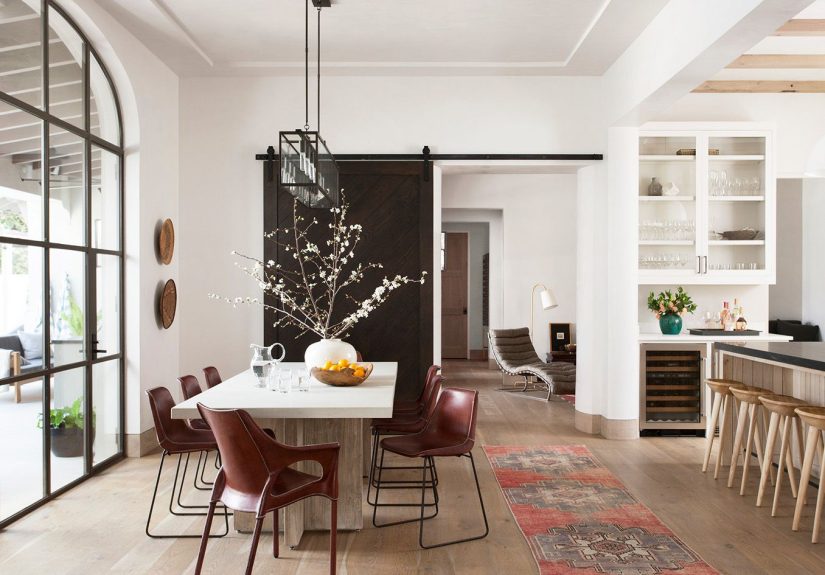
Keep the look cohesive by repeating finishes: black steel hardware pairs with matte black lighting and pulls; warm wood tones pair with open shelving and beams. Popular door styles include classic X-brace, chevron, and simple vertical planks. A recessed pull on the back side helps the door close without finger-pinches near the jamb.
Cost, time, and DIY vs. pro
Barn door projects range from budget-friendly to “statement piece” pricing, depending on door material, size, and hardware quality. Cost guides commonly place installed interior barn doors anywhere from a few hundred dollars to a few thousand, with labor rising when you need blocking, electrical changes, or custom trim work. A straightforward DIY install is often a weekend project; double doors, bypass systems, and masonry mounting can be better with a pro.
Safety and maintenance
Use a helper when lifting the door, wear eye protection when drilling, and follow your kit’s instructions. After installation, periodically check that lag bolts and hanger fasteners are snug, and keep the track and guide free of dust so the door stays smooth and stable.
Conclusion
A barn door can be more than a trend. When it’s measured well, anchored into real structure, and guided properly at the bottom, it becomes a practical, space-saving door that adds farmhouse character without the daily annoyances. Take your time on the level line, don’t skip structural backing, and you’ll get that satisfying, one-finger glide that makes you open the door just to prove you can.
Experiences: what people wish they’d known before installing
DIY guides make barn doors look effortless, but real homes add real variables. Here are the most common “wish I knew” moments homeowners shareand how to use them to your advantage.
- Studs rarely line up with track holes. Many people end up thankful they used a header/backer board, because it turns “hole mismatch panic” into “mount it wherever you need.”
- Trim changes everything. Baseboards and thick casing increase the wall gap and reduce privacy. Installers who planned extra overlap or adjusted trim in the travel path were happiest with the finished feel.
- The open position needs planning. A door that parks over a light switch, outlet, or thermostat gets annoying fast. Taping out the door footprint first helps you choose the best slide directionor a double-door setup.
- Floor guides are underrated. A sturdy guide makes the whole system feel “built-in.” Families with kids and pets often upgrade the guide to reduce wobble.
- Bedrooms and nurseries want soft-close. Soft-close kits turn “slam city” into “polite library door,” and many people say it was their favorite add-on.
- Bathrooms are a judgment call. Some love the look; others dislike the gaps. Wider doors plus a latch help, but if you want true privacy and sound control, a traditional door still wins.
Mini story #1: The laundry nook that needed a door… but not a door swing. A common “starter barn door” is a laundry alcove off a hallway. The installer measures the opening, buys a door that matches the opening exactly, and then wonders why the washer sounds like it’s practicing drumline in the living room. The fix usually isn’t complicated: go wider for more overlap, add a simple latch, and consider a soft-close kit so the door doesn’t slam when someone’s carrying a basket with zero free hands. The lesson: if the door is meant to hide noise or clutter, treat overlap like a feature, not an afterthought.
Mini story #2: The home office door that kept drifting open. Older houses can have floors that slope slightly and walls that aren’t perfectly straight. Even with a level track, some owners notice the door slowly rolls toward the “downhill” side. People who solved it fastest did three things: (1) checked level across the entire track length (not just one spot), (2) adjusted the stoppers so the door naturally settles at the end positions, and (3) added soft-close hardware that gently pulls the door into place. The lesson: testing the roll before you call the job “done” saves you from living with a door that acts like it has opinions.
Mini story #3: The closet door that rubbed every time it passed the baseboard. Closets often have baseboards, shoe molding, or thick casing that push the slab away from the wall. Some homeowners try to “fix” the rubbing by shaving the door edge (please don’t), when the real issue is offset. Switching to standoffs included in the kit, using a header board, or trimming the baseboard only in the travel zone usually solves it. Some people even replace the baseboard behind the travel path with a thinner profile so the rest of the room stays consistent. The lesson: when a barn door doesn’t feel smooth, the wall trim is often the culpritnot the rollers.
Handle placement is more important than you think. A lot of first installs get the door hung beautifully… then the handle ends up too high for kids, too low for adults, or perfectly located to smash into the adjacent wall when the door is open. Installers who were happiest mocked the handle position with painter’s tape, tested a “grab and slide” motion, and chose a low-profile or recessed pull on the back side. The lesson: ergonomics is part of farmhouse style, too.
The “I can’t believe I almost skipped the floor guide” moment. Barn doors feel best when the bottom edge stays steady. People who skipped the guide (or used a flimsy one) often noticed wobble, rattling, and a door that felt cheap even if the hardware wasn’t. Upgrading to a sturdier guide, aligning it carefully to the door thickness, or using a grooved-door guide turned the whole system into a smoother, more confident slide. The lesson: the guide is what makes the door feel installed, not just hung.
When installers treat the project as a small piece of carpentry (not just décor), the result is usually a door that’s both beautiful and genuinely convenientaka the best kind of farmhouse style.