Table of Contents >> Show >> Hide
- What “Stealth Tanks” Actually Means
- Popular Mechanics and the Dream of Tomorrow’s Armor
- The U.S. Army’s Long Search for a Light Tank
- Why the Modern Battlefield Changed the Conversation
- So Were the Stealth Tank People Right?
- The M10 Booker and the Problem of Timing
- What the Next “Stealth Tank” Will Probably Look Like
- Why Tanks Still Matter
- Conclusion
- Field Notes: A 500-Word Reflection on the Experience of “Meeting” the Stealth Tanks
Some headlines sound like they were cooked up in a military lab after too much coffee and not enough sleep. “PM Meets the Stealth Tanks” is one of them. But in this case, “PM” is not a prime minister waving at armored behemoths on a parade ground. It is Popular Mechanics, which has long had a soft spot for futuristic machines that look ready to roll straight out of tomorrow.
And yes, “stealth tanks” are a real idea, even if the phrase sounds like a contradiction. Tanks are large, loud, hot, and about as subtle as a marching band in a library. But modern armies have spent decades trying to make armored vehicles harder to spot, track, target, and destroy. That means reducing thermal signature, acoustic noise, radar profile, and electronic emissions. In plain English, the new goal is not to make tanks invisible. It is to make them annoying to find and even more annoying to kill.
This article looks at what the old “stealth tank” idea meant, how it evolved into modern concepts for light armored firepower, why the battlefield changed faster than some procurement programs could keep up, and what the future may hold for tanks that want to survive in an age of drones, precision missiles, and sensors that never seem to blink.
What “Stealth Tanks” Actually Means
Let’s clear up the biggest misconception first. A stealth tank is not a magic metal rhino that disappears from view like a sci-fi spaceship. Ground vehicle stealth is much more practical than that. Designers focus on lowering the signals a vehicle gives off across multiple detection methods.
Thermal Signature
Tanks generate heat like they are being paid by the degree. Engines run hot. Exhaust systems glow. Gun barrels heat up after firing. Modern battlefield sensors love all of this. So one major branch of “stealth” work involves cooling, masking, or dispersing heat so that thermal cameras and infrared seekers have a harder time locking on.
Acoustic Signature
Tracked vehicles are not known for tiptoeing. A tank often announces itself before anyone sees it. Quieter engines, improved drive systems, better track design, and hybrid or electric support systems can all help reduce the rumble and clatter.
Radar and Visual Signature
Camouflage has grown up. It no longer means just painting a vehicle green and hoping for the best. Modern multispectral camouflage aims to confuse visual, infrared, and radar detection at the same time. Shape management also matters. The less a vehicle stands out against terrain, the better its odds.
Electronic Signature
Today’s battlefield is crowded with radios, datalinks, drones, and sensors. Every transmission can become a breadcrumb trail. A survivable armored platform has to think not only about armor plate, but also about emissions control. In other words, your tank can be very brave and still get itself located by talking too much.
Popular Mechanics and the Dream of Tomorrow’s Armor
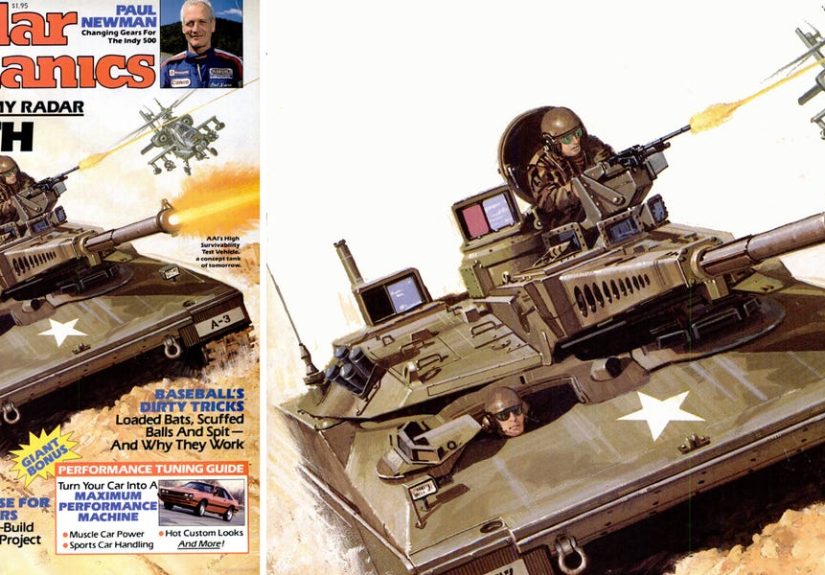
The phrase behind this title traces back to Popular Mechanics coverage that treated the future of armored warfare as a contest between firepower and detectability. That was a smart instinct. Even decades ago, military planners understood that tanks would have to evolve beyond thick armor and big guns alone. A vehicle that can strike first, hide better, move faster, and avoid detection has a major edge before the first shot is even fired.
Back then, the vision centered heavily on light tanks. These vehicles promised a different balance: less weight than heavy main battle tanks, enough direct firepower to support infantry, and better strategic mobility for fast deployments. The idea was seductive. Why wait for a massive armored formation when you could fly in something smaller, meaner, and more agile?
That dream never fully died. It simply kept getting redesigned, renamed, and handed from one Army modernization era to the next like a very expensive relay baton.
The U.S. Army’s Long Search for a Light Tank
The United States has spent years trying to fill a gap in infantry support. Heavy tanks such as the M1 Abrams bring enormous combat power, but they are not always ideal for every deployment, terrain type, or logistics chain. Light infantry formations especially have wanted mobile, protected direct fire support that can move with them and break up bunkers, fortified positions, and light armored threats.
That need helped drive the Mobile Protected Firepower program, later renamed the M10 Booker. The concept sounded straightforward enough: give Infantry Brigade Combat Teams a tracked armored vehicle with a 105mm gun, solid protection, and enough mobility to operate where a heavier system would be harder to deploy.
For a while, it looked like the long wait was finally over. The Army selected General Dynamics Land Systems to build the vehicle, and by 2024 the service had taken delivery of the first M10 Booker. The vehicle was positioned as a way to add protected direct fire capability to infantry formations without pretending to be a full-on Abrams replacement.
And yet, like many military programs, the Booker ran into the one enemy that never sleeps: reality.
Why the Modern Battlefield Changed the Conversation
If you want to understand why “stealth tanks” matter now, look at how armored warfare has changed. The tank is no longer just threatened by enemy tanks, anti-tank guns, and attack helicopters. It now lives under a swarm of persistent eyes.
Drones Changed the Math
Small drones, loitering munitions, and cheap surveillance systems have made concealment harder and punishment quicker. Armored vehicles that once worried mostly about frontal engagements now have to think about being watched from above by something that costs less than their road wheels.
Precision Weapons Punish Exposure
Anti-tank guided missiles, top-attack munitions, and networked fires mean that detection can lead to destruction very fast. The sequence has been compressed: spot, identify, share coordinates, strike. A vehicle that emits too much heat, noise, or radio traffic is helping the enemy move through that kill chain.
Survivability Is No Longer Just Armor Thickness
Modern survivability is layered. It includes camouflage, active protection systems, mobility, counter-drone defenses, low signatures, decoys, dispersion, and digital discipline. Thick armor still matters, but armor alone is no longer enough. A tank that can avoid being targeted in the first place may be more survivable than one that simply tries to absorb every hit like a metal linebacker.
So Were the Stealth Tank People Right?
In broad terms, yes. The old idea that armored vehicles would need to become harder to detect was not a gimmick. It was a preview. The funny part is that the battlefield became even more unforgiving than many early futurists imagined.
What they got right was the core principle: the future tank would need to manage its signature. What has changed is the scope of the problem. It is not enough to reduce radar return or cool the exhaust. Armored vehicles now have to survive under visual observation, thermal imaging, drone feeds, acoustic detection, radar, electronic intercepts, and precision strike networks. That is a lot of bad news for one machine to absorb before breakfast.
In that sense, “stealth” for armored warfare has matured into a bigger concept: not invisibility, but signature management. The tank of the future will need to be harder to see, harder to hear, harder to classify, harder to track, and harder to hit.
The M10 Booker and the Problem of Timing
The M10 Booker was supposed to answer a long-standing operational need. In many ways, it did. It offered infantry formations a protected mobile gun platform that could engage strongpoints, walls, and lighter armored threats. The Army clearly believed it addressed a real capability gap.
But procurement does not happen in a vacuum. By June 2025, the Army announced it would cease procurement of M10 Booker combat vehicles rather than move into full-rate production. That decision became a symbol of a wider tension in military modernization: what happens when a program solves yesterday’s gap, but tomorrow’s battlefield has already changed the test?
Critics argued that the Army needed to prioritize systems better suited to a sensor-saturated, drone-heavy environment. Supporters countered that infantry still needs protected direct fire and that not every fight can be won by screens, software, and inspirational PowerPoint slides. Both sides had a point.
The Booker debate revealed something larger than the fate of one vehicle. It showed how hard it is to build armored systems for a future that keeps arriving ahead of schedule.
What the Next “Stealth Tank” Will Probably Look Like
The next truly survivable armored vehicle probably will not be sold under a dramatic comic-book label. It may not even be called a tank in the traditional sense. But it will likely combine several traits that defense analysts and Army planners keep circling back to.
Smarter Signature Control
Expect more multispectral camouflage, better heat suppression, quieter power systems, and more attention to managing emissions. Designers know that being found is often the first step toward being destroyed.
Active Protection as Standard Equipment
Hard-kill and soft-kill protection systems are becoming central to armored survival. These systems do not replace armor, but they add a crucial outer layer of defense against incoming missiles and rockets.
Human-Machine Teaming
Future armored formations may operate with robotic scouts, sensor drones, and decoys that move ahead of crewed vehicles. That would let armored units see more without exposing themselves as quickly.
Faster Adaptation Cycles
The battlefield changes too quickly for 20-year technology assumptions. Future vehicles will need open architecture, modular upgrades, and a design philosophy that welcomes constant revision rather than dreading it.
Why Tanks Still Matter
Every few years, someone declares the tank obsolete. Then the world rudely refuses to cooperate. Armor still matters because protected firepower still matters. Infantry still needs vehicles that can move under threat, smash through defenses, and hold ground with force that is both mobile and immediate.
What has changed is not the value of armored force, but the conditions under which it survives. Tanks are not going away. They are being pushed into a harsher exam. The winners will be the vehicles that combine lethality with deception, mobility with survivability, and armor with disciplined signature control.
Conclusion
“PM Meets the Stealth Tanks” sounds playful, but it points to a serious truth. The old dream of stealthy armor was never really about making tanks disappear. It was about helping them stay relevant in a world that keeps inventing new ways to detect and destroy them.
From the light-tank ambitions celebrated by Popular Mechanics to the rise and stumble of the M10 Booker, the same strategic question keeps resurfacing: how do you give troops direct, protected firepower without serving them up as an easy target on a sensor-rich battlefield? The answer will not be one miracle platform. It will be a blend of lower signatures, smarter protection, better mobility, integrated drones, and much faster adaptation.
So yes, the stealth tanks were real, just not in the Hollywood sense. They were an idea ahead of their time, and now their logic is everywhere. The future of armor belongs not to the tank that is merely toughest, but to the one that is toughest to find, hardest to fix, and quickest to evolve. That may not sound as flashy as an invisible battle machine, but on the modern battlefield, boring survival tricks are often the real superpower.
Field Notes: A 500-Word Reflection on the Experience of “Meeting” the Stealth Tanks
Writing about stealth tanks feels a little like trying to describe a magician while he is still building the trick. Nothing about armored warfare is static anymore. The moment you think you understand the future of tanks, a drone buzzes overhead, a new missile appears, a procurement office changes direction, and suddenly the conversation is not about armor thickness at all. It is about heat, noise, data, signatures, and whether a tracked vehicle can survive the attention span of modern sensors.
There is also something oddly human about this topic. Armies keep returning to the same hope: can we protect soldiers better without slowing them down, weighing them down, or pricing them into oblivion? That is the emotional center of the stealth tank story. The machines are fascinating, sure, but the real point is what they are meant to do for the people inside them. A tank is not just a weapon. It is a promise that troops will not be sent forward with nothing but grit and harsh language.
The experience of exploring this subject is also a lesson in military humility. For decades, defense thinkers imagined better camouflage, lower signatures, advanced protection, and lighter armored firepower. Many of those ideas were smart. Some were very smart. But the battlefield got clever too. Cheap drones did not politely wait for expensive programs to finish testing. Precision strike systems did not pause so doctrine writers could catch up. The result is a strange, slightly brutal kind of progress where good ideas can still arrive at the wrong moment.
That tension gives the stealth tank concept its drama. It is not a story about a single vehicle winning the future. It is a story about adaptation. Every generation of armored warfare tries to solve the last war’s problem while anticipating the next one. Sometimes it works beautifully. Sometimes it creates a vehicle that looks impressive in a briefing and less convincing in a battlefield full of flying cameras and smart munitions.
And yet the topic never loses its grip. Tanks remain one of those military technologies that capture the imagination because they combine brute force with engineering ambition. Add the word “stealth,” and suddenly the old image of armor becomes more mysterious. The machine is still heavy, still dangerous, still unmistakably a tank, but it is now trying to be clever too. That combination is irresistible.
In the end, the experience of “meeting” the stealth tanks is really the experience of meeting a military idea in transition. It is seeing how defense planners, engineers, journalists, and soldiers all wrestle with the same question: what should armored power look like when the battlefield sees almost everything? The answer is still being written. But one thing is clear already. The future tank will not survive by being a bigger hammer alone. It will survive by becoming a harder problem to solve.