Table of Contents >> Show >> Hide
- A Shared Address with Two Creative Agendas
- Meet the Two Halves of the Story
- Why Frederiksberg Makes So Much Sense
- Material Contrast: Paper, Steel, Wood, and Light
- Why the Kitchen Belongs in an Art Studio
- A Small Room with Big Ideas About Contemporary Design
- What Designers and Creatives Can Learn from It
- The Experience of Shared Space in Frederiksberg Copenhagen
- Final Thoughts
Some interiors whisper. This one has better manners than that, but it still manages to say a lot without shouting. In Frederiksberg, one of Copenhagen’s most design-conscious neighborhoods, artist Silke Bonde and Établi have created a shared space that feels equal parts atelier, showroom, salon, and quiet manifesto. It is not huge. It is not flashy. It is not trying to win a shouting match with the internet. And that is exactly why it works.
The space brings together two creative languages that, on paper, should feel wildly different: Bonde’s delicate paper artworks and Établi’s sculptural stainless-steel kitchen systems by Alpes Inox. Yet in practice, the pairing feels almost suspiciously right. Paper and steel. Watercolor softness and industrial precision. A room for making art and a room for imagining meals, conversations, and future gatherings. Put it all together and you get something more interesting than a store, more welcoming than a gallery, and more useful than a room that exists only to be photographed and admired from a safe emotional distance.
That is the real charm of this shared space in Frederiksberg, Copenhagen. It proves that great design does not always come from choosing one identity and clinging to it for dear life. Sometimes the best spaces are the ones brave enough to be two things at once.
A Shared Address with Two Creative Agendas
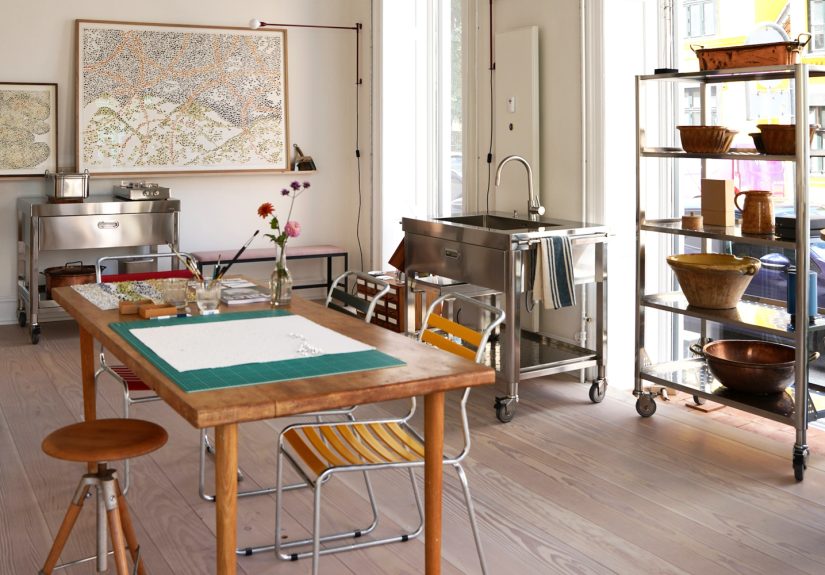
Located on Forhåbningsholms Allé in Frederiksberg, the studio-showroom is compact by grand design standards, but that is part of its intelligence. At around 72 square meters, it has enough room to function as Bonde’s working atelier while also serving as Établi’s Scandinavian base for Alpes Inox. In other words, it is a workplace, a display environment, a meeting point, and a space for future events. Not bad for a footprint that most oversized suburban kitchens would probably consider a warm-up act.
What makes the layout compelling is that it does not force a hard boundary between art and domestic design. Bonde’s studio table can shift position. Works can be displayed, stored, or set in progress. Around the perimeter, modular kitchen elements create structure without making the space feel fixed. The room reads less like a showroom frozen in time and more like a creative environment that expects real life to happen inside it.
That distinction matters. Too many “concept spaces” are basically beautiful furniture wearing uncomfortable shoes. This one appears designed for movement, work, conversation, and reconfiguration. It is polished, yes, but not precious. It understands that function is not the enemy of beauty. In Scandinavian design, function is usually beauty’s very organized roommate.
Meet the Two Halves of the Story
Silke Bonde: Paper, Watercolor, and Organic Quiet
Silke Bonde’s work centers on cotton paper transformed through simple techniques and aquarelle, revealing layered, organic worlds within a flat surface. Her practice is tactile, restrained, and deeply attentive to fragility. That artistic language matters when reading the shared space, because it sets the emotional temperature. Bonde’s work brings softness, patience, and a handmade intimacy that keeps the interior from tipping into cool design minimalism for its own sake.
Her aesthetic is not loud minimalism, the kind that looks great until you actually try to live with it. It is a gentler version: spare, calm, and observant. In a room with reflective steel, these qualities are crucial. Bonde’s art acts like a humanizing counterweight, reminding visitors that refinement does not have to feel sterile. It can feel sensitive. It can feel close.
Établi: A Curated Showroom, Not a Generic Design Store
Établi describes itself as a showroom representing a small, special selection of kitchens, furniture, and art. That phrase “small, special selection” does a lot of heavy lifting here. It tells you this is not a warehouse of options designed to overwhelm you into making a purchase out of sheer fatigue. It is a curated point of view.
That point of view centers on Alpes Inox, the Italian brand known for freestanding stainless-steel kitchen systems. Établi’s role as the exclusive distributor for Alpes Inox in Denmark gives the Frederiksberg space a strong design backbone. But because the showroom is shared with an artist’s atelier, those kitchen systems are not presented in a sterile retail vacuum. They are shown in dialogue with creative work, natural light, and actual atmosphere. Suddenly the kitchen is not just a product category. It becomes part of a lifestyle argument.
Why Frederiksberg Makes So Much Sense
Frederiksberg is a particularly fitting home for this project. The neighborhood is widely associated with curated shopping, independent boutiques, local character, and a more cultivated pace than the louder, trend-chasing corners of urban life. It has commerce, but it also has composure. That makes it ideal for a space that depends on nuance rather than spectacle.
This matters because location is never just background. A shared studio-showroom like this needs a neighborhood that supports discovery. Frederiksberg offers exactly that: the kind of area where people still enjoy wandering into places that feel personal, handcrafted, and slightly hidden. It is less “mega flagship” and more “you have taste, come this way.”
There is also a broader Copenhagen logic at work. The city’s design culture has long valued simplicity, usability, natural light, and material honesty. Those values are all over this project. So while the space is highly specific to Bonde and Établi, it also feels deeply rooted in a larger Scandinavian approach. It is local in address and cultural in spirit.
Material Contrast: Paper, Steel, Wood, and Light
If the shared concept is the intellectual hook, the material palette is what makes the space memorable. The existing glass ceiling and generous windows bring in northern light, which is practically a building material in Copenhagen. In Scandinavian interiors, daylight is never just illumination; it is mood, clarity, architecture, and sometimes emotional support.
Here, that light plays against Douglas fir flooring, white linseed paint, restrained lighting choices, and highly reflective stainless steel. The result is a carefully judged contrast between warmth and precision. The wood grounds the room. The white surfaces keep it open. The steel sharpens it. Bonde’s paper works soften it again. Nothing feels accidental, but nothing feels overly stage-managed either.
This is where the project becomes more than a nice-looking collaboration. It becomes a study in tension done well. Stainless steel can easily feel clinical in the wrong setting. Paper art can feel too delicate if surrounded by excessive softness. Put them together in a well-lit room with natural materials and suddenly both become more interesting. The steel looks luminous rather than cold. The paper looks intentional rather than fragile. Each medium improves the other by refusing to compete on the same terms.
Even the lighting choices reinforce the balance. Minimal fixtures keep attention on the surfaces and objects. Nothing screams for applause. The room trusts texture, reflection, and daylight to do the dramatic work. Honestly, that level of confidence is attractive.
Why the Kitchen Belongs in an Art Studio
At first glance, the phrase “artist atelier meets kitchen showroom” may sound like one of those design-world ideas invented purely to justify a cocktail party. But the combination actually makes practical and philosophical sense.
Alpes Inox has built its reputation on freestanding kitchen systems that prioritize flexibility, durability, and multifunctionality. Its elements are designed to handle washing, prep, cooking, and storage in self-sufficient modules. Some can be moved or rearranged, and the brand’s long history in stainless steel reinforces the idea of the kitchen as a hardworking tool rather than a decorative backdrop.
That mindset pairs naturally with an artist’s studio. Both environments revolve around process. Both need surfaces that can be used, cleaned, adapted, and trusted. Both require a choreography of tools, storage, movement, and display. And both are, at their best, spaces where solitary making and social gathering can coexist. An atelier is where ideas are formed. A kitchen is where people orbit. Put them together and you create a room that can support both reflection and exchange.
There is also something refreshing about presenting a kitchen not as a luxury symbol, but as part of a creative ecology. In this Frederiksberg space, the kitchen systems do not merely say, “Look how expensive I am.” They suggest utility, mobility, and possibility. They look ready for food, yes, but also for flowers, sketchbooks, coffee, conversations, openings, and the kind of dinner that begins with “just stop by for a minute” and ends three hours later.
A Small Room with Big Ideas About Contemporary Design
One reason this project resonates is that it fits a larger shift in design culture. Hybrid spaces are on the rise: places that blur the boundaries between gallery and store, studio and workplace, home and public gathering place. These smaller, mixed-use creative spaces feel especially relevant now because they reject rigid categories in favor of intimacy, flexibility, and community.
Bonde and Établi’s shared space is a strong example of that evolution. It is not trying to behave like a traditional gallery, where the art floats in rarefied silence. It is not pretending to be a conventional retail showroom either. Instead, it operates in the fertile middle ground where objects are encountered as part of a lived environment. You do not just look at a table. You imagine working there. You do not just admire a kitchen module. You see how it might host making, hosting, and daily rituals.
That shift is important for brands and artists alike. For brands, it creates more emotionally intelligent storytelling. For artists, it offers a more relational way of showing work. For visitors, it feels better. Less transactional. Less intimidating. More like entering a world than browsing a catalog.
What Designers and Creatives Can Learn from It
The first lesson is that restraint still wins. The space does not rely on loud color, oversized gestures, or novelty for novelty’s sake. It trusts material honesty, careful editing, and natural light. In a digital culture that often confuses “more” with “better,” that feels downright radical.
The second lesson is that contrast can be more powerful than uniformity. The success of this interior comes from pairing opposites: soft and hard, handmade and industrial, art and utility, display and work. Good design is not always about matching. Sometimes it is about creating enough tension for a room to feel alive.
The third lesson is that flexible spaces have emotional value. A room that can change with the day feels more generous than one locked into a single script. That adaptability is not only practical; it is also psychologically welcoming. It tells people they can use the space rather than merely admire it from six respectful feet away.
The Experience of Shared Space in Frederiksberg Copenhagen
What makes this project especially compelling is the experience it seems designed to create. Imagine arriving from the street in Frederiksberg, where the neighborhood already has a reputation for curated local shopping and a quieter kind of sophistication. You step inside and the mood shifts immediately. The room is bright, but not aggressively so. The light is soft, filtered, and distinctly northern, which means surfaces do not simply shine; they glow. The stainless steel reflects without turning the space into a mirror maze. The white walls open everything up. The Douglas fir underfoot adds warmth and a sense of ease. Nothing says, “Please don’t touch anything.” The room says, “Stay a while.”
Then your eye begins to move. First to Bonde’s paper works, which ask for a slower kind of looking. These are not pieces that hit you over the head with drama. They pull you closer. Their textures, cut surfaces, and watercolor layers reward attention, and that slows down the whole pace of the visit. In a world addicted to scrolling, that alone feels luxurious. You stop rushing. You notice edges. You notice shadow. You notice how a handmade piece can make a room feel more human even when it is standing next to immaculate steel.
From there, the kitchen elements come into focus. But they do not read like a standard sales display. They feel integrated into the room’s daily logic. You can imagine someone preparing coffee there in the morning, rearranging materials before an event in the afternoon, then gathering a small group around the same surfaces by evening. That is the beauty of freestanding systems in a creative setting: they look less like permanent infrastructure and more like collaborators.
There is also an emotional experience built into the contrast between Bonde’s art and Établi’s design language. The paper introduces fragility, patience, and touch. The steel introduces precision, confidence, and resilience. Together they create a balanced atmosphere that feels both inspiring and grounded. It is the sort of room that invites ideas without becoming chaotic. A rare achievement, because creative spaces can easily drift into one of two extremes: either too cold to think in or too messy to breathe in. This space seems to avoid both traps.
If gatherings and events become a bigger part of the place, that may be where the concept becomes even richer. One can imagine dinners, conversations, small exhibitions, or food-centered creative evenings unfolding naturally here. Not because the room is trying to be all things to all people, but because it already understands the relationship between making and meeting. Art and cooking share a surprising amount of DNA: rhythm, composition, material awareness, experimentation, and the hope that someone else will feel something when you are done.
In that sense, the most lasting experience of this shared space may not be visual at all. It may be the feeling that design, art, and everyday rituals do not need separate rooms, separate industries, or separate personalities. They can coexist. They can improve one another. And in a carefully edited interior in Frederiksberg, they can even make stainless steel feel warm and paper feel architectural. That is not just good styling. That is a genuinely persuasive idea about how creative life can look now.
Final Thoughts
Shared Space: Silke Bonde & Établi in Frederiksberg Copenhagen is compelling because it is specific. It does not chase generic Scandinavian style clichés, even though it clearly benefits from the best Scandinavian principles: light, functionality, natural materials, clarity, and calm. Instead, it builds a distinct identity through collaboration, contrast, and intelligent restraint.
It is a paper artist’s atelier. It is a showroom for Italian stainless-steel kitchens. It is a future event space. It is a neighborhood destination. It is a lesson in how small interiors can carry large ideas. Most of all, it is proof that when creative disciplines share a room without trying to overpower one another, the result can feel unusually complete.
And that may be the nicest surprise of all. In a design era obsessed with categories, this Frederiksberg space quietly makes the case for overlap.