Table of Contents >> Show >> Hide
- What the Six Feet Under: Barricade kit actually is
- Big claim, big question: How does it work?
- “Minimum risk” explained: what it means (and what it doesn’t)
- Where Barricade fits in a real-world pest-control plan
- Performance expectations: what to expect (and what not to expect)
- Indoor use, scent, and surfaces: the “don’t learn this the hard way” section
- Safety: “minimum risk” still means “use your head”
- Cost and value: who this kit makes sense for
- Pros and cons at a glance
- Quick FAQ
- Conclusion: a smarter perimeter mindset (with fewer chemical vibes)
- Experiences that feel true to life (and why routines beat panic)
If you’ve ever watched a single ant turn into a full-on conga line across your countertop, you already know the truth:
bugs don’t “visit.” They move in, rearrange the furniture, and then act shocked when you complain.
The good news is that modern DIY pest control has gotten more sophisticated than a rolled-up magazine and a prayer.
One of the newer contenders in the “keep crawlers outside where they belong” category is the
Six Feet Under: Barricade Household Insect Kit.
This article breaks down what the kit is, what it claims to do, what “minimum risk” really means in U.S. pest-control terms,
how it fits into a smart home pest plan, and the practical pros/cons to consider before you commit to a perimeter “bug boundary.”
(And yes, we’ll keep it funbecause if we can’t laugh at the idea of a roach doing laps around your pantry, what can we laugh at?)
What the Six Feet Under: Barricade kit actually is
The Six Feet Under: Barricade Household Insect Kit is marketed as a plant-forward, DIY perimeter defense designed to help
kill and deter common crawling household insects before they cross the threshold into your living space.
Rather than being a simple trigger spray, it’s positioned as a “kit” that includes tools meant to make a more structured,
exterior-focused application easier for homeowners who don’t want to book (and bankroll) a recurring exterminator visit.
What’s included
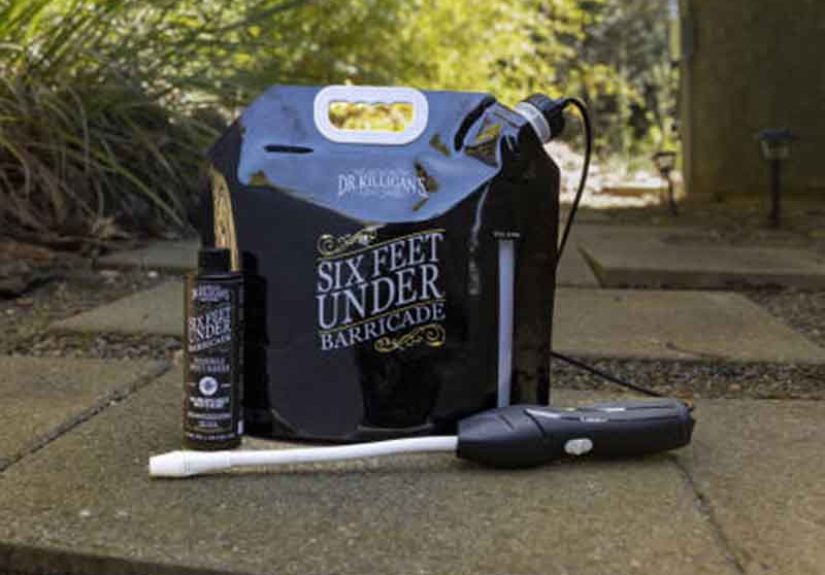
The product listing describes the kit components as a rechargeable sprayer, an application bag,
and a bottle of concentrate. That’s a clue that this is intended to cover more ground than a small bottle you stash under the sink.
The kit is also sold in different “home size” options, commonly framed around coverage such as
up to 2,500 sq ft (with larger options available).
What it’s designed to target
Barricade is positioned for the greatest hits of household invadersthink ants, cockroaches,
beetles, and other crawling pests people typically notice around foundations, door thresholds, patios,
garages, and entry points. The kit is also described as effective against a broad list (“50+ bug types” is a common marketing line),
which is less about one supervillain insect and more about reducing the general “tiny intruder traffic.”
Big claim, big question: How does it work?
Pest control products usually land in one of two buckets:
chemical poisons that target insect nervous systems or physical/mechanical approaches that disrupt pests in other ways.
Six Feet Under: Barricade leans hard into the second bucket, describing a “mechanical-kill” mode of action
that affects insects on contact and helps avoid the classic “the bugs adapted, now they laugh at your spray” scenario.
Mechanical action and “resistance” (in plain English)
In the pest world, resistance can develop when the same type of pesticide is used repeatedly and
the survivors pass on traits that help them tolerate it. That’s why university IPM programs and regulators often talk about
rotating modes of action and using the least-risk approach that still works.
A mechanical/physical approach is marketed as harder for pests to “out-evolve” because it’s not relying on one specific nerve target.
(In other words: it’s less “outsmart the chemical” and more “good luck arguing with physics.”)
What’s in it: plant-based messaging vs. disclosed ingredient lists
Here’s where it gets important to read carefully. Coverage about Barricadesuch as launch announcements and product features written
for consumer audiencesfrequently highlights ingredients and concepts like soybean oil and “botanical” technology.
Meanwhile, the product’s own “ingredients” section may list a set of components that includes
water, mineral silicates, preservatives, and wintergreen oil.
The practical takeaway: regardless of the exact ingredient set in the version you’re looking at, Barricade is positioned as a
non-traditional, plant-forward approach that emphasizes a physical/mechanical interaction with pests rather than
classic synthetic neurotoxic pesticide chemistry. If you’re comparing products, always treat the specific label/ingredient disclosure
on the exact kit you’re buying as the source of truth.
“Minimum risk” explained: what it means (and what it doesn’t)
The phrase “minimum risk” gets used casually online, but in the U.S. it has a very specific regulatory context.
The U.S. Environmental Protection Agency (EPA) describes minimum risk pesticides as products that can qualify for an exemption from
federal registration requirements under FIFRA if they meet the conditions of the minimum-risk exemption.
The “minimum risk” basics
- Ingredient limits: Only certain active and inert ingredients are eligible under the exemption.
- Label transparency: Products must identify ingredients and cannot make misleading claims.
- Still requires care: “Minimum risk” does not mean “risk-free.” Even plant oils can irritate eyes or trigger sensitivities.
- States may still regulate: Even when exempt federally, some states require registration or other steps for sale/distribution.
In other words, “minimum risk” is best read as “limited to a set of lower-concern ingredients under federal rules,” not “spray it like perfume.”
A smart homeowner still treats it like a pest-control product: use carefully, store safely, and follow the label.
Where Barricade fits in a real-world pest-control plan
The most effective home pest approach is usually not “one product, one time, forever.”
It’s layeringa strategy known as Integrated Pest Management (IPM), which prioritizes prevention and low-risk methods first.
Think of it like home security: you don’t rely on one lock; you use locks, lights, cameras, and common sense.
Layer 1: Make your home boring to bugs
Bugs want three things: food, water, and easy entry. Remove those, and you’re already winning.
Common IPM steps include:
- Sanitation: wipe up crumbs, rinse recycling, keep trash sealed, and don’t let pet bowls become an all-day buffet.
- Moisture fixes: address leaks, damp cardboard, wet mulch pressed against the house, and other “bug spas.”
- Exclusion: seal cracks, add door sweeps, repair screens, and close up tiny gaps that turn into insect highways.
Layer 2: Target the “why here?” factor
Ants often follow scent trails to food sources; roaches love hidden moisture and clutter; beetles can be attracted by outdoor lighting and entry gaps.
When you find the pattern, you can reduce it. That’s the unglamorous part of pest control that works suspiciously well:
less “battle” and more “remove their reason to exist.”
Layer 3: Use a barrier product as a perimeter backstop
This is the lane where Six Feet Under: Barricade Household Insect Kit is positioned:
as an exterior-focused “line in the sand” (or, more accurately, a line on your home’s boundary).
The brand frames it as both kill-on-contact and residual deterrence, with a durability claim that can extend for
up to about 90 days depending on conditions.
If you like the idea of a perimeter strategy but want to stay in a lower-toxicity ingredient universe, Barricade is meant to feel like a
modern compromise: robust coverage without the traditional “industrial chemical” vibe.
Performance expectations: what to expect (and what not to expect)
Let’s set expectations the honest way:
no household product can rewrite the laws of nature.
If your neighbor’s yard is basically an all-you-can-eat insect resort, you’ll still see some visitors.
But barrier-style products can reduce the frequency and intensity of “crawlers inside” when combined with prevention.
What tends to go well
- Seasonal surges: spring and summer “bug pressure” can be easier to manage when you have a consistent perimeter approach.
- Common crawlers: ants and similar pests often respond well when entry points and trails are disrupted.
- DIY confidence: homeowners who want a repeatable routine like “every few months, refresh the perimeter plan” often like kit formats.
What can limit results
- Heavy rain and harsh exposure: any exterior-applied product can lose persistence faster with weather and runoff.
- Indoor infestations: if pests are already established indoors, an outdoor barrier alone may not fully solve the issue.
- Structural issues: major gaps, moisture problems, or clutter near foundations can overwhelm even a strong perimeter strategy.
Indoor use, scent, and surfaces: the “don’t learn this the hard way” section
One detail that’s easy to miss when shopping online: the Barricade kit is not positioned primarily as an indoor sprayer.
The product FAQ notes reasons it may be not recommended for indoor use, including a higher-output sprayer,
a stronger initial scent (often described as intense at first), and the potential to stain interior surfaces.
If you’re shopping specifically for indoor spot treatment, the brand points people toward their separate indoor spray option instead.
Translation: this kit is meant to be a perimeter specialist, not an all-purpose “spray everything everywhere” solution.
And honestly, that’s a good thingprecision usually beats panic-spraying.
Safety: “minimum risk” still means “use your head”
Even with lower-concern ingredients, safe use and storage matterespecially around children and pets.
The EPA’s consumer guidance repeatedly emphasizes reading labels, keeping products in original containers,
and keeping kids/pets away from treated areas as the label directs.
Minimum-risk products can still cause irritation (eyes are a common vulnerability), and sensitivities can vary by person.
Practical safety mindset (without overcomplicating it)
- Read the label like it’s a recipe you can’t improvise. That’s where the “how,” “where,” and “what to avoid” lives.
- Keep it out of reach. Store pest-control products where kids and pets can’t access themalways.
- Don’t decant into other bottles. Putting any pest product into a food/beverage container is a classic bad idea with real consequences.
- Ventilation and exposure awareness matter. Oils and fragrances can be irritating; treat them with respect.
If someone in the household has asthma, allergies, or chemical sensitivities, it’s worth being extra cautious and considering non-spray IPM steps first.
And if you ever suspect an exposure issue, contact Poison Control (in the U.S.) and follow the product label guidance.
Cost and value: who this kit makes sense for
The kit is commonly listed around $49.97 for a standard home size tier, and it’s marketed as a way to avoid recurring
professional service costs. That doesn’t mean it replaces every exterminator scenariosevere infestations, termites,
and certain high-risk pest situations are still in “call a pro” territory.
But if your goal is to cut down on routine crawling insects and you like a scheduled, DIY routine,
Barricade’s value proposition is straightforward:
perimeter-oriented coverage + kit tools + multi-month durability claims + a money-back style guarantee.
This kit is a good match if…
- You want a perimeter-style approach and prefer products positioned as lower-toxicity or “minimum risk.”
- You like kit-based routines and don’t want to guess what tools you need.
- You’re already doing basic IPM steps (cleaning, sealing entry points) and want a stronger “outer layer.”
This kit may not be the best fit if…
- You need an indoor-only solution (the brand suggests another product for indoor spot treatment).
- You’re dealing with a full indoor infestation that requires targeted, multi-pronged control.
- You want a totally fragrance-free experience (botanical oils can be noticeable at first).
Pros and cons at a glance
Pros
- Minimum-risk positioning under U.S. rules, with an emphasis on plant-forward ingredients.
- Mechanical-action marketing, aimed at avoiding classic pesticide resistance problems.
- Kit format (sprayer + concentrate + bag) designed for broader perimeter coverage.
- Long-duration claim (often framed as “up to 90 days”) and broad pest list positioning.
Cons
- Not an indoor-first product; indoor use is discouraged in the product FAQ for practical reasons.
- Weather and environment matter; outdoor durability can vary with rain, landscaping, and exposure.
- Marketing claims vary by source; always rely on the exact product label/ingredient disclosure for what you’re buying.
- Still requires safe handling; “minimum risk” is not “no risk.”
Quick FAQ
Is Six Feet Under: Barricade the same as the indoor Six Feet Under spray?
No. The Barricade kit is positioned as an outdoor/perimeter-focused product with a higher-output sprayer and longer outdoor persistence claims.
The brand recommends a different product for indoor spot treatment.
Does it work immediately?
The brand describes it as capable of killing on contact and also leaving behind a deterrent effect.
Real-world results can vary by pest type, pest pressure, and conditions around the home.
What does “up to 90 days” really mean?
“Up to” is doing some work in that sentence. It’s a durability claim that depends on weather, runoff, sun exposure,
and how intense pest activity is in your area. Think “potential ceiling,” not a guaranteed stopwatch.
Conclusion: a smarter perimeter mindset (with fewer chemical vibes)
The Six Feet Under: Barricade Household Insect Kit is built for people who want to defend their home like it’s a tiny castle:
block the entry points, discourage the scouts, and stop the crawlers before they turn your hallway into a parade route.
Its “minimum risk” positioning and mechanical-action messaging are appealing if you’re trying to avoid harsher traditional pesticide approaches,
and the kit format is designed to feel more “system” than “random bottle under the sink.”
The best results still come from pairing it with the boring-but-brilliant fundamentals of IPM:
seal gaps, reduce moisture, clean up food access, and make your property less inviting in the first place.
Do that, and a perimeter-focused kit can become a useful part of a repeatable, less stressful home routine
the kind that keeps bugs outside and your sanity inside.
Experiences that feel true to life (and why routines beat panic)
Most DIY pest-control experiences follow a predictable emotional arc: confidence, disgust, determination, and thenif you’re luckyquiet satisfaction.
With a kit like Six Feet Under: Barricade, the “experience” isn’t just about what’s in the bottle; it’s about what happens to your habits.
People who get the best outcomes tend to stop treating pest control like an emergency room visit and start treating it like brushing your teeth:
not thrilling, not glamorous, but oddly powerful when you do it consistently.
A common scenario looks like this: the first warm week hits, and suddenly the ants act like they’ve been waiting all winter for an invitation.
You spot one by the back door. Then a second. Then the entire extended family shows up with matching outfits.
The first impulse is to chase them around indoors with whatever spray is closest, like you’re playing whack-a-mole in slippers.
The more effective pattern is to zoom out and ask, “Where are they coming from, and why do they like my house?”
That question leads you to wipe up a sticky spot you didn’t notice, tighten up food storage, and finally seal that tiny crack you’ve ignored for months.
The pest-control product becomes the last step, not the first.
Another very real experience: the “I thought this would be scent-free” moment. Plant-forward products often have botanical notessometimes mild,
sometimes bold. Some people describe it as “fresh,” others describe it as “minty intensity,” and a few describe it as “my porch smells like a spa that
also hates insects.” The key is remembering that scent isn’t just a vibe; it’s information. If the product guidance says the initial scent can be strong,
plan accordinglyespecially if anyone in your home is sensitive to fragrances.
You don’t want to discover that fact in the middle of a busy weekend when everyone’s coming and going through the same doorway.
Then there’s the weather lesson. Homeowners often learn (sometimes the hard way) that outdoor durability isn’t just about what the product claimsit’s about
what nature does. A stretch of dry weather can make any perimeter strategy feel like a genius move. A heavy rain period can make you realize your landscaping
pushes runoff directly toward your foundation, or that mulch is pressed against the house like a welcome mat for insects.
The “experience” becomes a mini home audit: you improve drainage, pull vegetation back from the exterior, and suddenly the whole system works better.
The kit didn’t change; your environment did.
One of the most satisfying experiences people report with any perimeter-style plan is the “quiet house” effect:
fewer surprise crawlers, fewer late-night lights flicking on to reveal a six-legged sprint across the floor.
It’s not always dramatic. Sometimes it’s simply noticing you haven’t had to stomp anything in weeks, and that your entry points feel calmer.
That’s also where routines shine. Instead of waiting until you’re annoyed, you set a reminder cadenceseasonal checkups for cracks, quick cleaning resets,
and a consistent approach to prevention.
Over time, your home becomes harder for pests to exploit, and your reactions become less frantic.
If you want the most “real” takeaway from DIY pest control, it’s this:
the product is a tool, but the system is the solution.
A kit can help you be consistent, but the consistency is what really changes your outcomes.
And that’s the best kind of home improvementone that saves you money, reduces stress, and keeps the bugs outside where they can start their own little society
that does not involve your pantry.