Table of Contents >> Show >> Hide
- Why standing desk chairs are worth considering
- How we chose the best standing desk chairs
- The 10 Best Standing Desk Chairs
- HÅG Capisco 8106 Best overall premium standing desk chair
- Branch Saddle Chair Best standing desk chair for most people
- Vari Active Seat Best for smooth, subtle movement
- UPLIFT Motion Stool Best for height range and all-purpose perching
- SONGMICS Ergonomic Wobble Stool Best budget standing desk chair
- Uncaged Ergonomics Wobble Stool Best for people who cannot sit still
- Laura Davidson SOHO II Padded Drafting Chair Best standing desk chair with a backrest
- LeanRite Elite Best leaning chair for stand-heavy workdays
- UPLIFT Engage Stool Best lightweight portable option
- Learniture Adjustable-Height Active Learning Stool Best simple no-fuss active stool
- How to choose the right standing desk chair
- Common mistakes people make when buying a standing desk chair
- Final thoughts
- What it’s actually like to use a standing desk chair every day
If you have ever stood at your standing desk for 47 minutes and started bargaining with your knees like they were tiny union reps, welcome. You are exactly why standing desk chairs exist. These clever in-between seats are designed for people who want the benefits of a sit-stand setup without turning their workday into a lower-body endurance event.
The best standing desk chairs are not really “chairs” in the old-school, sink-in-and-disappear sense. They are more like posture sidekicks. Some wobble. Some perch. Some lean. Some look like they were designed by a Scandinavian architect who refuses to slouch. But the goal is the same: keep you moving, keep your hips more open, and make it easier to switch positions throughout the day.
That last part matters. A standing setup is useful, but it is not a miracle. The smartest ergonomic advice still comes down to variety: sit a bit, stand a bit, move a bit, then repeat before your spine starts sending passive-aggressive emails. With that in mind, here are the 10 best standing desk chairs worth considering right now, plus how to choose the right one for your workspace, budget, and tolerance for wobble.
Why standing desk chairs are worth considering
A good standing desk chair helps solve a very modern problem: we want to avoid sitting all day, but we also do not want to cosplay as a statue for eight straight hours. A standing desk stool or active chair gives you a middle ground. Instead of collapsing into a traditional task chair or staying locked upright, you can perch, lean, rock gently, or shift your weight while working.
That may sound like a small change, but it can make a huge difference in how your body feels by midafternoon. Many active seating designs encourage more micro-movement, a more open hip angle, and more frequent posture changes. In plain English, they make it harder to turn into a shrimp.
That said, not every standing desk chair is meant for all-day use. Some are excellent for quick emails, calls, brainstorming, and short focus sessions. Others can handle longer stretches. The trick is choosing a model that matches your desk height, your work style, and how much support you want.
How we chose the best standing desk chairs
For this list, we prioritized five things: posture variety, adjustability, comfort, footprint, and real-world usability. In other words, a standing desk chair had to do more than look cool in a home-office photo. It needed to be practical for actual humans who type, fidget, reach for coffee, forget to stretch, and occasionally sit like a gremlin.
We also looked for a mix of chair types. Some people want an active wobble stool. Others want something closer to a drafting chair with a backrest. Others want a leaning support that feels more like a controlled hover than true sitting. The best list should reflect that reality, because one person’s perfect ergonomic perch is another person’s “absolutely not.”
The 10 Best Standing Desk Chairs
-
HÅG Capisco 8106 Best overall premium standing desk chair
If you want the standing desk chair that most clearly says, “Yes, I care about posture, but I also care about design,” the HÅG Capisco 8106 is the one. It has the famous saddle-style seat, a flexible back, and a shape that encourages you to sit forward, backward, sideways, or in a perched position instead of freezing in one pose all day.
This is the premium pick because it adapts beautifully to both standard desk work and sit-stand desk use. It supports movement without feeling flimsy, and it is one of the few options that truly bridges the gap between office chair and active perch. The downside is obvious: it is expensive. But if you want one chair that feels intentional rather than improvised, this is the gold-standard choice.
-
Branch Saddle Chair Best standing desk chair for most people
The Branch Saddle Chair is the rare active seat that feels approachable. It does not look weird enough to scare your guests, but it still nudges your body into a more upright, engaged posture. The compact design also makes it easy to tuck under a desk, which matters if your office is also your dining room, guest room, or “room where random packages go to think.”
What makes it a great all-around pick is balance. It is stylish, supportive, small-space friendly, and less intimidating than some ultra-active stools. If you want a standing desk chair that can upgrade your posture without making you feel like you have enrolled in a furniture-based fitness challenge, this is a smart choice.
-
Vari Active Seat Best for smooth, subtle movement
Vari’s Active Seat is ideal for people who want movement without drama. Its articulating base allows you to rock, lean, and shift in multiple directions, but the overall feel is controlled rather than chaotic. That makes it especially appealing if you want more motion in your day without feeling like you are balancing on a circus prop.
Another plus is its minimal footprint. It is easy to slide around, easy to position near a standing desk, and easy to live with in a smaller workspace. If your dream setup involves clean lines, less bulk, and gentle active sitting, the Vari Active Seat earns its place near the top.
-
UPLIFT Motion Stool Best for height range and all-purpose perching
The UPLIFT Motion Stool is a strong middle-ground option for users who want a classic active stool with a little more comfort built in. Its weighted convex base supports movement in every direction, while the cushioned seat and waterfall edge make longer perching sessions more realistic.
This is the stool for people who like the idea of active seating but still want a seat that feels friendly. It works well for switching between quick sit-down tasks and near-standing desk use. Think of it as the coworker who is surprisingly productive, never too loud, and always has a charger.
-
SONGMICS Ergonomic Wobble Stool Best budget standing desk chair
If you want a standing desk chair that does the job without torching your budget, the SONGMICS Ergonomic Wobble Stool is a terrific pick. It keeps the formula simple: adjustable height, stable base, responsive cushion, and enough movement to keep your body from going completely idle.
Its biggest strength is comfort relative to price. Budget stools often feel like punishment disguised as ergonomics, but this one is better padded and more inviting than many low-cost alternatives. It is a particularly good fit for first-time buyers who want to experiment with active sitting before committing premium-chair money.
-
Uncaged Ergonomics Wobble Stool Best for people who cannot sit still
Some people gently shift while working. Others bounce a knee, twist in their chair, stand up every four minutes, and accidentally turn conference calls into interpretive dance. If that sounds familiar, the Uncaged Ergonomics Wobble Stool deserves your attention.
Its rounded base encourages more active movement than flatter, steadier stools, which makes it a great choice for fidgeters. Rocking, tilting, pivoting, and perching all come naturally here. It is not the stool for someone who wants maximum stillness, but it is excellent for anyone who concentrates better when the body is allowed to move.
-
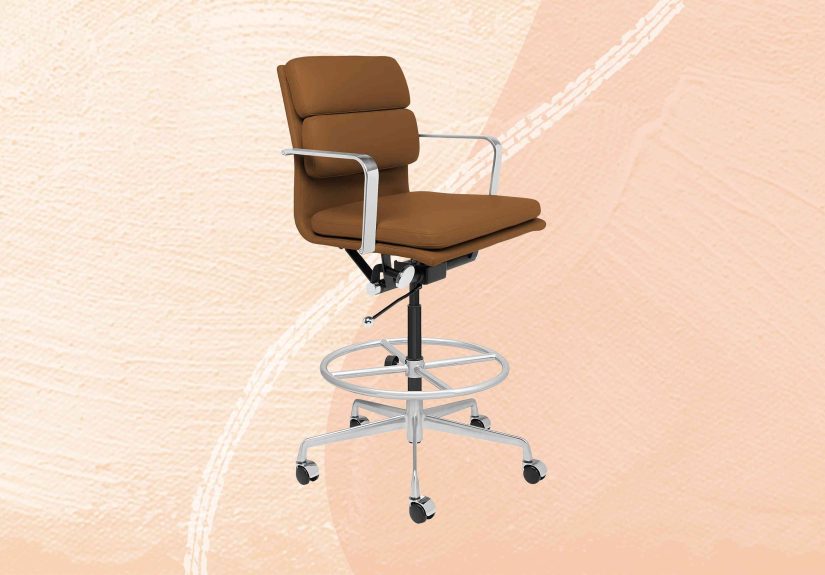
Laura Davidson SOHO II Padded Drafting Chair Best standing desk chair with a backrest
Not everyone wants a backless perch. If your setup stays on the taller side for long stretches, a drafting chair may be the better answer, and the Laura Davidson SOHO II Padded Drafting Chair is one of the strongest options in that category.
This chair looks more like a proper office chair than a stool, which will instantly appeal to anyone who wants elevated seating with more traditional comfort. The padded seat and backrest create a more familiar experience, while the taller configuration works especially well for drafting tables and standing desks used at fixed higher positions. It is less versatile than a wobble stool, but more reassuring if you want support behind you.
-
LeanRite Elite Best leaning chair for stand-heavy workdays
The LeanRite Elite is the weird genius of this category. It is not really a stool, not really a standard chair, and not really a typical perch. Instead, it supports a full sit-stand-lean workflow, which means you can rest part of your weight without fully dropping into a seated posture.
For people who like standing but get fatigued after a while, this can feel like a breakthrough. You stay more upright, keep your body engaged, and still get relief when your legs start filing complaints. The LeanRite is especially useful for long workdays that include lots of reading, video calls, or heads-down computer work where total standing becomes tiring.
-
UPLIFT Engage Stool Best lightweight portable option
The UPLIFT Engage Stool is made for mobility. It is light, easy to carry, and simple to reposition, which makes it perfect for flexible workspaces, shared offices, and people who move between desk, counter, and collaboration areas during the day.
It also delivers exactly what active seating should: motion, height adjustability, and a clean, compact design. If you do not want your standing desk chair to feel like permanent furniture, this one makes a lot of sense. It is the kind of stool you can actually imagine taking to another room instead of staring at forever from the corner of your office.
-
Learniture Adjustable-Height Active Learning Stool Best simple no-fuss active stool
The Learniture Adjustable-Height Active Learning Stool comes from the education world, and honestly, that is part of its charm. It is designed around easy adjustment, moderate range of motion, and practical day-to-day use rather than luxury-office theatrics.
This makes it a strong pick for shared spaces, home offices, study areas, and anyone who wants a straightforward active stool that does not overcomplicate the job. It is not the fanciest option here, but it is sensible, functional, and easy to understand. Sometimes the best ergonomic upgrade is the one you will actually use instead of endlessly researching until your lower back retires.
How to choose the right standing desk chair
Pick a saddle chair if you want posture support without going fully backless
Saddle chairs such as the HÅG Capisco or Branch Saddle Chair work well for people who want a more upright sitting position but still want something that feels like a real seat. They are often easier to adopt if you are moving from a traditional ergonomic office chair.
Pick a wobble stool if you want more movement
Wobble stools are perfect for active sitters, fidgeters, and people who like small constant adjustments. They are excellent with standing desks, but many are better for shorter sessions than full-day use.
Pick a drafting chair if your desk stays high for long periods
If your work surface is regularly set above standard seated height, a drafting chair with a footrest and back support may be the better fit. It is less “active” in the wobble-stool sense, but more supportive for extended tasks.
Pick a leaning chair if standing feels best but not forever
A leaning chair like the LeanRite Elite is excellent if you prefer to stay mostly upright and just want relief from all-out standing. It is particularly useful for people who already like standing desks but need a smarter recovery option than slumping into a couch after lunch.
Common mistakes people make when buying a standing desk chair
Mistake one: buying the chair before measuring desk height. This is the ergonomic version of buying curtains before you own windows.
Mistake two: assuming a backless active stool can replace a fully adjustable office chair for every task. It might for some people, but for many users it works better as part of a posture rotation.
Mistake three: thinking more discomfort means better posture. No. A good standing desk chair should encourage movement and alignment, not make you feel like you are being corrected by Victorian school furniture.
Mistake four: forgetting the rest of the setup. Monitor height, keyboard position, mat support, and shoes still matter. The chair is only one piece of the puzzle.
Final thoughts
The best standing desk chair is the one that makes changing positions easier, not harder. For most people, that means a compact, adjustable seat that supports active work without demanding perfect posture for hours on end. If you want the best premium option, go with the HÅG Capisco 8106. If you want the most practical choice for everyday buyers, the Branch Saddle Chair is a standout. If you are shopping on a tighter budget, the SONGMICS Ergonomic Wobble Stool is hard to beat.
Most importantly, do not chase the fantasy of one perfect working position. The whole point of a standing desk chair is movement, variety, and relief. Your body does not want to be “set and forget.” It wants options. Give it a few, and your workday gets a lot more comfortable.
What it’s actually like to use a standing desk chair every day
The first day with a standing desk chair is usually a mix of optimism and mild confusion. You sit down and think, “This is different.” Then about 20 minutes later you think, “Oh, so my core has apparently been on vacation.” That early adjustment period is normal. A standing desk chair changes the way your body organizes itself at the desk, especially if you are used to a deep office chair that lets you sink, slouch, and slowly become one with the upholstery.
During the first week, the biggest difference most people notice is not dramatic pain relief or superhero posture. It is awareness. You become much more aware of how often you lean forward, how often you tuck a foot under you, how often you freeze in one position, and how much better small movements can feel. On an active stool, you shift more often. On a saddle chair, you sit more upright without constantly reminding yourself to do it. On a leaning chair, you realize standing with support is a lot less tiring than pure standing.
There is also a productivity rhythm that emerges. Many users find standing desk chairs especially helpful for shorter, lighter, or more dynamic tasks: answering email, reviewing documents, hopping on calls, sketching ideas, or working through a to-do list. For long, intense concentration sessions, preferences vary. Some people love the extra alertness of active sitting. Others still want a conventional ergonomic chair nearby for deep-focus work. That is not failure. That is smart setup design.
Another real-world benefit is spatial. A lot of standing desk chairs take up less room than a full office chair, which makes a home office feel less crowded. That matters more than people expect. A smaller chair is easier to move, easier to tuck away, and less likely to dominate a room that has to serve multiple purposes. In a small apartment or hybrid workspace, this can be the difference between a setup you enjoy and a setup you resent every time you walk past it.
There are a few trade-offs, of course. Backless stools are not always ideal when you are tired. Super-active wobble designs can feel distracting if you prefer stillness. Drafting chairs can be fantastic at the right desk height and completely wrong at the wrong one. And almost every standing desk chair works better when you treat it like part of a rotation instead of a forever-throne. The best long-term experience usually comes from alternating between perching, standing, sitting, and walking around rather than trying to prove you can endure one posture longer than your coworkers.
Over time, though, many people find that a standing desk chair changes how they work in subtle but meaningful ways. You may stand more often because switching becomes easier. You may feel less stiff at the end of the day because you moved more without thinking about it. You may even stop doing that strange desk hunch where your chin creeps toward the monitor like it is trying to read confidential gossip. None of this is magic. It is just what happens when your furniture stops encouraging stillness and starts encouraging motion.
So the everyday experience of using a standing desk chair is less about instant transformation and more about better habits becoming easier. You move more. You lock up less. You notice your body sooner. And after a while, going back to a static chair can feel oddly similar to wearing jeans that fit fine technically but make you want to renegotiate your entire life by 2 p.m. That is when you know the switch was worth it.