Table of Contents >> Show >> Hide
- Introduction: The Monster That Refuses to Stay in One Shape
- What Is a Skinwalker?
- What Do Skinwalkers Look Like?
- Why Are Skinwalkers So Terrifying?
- Skinwalker Appearance in Folklore vs. Internet Horror
- Signs Commonly Associated With Skinwalker Encounters
- Why the Skinwalker Legend Still Grabs Modern Readers
- Experiences and Encounter Stories Related to Skinwalkers
- Conclusion: The Horror Is in the Almost
Note: This article discusses skinwalkers as part of Navajo/Diné folklore and modern American horror culture. Because the topic is culturally sensitive, it avoids presenting sacred or closed knowledge as entertainment.
Introduction: The Monster That Refuses to Stay in One Shape
Ask ten people what a skinwalker looks like, and you may get ten different answers: a coyote that stands too tall, a wolf with human eyes, a stranger at the edge of a road, a deer moving like it missed several important deer meetings, or a shadow that seems to know your name. That uncertainty is exactly why skinwalkers are so terrifying. They are not frightening because they have one famous movie-monster design. They are frightening because, in the stories, they can look almost normaluntil something is deeply, bone-chillingly wrong.
The skinwalker legend comes from Navajo, or Diné, tradition, where the figure is not simply a campfire creature or a trendy internet cryptid. In many tellings, a skinwalker is understood as a harmful witch or corrupted person who can transform into, disguise themselves as, or take on the traits of animals. The Navajo term often associated with the figure is yee naaldlooshii, commonly translated as “with it, he goes on all fours.” That phrase alone is enough to make your hallway feel longer at night.
In modern horror, the skinwalker has become a shape-shifting nightmare attached to lonely highways, rural homes, desert landscapes, and “did that animal just smile?” moments. But a respectful answer to “what do skinwalkers look like?” must separate three things: traditional cultural context, reported folklore patterns, and internet horror exaggeration. So, let’s step carefully into the darkbut maybe keep a porch light on.
What Is a Skinwalker?
A skinwalker is usually described as a malevolent witch-like figure from Navajo/Diné folklore. Unlike a werewolf, which is often portrayed as cursed, infected, or helpless under the full moon, a skinwalker is commonly described as choosing evil power. That difference matters. The horror is not only “a human becomes an animal.” The horror is “a human being knowingly becomes something dangerous.”
In many accounts, skinwalkers are linked with witchcraft, taboo-breaking, disguise, animal skins, and supernatural harm. They are not generally treated as random forest goblins or cute Halloween mascots. In Navajo cultural context, the subject can be serious, frightening, and not something people discuss casually with outsiders. That is one reason internet versions often get sloppy: they borrow the scary surface while missing the deeper meaning.
Skinwalkers Are Not Just “Native Werewolves”
One of the biggest mistakes in pop culture is calling skinwalkers “Native American werewolves.” That comparison is catchy, but it is also too simple. Werewolves usually have a fixed wolf-human form and a transformation tied to a curse, moon cycle, or bite. Skinwalkers are described more broadly as witches who may take many animal forms, including coyotes, wolves, dogs, foxes, bears, cougars, owls, crows, or other animals associated with stealth, speed, danger, or bad omens.
So if a werewolf is a horror movie with fur and anger issues, a skinwalker is closer to a shapeshifting threat with intelligence, strategy, and a very disturbing talent for blending in.
What Do Skinwalkers Look Like?
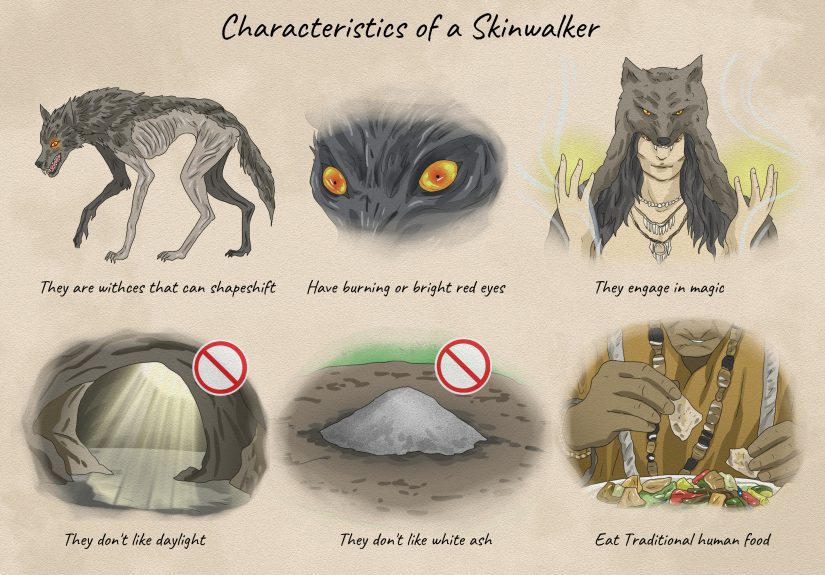
The short answer: skinwalkers are said to look like humans, animals, or something unsettlingly between the two. The longer answer is where the dread lives. Their appearance changes depending on the story, but several descriptions appear again and again in folklore discussions, modern retellings, and reported encounters.
1. An Animal That Looks Almost Normal
The scariest skinwalker description is not always a giant monster with horns, claws, and a soundtrack. Sometimes it is just an animal that should not be where it is, doing what it is doing. A coyote sits too still by the road. A dog watches from a hill without blinking. A deer stands on the shoulder at midnight, then rises in a way that feels too human. The details are small, but your instincts notice them before your brain does.
Common animal forms in skinwalker stories include coyotes, wolves, foxes, dogs, bears, cougars, owls, and crows. Coyotes and wolves appear especially often because they are intelligent, liminal animals in many storiescreatures of dusk, distance, and uneasy laughter. A skinwalker in animal form may look ragged, oversized, too thin, unusually fast, or strangely calm around people. In other words, it may look like wildlife with the “wild” removed and something smarter put behind the eyes.
2. Human Eyes in an Animal Face
One of the most repeated features in skinwalker appearance is the eyes. In some accounts, the animal form has eyes that seem human, aware, or reflective in a way that feels personal. This is classic uncanny horror. An animal should look at you like an animal. If it looks at you like a person wearing an animal as a bad disguise, your nervous system will immediately file a complaint.
Stories sometimes describe glowing eyes, red eyes, or eyes that do not reflect light normally. Whether taken as folklore, fear response, or modern embellishment, the idea is powerful because eye contact means recognition. The terror is not just “I saw something.” It is “something saw me backand understood me.”
3. A Human Figure Wearing Animal Skins
Another traditional and widely repeated image is a person wearing an animal skin or pelt. This is where the English word “skinwalker” comes alive visually: someone moving under the identity of an animal. In horror retellings, this may appear as a hunched figure draped in fur, a person with a coyote hide over their shoulders, or a shadowy body with animal parts attached in ways that look ceremonial, predatory, or wrong.
It is important not to treat this as costume-party material. In cultural context, animal skins and the idea of transformation can carry serious spiritual weight. In modern horror writing, however, the image has become a shorthand for a being that crosses boundaries: human and animal, living and dead, known and unknown.
4. Too Tall, Too Thin, Too Fast
Modern skinwalker stories often describe a creature that is stretched, gaunt, or unnaturally proportioned. Imagine a dog with legs a little too long, a deer with a chest that moves wrong, or a humanoid figure that runs on all fours faster than a normal person could sprint. It is not the size alone that frightens peopleit is the mismatch.
Our brains are excellent at recognizing natural movement. That is why bad animation looks creepy and why a person crawling quickly down a hallway is automatically illegal in the court of common sense. A skinwalker’s terror often comes from broken movement: joints bending oddly, an animal rising onto two legs, or a figure dropping from two legs to four without slowing down.
5. A Familiar Voice in the Wrong Place
Skinwalkers are not only described visually. Many stories include mimicry: a voice calling from outside, a cry that sounds like a loved one, a baby-like wail in the distance, or an animal sound that seems to form words. The “look” of a skinwalker can therefore begin before you see anything at all. You hear something, you turn toward it, and your imagination starts painting the dark.
This is one reason skinwalker stories work so well in rural settings. A voice outside a city apartment is annoying. A voice outside a remote house at 1:37 a.m., when the dogs have gone quiet and the nearest neighbor is a long drive away, is a completely different subscription plan.
Why Are Skinwalkers So Terrifying?
They Break the Boundary Between Human and Animal
Humans like categories. Dog: friendly, maybe muddy. Coyote: wild, keep distance. Neighbor: waves awkwardly while taking out trash. Skinwalker stories smash those categories together. The animal may be a person. The person may be a threat. The thing at the fence may know your habits. That confusion creates dread because the ordinary world no longer follows ordinary rules.
They Are Intelligent, Not Mindless
A zombie is scary, but at least it usually has one business plan: shuffle, groan, bite. Skinwalkers are frightening because they are often described as intentional. They deceive. They stalk. They watch. They may imitate voices or use familiar shapes. In a horror sense, intelligence turns a monster from a hazard into an enemy.
They Make the Familiar Feel Unsafe
The skinwalker legend is powerful because it does not require a haunted castle or a dramatic thunderstorm. It can happen on a normal road, beside a normal fence, near a normal house. The dog outside may not be a dog. The person walking at the edge of the headlights may not be just a person. The knock at the window may not be a branch. Congratulations, now even shrubbery has become suspicious.
They Carry Cultural Weight
Another reason skinwalkers are terrifying is that the subject is not merely fictional entertainment for many people. For Navajo/Diné communities, skinwalker beliefs can be connected to ideas about witchcraft, harm, taboo, and spiritual danger. Many people avoid discussing the topic openly. That silence gives the legend a gravity that internet monster stories cannot easily copy.
When a culture treats a subject as dangerous to discuss, outsiders often become more curious. But curiosity should come with respect. The skinwalker is not just a spooky label to slap onto any weird animal video. It belongs to a living cultural context, and careless use can flatten something meaningful into clickbait.
Skinwalker Appearance in Folklore vs. Internet Horror
Traditional descriptions tend to emphasize witchcraft, transformation, animal disguise, secrecy, and moral corruption. Internet horror tends to add dramatic visuals: antlers, skeletal bodies, backward limbs, giant smiles, pale humanoids, and creatures that look like they escaped from a nightmare gym where every day is leg day.
Some of those modern images may be inspired by other monsters, including wendigos, crawlers, rake-like creatures, werewolves, and general cryptid art. That blending is common online, but it can confuse readers. Not every pale creature in the woods is a skinwalker. Not every strange deer is a skinwalker. Not every blurry trail-cam photo is proof of a supernatural shapeshifter. Sometimes it is a sick animal, a trick of light, a hoax, or a raccoon having the worst hair day in North America.
Still, the modern image persists because it taps into a universal fear: the body that looks wrong. A skinwalker does not need to be fully visible. A half-seen shape in the headlights can be more frightening than a perfectly lit monster. Mystery gives the mind room to decorate, and the mind is a very enthusiastic interior designer when fear is involved.
Signs Commonly Associated With Skinwalker Encounters
Folklore and modern stories often describe skinwalker encounters through patterns rather than proof. These signs should be understood as storytelling motifs, not field-guide instructions. This is not “Birdwatching for Nightmares.” It is a look at how the legend is commonly told.
Unnatural Animal Behavior
Animals appear where they should not be, move in strange ways, stare too long, or seem fearless around humans. A coyote following a car, a wolf-like shape standing upright, or a dog appearing miles from any home may become the center of a skinwalker story.
Mimicked Voices
Many modern accounts mention voices calling names, sounding like relatives, or imitating cries for help. This detail is terrifying because it weaponizes compassion. The listener wants to help, but the story warns that answering may invite danger.
Knocks, Scratches, and Window Tapping
In some stories, the skinwalker does not burst through the door like an action villain. It taps. It scratches. It waits outside. That restraint makes the scene worse. A monster that waits is much scarier than a monster that forgot patience at home.
Roadside Encounters
Skinwalker stories often happen on lonely roads, especially at night. Headlights reveal a shape, the shape keeps pace, and the driver realizes the “animal” is moving too fast. Roads are perfect horror settings because they create a tunnel of visibility: you can see only what the headlights allow, and everything else belongs to the dark.
Why the Skinwalker Legend Still Grabs Modern Readers
The skinwalker has become a fixture in American horror searches because it sits at the intersection of folklore, taboo, wilderness fear, and viral storytelling. It is old enough to feel rooted and mysterious, but adaptable enough to appear in Reddit stories, YouTube narrations, podcasts, games, and late-night “true scary encounter” threads.
But its popularity also creates problems. When every odd sound becomes a skinwalker and every creepy animal photo gets the label, the term loses meaning. Worse, it can disrespect the Navajo/Diné origins of the belief. A better approach is to appreciate the legend as powerful folklore while recognizing that not all knowledge is ours to package, simplify, or meme into oblivion.
For writers, researchers, and horror fans, the responsible question is not only “What do skinwalkers look like?” It is also “Why has this figure remained so frightening, and how do we discuss it without stripping away its cultural context?” The answer is simple: with curiosity, caution, and enough humility to admit that some doors should not be kicked open just because the internet brought a flashlight.
Experiences and Encounter Stories Related to Skinwalkers
Experiences connected to skinwalkers usually follow a few unforgettable patterns. The first is the roadside sighting. A driver is crossing a remote stretch of desert or reservation road late at night. The radio fades. The headlights catch an animal aheadoften a coyote, dog, or deer. At first, nothing seems impossible. Then the animal begins to run beside the car. It keeps pace at a speed no ordinary animal should maintain. The driver speeds up. The shape stays close. Sometimes it turns its head, and the eyes look too knowing. The experience may last only seconds, but the memory becomes permanent. Nobody needs a ten-minute monster monologue when three seconds of “that deer just ran like a track athlete” will do the job.
Another common experience centers on the home. Someone hears tapping on a window, scratching at a wall, or footsteps outside. The strange part is not only the sound; it is the timing. It happens after midnight, when the house feels sealed off from the world. Dogs may whine or refuse to bark. Livestock may become restless. A voice may call from outside, sounding almost like a family member. In these stories, the fear comes from invitation. The person inside wonders whether to look, answer, or open the door. The safest choice in folklore is usually “absolutely not,” which is also excellent advice for suspicious midnight noises in general.
Some reported experiences involve mimicry in open spaces. Campers, hikers, or rural residents describe hearing their names called from the dark. The voice may sound familiar but slightly flat, as if someone learned the words without understanding the person. This detail is especially chilling because it attacks trust. Human beings are wired to respond to voices, especially voices that sound hurt, young, or familiar. A skinwalker story twists that instinct into a trap.
There are also stories about animals that behave with unsettling intelligence. A coyote may sit near a fence and watch a family for too long. A dog-like creature may appear at the edge of a yard and vanish when approached. A bird may follow a person from place to place. In ordinary life, animals do strange things all the time. Owls stare. Coyotes scream. Foxes sound like haunted toddlers. Nature is weird enough without supernatural assistance. But in skinwalker experiences, the behavior feels directed. The witness senses intention, and intention is what turns an animal sighting into a haunting.
The most frightening experiences are often the least dramatic. No claws. No attack. No cinematic reveal. Just a shape at the edge of the headlights, a voice outside the window, a too-still animal watching from the dark. Skinwalker stories thrive in that gap between explanation and fear. Maybe it was wildlife. Maybe it was imagination. Maybe it was a prank. But the person who experienced it remembers the feeling: the sudden certainty that something nearby was pretending to be ordinaryand doing a poor enough job that the soul noticed.
Conclusion: The Horror Is in the Almost
So, what do skinwalkers look like? In the most common descriptions, they look like animals, humans, or warped combinations of both. They may appear as coyotes, wolves, dogs, foxes, bears, cougars, owls, or other creatures. They may have human-like eyes, unnatural speed, strange proportions, or movements that make the body feel borrowed rather than born. They may also look like a person wearing an animal skin or a figure that refuses to stay in one category long enough for comfort.
But the real terror of the skinwalker is not just appearance. It is uncertainty. A skinwalker is frightening because it turns the familiar world unreliable. An animal may not be an animal. A voice may not belong to who it imitates. A road may not be empty. A window tap may not be the wind. The legend endures because it understands one of horror’s oldest truths: the scariest thing is not always the monster you see clearly. Sometimes it is the thing that looks almost normaluntil it looks back.