Table of Contents >> Show >> Hide
- Meet JUNO: A Giant “Fishbowl” Built to Catch Ghost Particles
- Why Neutrinos Are So Hard to Study
- How JUNO Detects Reactor Antineutrinos (Without Losing Its Mind)
- What “Collecting Data” Really Means
- The Main Mission: The Neutrino Mass Ordering Problem
- Bonus Science: JUNO Is Also a Multi-Tool
- How JUNO Fits into the Global Neutrino Race
- The Not-So-Glamorous Challenges Behind the Science
- What to Watch Next
- Experiences from the Underground: What It Feels Like Around a Giant Neutrino Detector (Extra )
- Conclusion
Neutrinos are the universe’s ultimate introverts: they show up everywhere, refuse to make eye contact, and slip through walls like they forgot they’re in a physical reality. For decades, physicists have been building increasingly ridiculous “nets” to catch themmassive underground tanks, oceans of water, Antarctic ice, you name it. Now China’s Jiangmen Underground Neutrino Observatory (JUNO)often described as the world’s largest liquid-scintillator neutrino detectorhas crossed the line from “spectacular construction project” to “actual science machine.” Translation: it’s officially collecting data, and the early results are already turning heads.
In this article, we’ll break down what JUNO is, what “collecting data” really means (spoiler: it’s not just flipping a switch), and why the experiment matters for neutrino physics, particle physics, and our understanding of the universe. We’ll also talk about what it’s likepractically, emotionally, and caffeinelyto work around a detector the size of a small building.
Meet JUNO: A Giant “Fishbowl” Built to Catch Ghost Particles
JUNO sits deep underground in southern China, beneath layers of rock that act like a natural umbrella against cosmic rays. Underground placement matters because the surface of Earth is basically a nonstop particle rave, and neutrino detectors need something closer to a library.
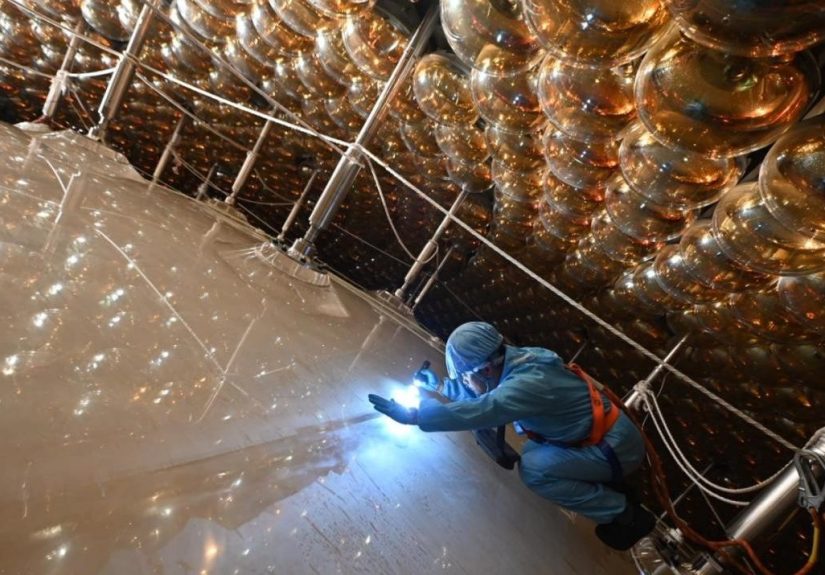
At the center of JUNO is a huge spherical vessel filled with about 20,000 tons of liquid scintillatora transparent fluid that emits tiny flashes of light when charged particles pass through it. Surrounding that sphere is a dense forest of ultra-sensitive photomultiplier tubes (PMTs)think of them as the detector’s thousands upon thousands of “eyes,” watching for the faintest glimmer.
If you’ve heard the phrase “world’s largest neutrino detector” and thought, “Wait… isn’t IceCube basically a cubic kilometer of Antarctic ice?” you’re not wrong. In neutrino-land, “largest” depends on context: by total instrumented volume at ultra-high energies, detectors like IceCube are enormous; by size and precision for low-energy reactor antineutrinos using liquid scintillator, JUNO is the heavyweight. Physics loves a good category systemespecially when it comes with trophies.
Why Neutrinos Are So Hard to Study
Neutrinos are electrically neutral, incredibly light, and interact through the weak force (which, despite the name, is still extremely rudejust selectively). Most neutrinos pass through Earth without interacting at all. That’s why scientists build detectors that are comically large: when your target barely ever hits anything, you scale up until statistics finally stop laughing at you.
The trick is that neutrinos don’t announce themselves directly. They show up only when, by rare chance, they collide with something and create secondary particles. Those secondary particles do leave signalslight flashes, timing patterns, and energy signaturesthat can be reconstructed into a neutrino “event.”
Neutrino Oscillations: The Plot Twist That Won’t Quit
One reason neutrinos are so interesting is that they oscillatethey change “flavor” (electron, muon, tau) as they travel. Oscillations are direct evidence that neutrinos have mass, which was not originally how the Standard Model expected the story to go. That mismatch is part of why neutrino experiments are a prime hunting ground for physics beyond the Standard Model.
How JUNO Detects Reactor Antineutrinos (Without Losing Its Mind)
JUNO’s main “light source” isn’t a star or a supernovait’s human-made: nearby nuclear power plants. Reactors produce enormous numbers of electron antineutrinos as a by-product of nuclear fission. JUNO is positioned so it can measure how those antineutrinos oscillate over a medium baseline (roughly tens of kilometers), which is ideal for teasing out subtle interference patterns.
The Signature Move: A Double Flash
In liquid scintillator detectors, a common detection channel is inverse beta decay: an antineutrino interacts with a proton, producing a positron and a neutron. The positron creates a prompt flash of light; the neutron is captured shortly after, creating a delayed flash. That time-correlated “double tap” is one of the cleanest ways to identify reactor antineutrino events.
Why So Many Photomultipliers?
JUNO’s physics goals demand exquisite precision. To read oscillation patterns, the detector needs exceptional energy resolutionthe ability to measure neutrino-related energies with minimal blur. That’s why it uses tens of thousands of light sensors and aims for extremely high light collection. Better light collection means tighter energy measurement, and tighter energy measurement means sharper oscillation “wiggles.”
It’s the experimental equivalent of trying to read a barcode while riding a bike on a cobblestone roadunless you stabilize the image, you get nonsense. JUNO’s engineering is all about stabilizing that image.
What “Collecting Data” Really Means
When people hear “the detector is collecting data,” they picture a dramatic button press and maybe a celebratory montage. Reality is more like: filling campaigns, purity checks, calibration runs, background studies, and an endless parade of dashboards that look like a spaceship’s heart monitor.
For JUNO, “collecting data” means the full detector system is operational: the scintillator is in place, the PMTs are live, the veto systems are working, and the data acquisition is stable enough to run continuously. It also means the collaboration has crossed into the phase where they can begin building high-quality datasets for precision measurementsnot just engineering tests.
Early Data Can Still Be World-Class
One of the delightful surprises of modern big-science detectors is that once everything is aligned, even early datasets can produce meaningful results. JUNO’s first public physics outputs have included high-precision measurements of key oscillation parameters based on initial operational runsan early sign that the detector’s performance is living up to its design ambitions.
The Main Mission: The Neutrino Mass Ordering Problem
Here’s the mystery JUNO is built to tackle: neutrinos come in three mass states, but we still don’t know their exact ordering. Physicists call this the neutrino mass ordering (or “mass hierarchy”). There are two main possibilities:
- Normal ordering: the third mass state is the heaviest.
- Inverted ordering: the third mass state is the lightest.
That might sound like a niche sorting question, but it ripples outward into multiple areas of physics: how we interpret neutrino experiments globally, how we model particle interactions, and how we plan future searches for rare processes.
Why Reactor Antineutrinos Help
Reactor antineutrinos provide a steady, well-understood source. JUNO measures their energy spectrum with extreme precision and looks for oscillation features that depend subtly on the mass ordering. The experiment’s design aims to reduce degeneraciescases where different parameter choices could mimic the same signalso the final conclusion is robust.
Bonus Science: JUNO Is Also a Multi-Tool
Even though mass ordering is the headline act, JUNO is more like a festival than a single concert. Once you’ve built a detector this sensitive, you’d be silly not to use it for everything you can reasonably justify without getting side-eyed by your funding agency.
Supernova Neutrinos: The Universe’s Early-Warning System
When a star goes supernova, neutrinos can arrive before the light show becomes visible. That means neutrino detectors can provide early alerts, helping astronomers point telescopes quickly and capture the event from its earliest moments. JUNO’s sensitivity to low-energy neutrinos makes it a strong candidate for contributing to supernova early-warning networks.
Solar, Geo-, and Atmospheric Neutrinos
Neutrinos come from the Sun, from radioactive decays inside Earth, and from particle interactions in the atmosphere. JUNO’s design allows it to study multiple neutrino sources, which helps refine models of astrophysical processes and Earth’s interior. Some of those measurements also cross-check oscillation physics in different environmentsan underrated but crucial part of building confidence in results.
Searching for “New Physics”
Beyond its core program, a detector like JUNO can look for anomalies that hint at physics beyond the Standard Model: sterile neutrinos, unexpected spectral distortions, or rare decay signatures. It’s not guaranteed, of coursebut neutrino physics has a history of rewarding patience with plot twists.
How JUNO Fits into the Global Neutrino Race
JUNO isn’t operating in a vacuum (well, actually it’s operating in ultra-pure liquids, which is basically the same vibe). It’s part of a global ecosystem of neutrino experiments, each optimized for different energies and questions:
- IceCube hunts high-energy cosmic neutrinos using Antarctic ice.
- Super-Kamiokande / Hyper-Kamiokande use gigantic water Cherenkov detectors to study atmospheric, solar, and accelerator neutrinos.
- DUNE (under construction in the U.S.) will use a powerful accelerator beam and liquid argon detectors to probe oscillations, CP violation, and more.
The point isn’t that one detector “wins.” The point is that the universe is stingy with neutrinos that interact, and we need multiple complementary approaches to triangulate the truth.
The Not-So-Glamorous Challenges Behind the Science
Building JUNO wasn’t just a matter of digging a hole and pouring in science juice. Precision neutrino experiments are allergic to three things: impurities, backgrounds, and surprise physics from “stuff you didn’t know was in your detector.”
Ultra-High Purity (Because Radioactivity Is a Party Crasher)
Natural radioactivity in materials can mimic neutrino-like signals. That’s why experiments chase astonishingly low contamination levels and obsess over cleanliness like they’re preparing for a surgical procedure on a diamond.
Cosmic-Ray Muons and Background Rejection
Even deep underground, muons from cosmic rays can sneak in. JUNO combats this with shielding and veto systems designed to tag and reject background events. The goal is a dataset where the remaining signals are truly neutrino-drivennot the experimental equivalent of “my dog ate my homework.”
Stability, Uptime, and the Quiet Heroism of Operations
The best physics comes from steady, long-duration data taking. That requires consistent calibration, monitoring, and rapid response when something drifts. In big collaborations, “operations” teams are the unsung heroes keeping the science machine humming while everyone else argues about plots.
What to Watch Next
JUNO’s early results are a preview, not the final act. The mass-ordering measurement will require large statistics and careful control of systematicsyears of data, refined calibrations, and relentless cross-checking.
In the meantime, expect a steady stream of performance papers, calibration updates, oscillation parameter refinements, and multi-messenger readiness work (especially around supernova alerts). If neutrino physics had a motto, it would be: “slow is smooth, smooth is fast.”
Experiences from the Underground: What It Feels Like Around a Giant Neutrino Detector (Extra )
If you’ve never been near a major underground physics experiment, it’s hard to appreciate how much of the “experience” is equal parts wonder and logistics. A neutrino detector is typically hidden in a place that feels like it belongs to miners, not particle physicists: long access roads, tunnels cut through rock, and safety briefings that remind you gravity is undefeated.
The first sensation is often scale. Photos don’t quite translate what it means to stand near a spherical detector structure that can make a human feel like a punctuation mark. You’ll see cables, scaffolding, catwalks, and rows of sensors that look like gold eyes staring back at you. It’s both beautiful and slightly unsettling, like being politely judged by a thousand robotic owls.
Then comes the soundor rather, the lack of it. Underground labs can be oddly quiet once you’re away from pumps and ventilation. People talk in lower voices, not because it’s required, but because the place feels like it should have library rules. The air is cool, the lighting is practical, and the vibe is intensely “we are doing real science, please do not spill anything.”
Operationally, the experience is defined by calibration and monitoring. In a control room, you’ll find a wall of screens showing detector rates, timing distributions, temperatures, and other metrics that look like modern art until you learn what “normal” is. There’s a particular kind of satisfaction in watching stable plots: flat lines become a love language. When a rate drifts upward or a timing peak shifts, everyone leans in like a group text just got dramatic.
Shift work is its own culture. Someone is always “on shift,” which means neutrino science runs on a rotating schedule and a heroic quantity of caffeine. Night shifts can be strangely peacefulfewer distractions, more focus, and the occasional moment where you remember: the signals you’re seeing come from particles that traveled through Earth and barely interacted with anything until now. It’s humbling in a very specific way, like getting a postcard from the Sun that says, “Hi, I passed through your planet.”
Collaboration life is also a big part of the experience. Large experiments are international by nature, which means you learn to communicate across time zones, accents, and entirely different ways of arguing politely about data cuts. Meetings range from intensely technical (“we need to model the nonlinearity at sub-percent level”) to delightfully human (“who has the latest version of that plot and why is it named final_FINAL_v7_reallyfinal.png?”).
Finally, there’s the emotional arc. Most people involved have spent yearsoften a decade or moredesigning, building, testing, and troubleshooting. When an experiment begins taking data, it feels less like a launch and more like a long-awaited conversation finally starting. You’ve built the instrument, tuned it, and protected it from every possible background you can think of. Then you wait for the universe to whisper back in photons so faint they’d be embarrassing at a birthday candle contest. And when the detector performswhen the first clean events come init’s hard not to feel like the whole underground mountain just gave you a quiet thumbs-up.