Table of Contents >> Show >> Hide
If your garden has that one shady corner where everything either sulks, scorches, or stages a dramatic fainting spell by July, astilbe might be your new best friend. This feathery perennial brings color, texture, and woodland charm to spots where many sun-lovers refuse to cooperate. But astilbe really shines when it is not planted alone. The right astilbe companion plants can make the whole bed look fuller, healthier, and far more intentional, like you actually planned it instead of panic-buying whatever was left at the nursery.
Astilbe thrives in partial shade to full shade, with rich, moisture-retentive, well-drained soil. In plain English, it likes conditions that feel cool, leafy, and a little pampered. So the secret to choosing good companions is simple: pick plants that enjoy the same environment. Once you do that, your shade garden becomes easier to manage and much more attractive from spring through fall.
Below are 12 of the best astilbe companion plants to grow if you want a healthier garden, longer-lasting interest, and fewer empty patches making your landscape look like it gave up halfway through the season.
What Makes a Great Astilbe Companion?
Before we get to the list, let’s talk strategy. Good astilbe companion plants usually share four important qualities:
1. Similar light needs
Astilbe prefers part shade or dappled light, especially in warmer climates. Pairing it with plants that also enjoy shelter from hot afternoon sun helps the entire planting look better for longer.
2. A love of moisture-rich soil
Astilbe is not the kind of plant that wants to “tough it out” in dry soil. When it gets thirsty, the foliage turns crispy fast. The best companions are plants that also appreciate evenly moist soil and organic matter.
3. Contrasting texture
Astilbe already brings a soft, feathery look. It looks especially good next to broad leaves, glossy foliage, mounding ground covers, or bold architectural forms. Think contrast, not clones.
4. Staggered seasonal interest
A healthy garden is not just about survival. It is also about timing. The smartest combinations give you spring flowers, summer plumes, and foliage that keeps the bed interesting long after one plant finishes blooming.
12 Astilbe Companion Plants for a Better Shade Garden
1. Hosta
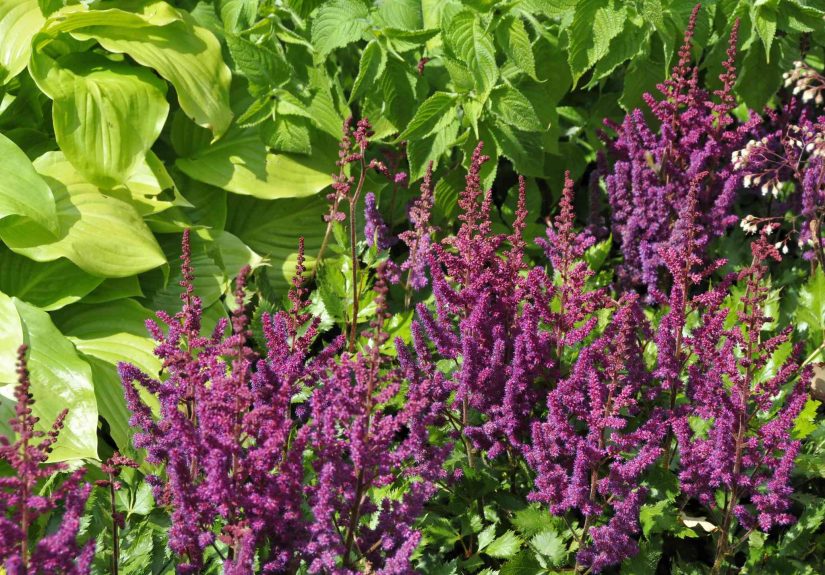
If astilbe is the confetti, hosta is the furniture. Hostas provide the broad, substantial leaves that make astilbe’s fluffy flower plumes look even more dramatic. They also like similar conditions: shade, rich soil, and steady moisture. That makes them one of the easiest and most reliable astilbe companion plants you can grow.
Design-wise, hostas anchor the bed while astilbe adds lift. Try blue hostas with pink astilbe for a cool-toned look, or chartreuse hostas with white astilbe if you want the area to glow in the evening light. It is a classic pairing for a reason. It works.
2. Japanese Painted Fern
Want your shade border to look like it belongs in a magazine instead of next to the air conditioner unit? Add Japanese painted fern. This fern offers silvery-green fronds with burgundy accents, which play beautifully against astilbe’s green foliage and colorful plumes.
Both plants enjoy humusy, consistently moist soil and protection from harsh sun. Together, they create that soft woodland look gardeners are always trying to fake with decorative signs and expensive pots. With these two, the plants do the work for you.
3. Brunnera
Brunnera is one of the best companions for astilbe if you want beautiful foliage from spring through frost. Its heart-shaped leaves, often splashed with silver, create a bold contrast with astilbe’s finely cut foliage. In spring, brunnera also produces airy blue flowers that resemble forget-me-nots.
This pairing works especially well because brunnera fills the early-season gap before astilbe really gets going. By the time brunnera’s flowers fade, astilbe is ready to take over with its summer show. That kind of handoff is what makes a bed feel polished instead of patchy.
4. Lungwort
Lungwort may have one of the least glamorous names in gardening, but do not hold that against it. Pulmonaria earns its keep with speckled leaves and early spring flowers in pink, blue, or violet. It thrives in cool, moist, shady spots, which puts it squarely in astilbe territory.
Lungwort is especially useful near the front of a border. It stays relatively low, covers bare soil, and gives you color before astilbe blooms. Plus, the spotted foliage continues to look decorative after the flowers are gone. It is a hardworking plant with terrible branding.
5. Bleeding Heart
Bleeding heart brings romance, arching stems, and unmistakable heart-shaped flowers to the shade garden. It prefers rich, humusy soil and part shade, so it fits beautifully with astilbe. The two plants also complement each other in timing and form.
Bleeding heart often steals the show in spring and early summer, then starts to fade or go dormant in the heat. Astilbe steps in right on cue, filling that visual gap with upright plumes and fresh foliage. It is a smart combination for gardeners who want the bed to stay lively as the season changes.
6. Coral Bells
Coral bells, or heuchera, are brilliant companions for astilbe because they bring leaf color that lasts much longer than flowers. Depending on the variety, you can find foliage in lime, caramel, plum, burgundy, silver, or nearly black. That means you can build all kinds of color combinations around astilbe’s pink, red, lavender, or white blooms.
Heuchera also adds a tidy mounded shape at the front or middle of the bed. It is especially effective when you want to keep a shade planting from becoming one giant green shrug. Mix dark-leaved coral bells with pale astilbe flowers and suddenly the whole border looks much more deliberate.
7. Japanese Forest Grass
Japanese forest grass brings movement to a shade garden in a way very few plants can. Its cascading habit softens edges, brightens dark corners, and contrasts perfectly with astilbe’s upright plumes. If your planting feels too stiff, this is the plant that loosens it up.
Golden cultivars are especially useful because they light up shady areas without needing direct sun. Pair them with rose-pink or burgundy astilbe for a rich, layered effect. The grass also helps connect bolder plants visually, making the whole composition feel more relaxed and natural.
8. Goat’s Beard
Goat’s beard looks a little like astilbe’s taller, wilder cousin. It has airy cream-colored plumes and a bold, shrub-like presence in the back of the border. Because it likes moist, rich soil and partial shade, it makes an excellent companion in larger beds or woodland gardens.
This is a great plant if your astilbe border needs height and volume. The pairing works best when you use goat’s beard behind medium-height astilbes and lower foliage plants. It adds scale without clashing, and the two together give the planting a lush, layered look.
9. Ligularia
If astilbe is soft and feathery, ligularia is bold and dramatic. Its large leaves and striking flower spikes create a strong textural contrast that makes astilbe pop. More importantly, ligularia loves the same thing astilbe does: moisture. In fact, if your garden tends to stay cool and damp, ligularia will look downright thrilled.
This is one of the best astilbe companion plants for rain gardens, pond edges, or shaded beds that never fully dry out. Just do not put either plant in a hot, dusty location and expect a miracle. That is not gardening. That is wishful thinking with a shovel.
10. Foamflower
Foamflower, or tiarella, is a lovely low-growing companion that helps unify a shade bed. It spreads gently, covers the ground, and produces frothy spring blooms that echo astilbe’s airy look on a smaller scale. The foliage often remains attractive for months, adding another layer of interest.
Use foamflower near paths, under taller perennials, or around the feet of astilbe plants to soften the base of the bed. It is especially helpful in younger plantings where there is still too much visible mulch and not enough garden swagger.
11. Hellebore
Hellebores are champions of the late-winter and early-spring garden. They flower when most of the yard still looks half asleep, then keep their leathery evergreen foliage for months. That makes them a practical and beautiful astilbe partner.
Even though hellebores prefer good drainage, they still appreciate rich, humusy soil and part shade, which overlaps nicely with astilbe’s needs. In mixed plantings, hellebores handle the early-season performance while astilbe takes over later. Gardeners love that kind of teamwork, mostly because it makes us look smarter than we are.
12. Toad Lily
Toad lily is the shade garden’s plot twist. Just when you think the season is winding down, it sends out orchid-like speckled flowers in late summer to fall. Since it enjoys moist, organic soil and part to full shade, it makes an excellent late-season partner for astilbe.
Plant toad lily where you can actually see the flowers up close, because the details are easy to miss from a distance. It works beautifully behind lower foliage plants and near astilbe varieties that bloom earlier in summer. Together, they stretch the bed’s interest deep into the season.
How to Combine Astilbe Companion Plants for a Healthier Garden
The healthiest garden beds are not always the flashiest ones. Often, they are the plantings where everything wants the same basic conditions and grows into place without constant rescue missions.
For a layered look, place taller plants like goat’s beard and ligularia in the back, medium-height plants like astilbe and hosta in the middle, and lower growers like lungwort, foamflower, or coral bells toward the front. Add one grass or fern for movement, and one bold leaf plant for contrast. That formula works almost every time.
You can also build by season. Hellebore, brunnera, lungwort, and bleeding heart carry spring. Astilbe, hosta flowers, and ligularia handle summer. Toad lily and the lingering foliage of hosta, heuchera, and Japanese forest grass keep the bed attractive into fall. Instead of a one-hit wonder, you get a garden with an actual storyline.
Common Mistakes to Avoid
Do not mix moisture lovers with drought lovers. Astilbe does not want to share space with plants that prefer dry shade. That is how one plant thrives while the other files a complaint.
Do not underestimate soil improvement. Shade alone does not guarantee success. If the soil is compacted, root-filled, or bone dry under trees, add compost and water deeply.
Do not forget mature size. A tiny hosta in a nursery pot can become a broad mound. Ligularia can get big. Goat’s beard can get bigger. Leave room for the bed to breathe.
Do not rely only on bloom color. In shade gardening, foliage matters just as much as flowers. Maybe more. Texture and leaf color are what keep the garden attractive when nothing is in bloom.
Final Thoughts
Astilbe is one of the best plants for turning a shady garden from “problem area” into “favorite corner.” But it looks and performs even better when you surround it with companions that share its taste for cool roots, organic soil, and regular moisture. Hosta, ferns, brunnera, lungwort, bleeding heart, coral bells, Japanese forest grass, goat’s beard, ligularia, foamflower, hellebore, and toad lily all bring something useful to the mix.
The result is not just a prettier planting. It is a healthier garden bed with better coverage, stronger seasonal interest, and fewer awkward empty spots. And honestly, anything that makes a shade garden look lush instead of apologetic deserves a spot on the planting plan.
Real-World Growing Experiences With Astilbe Companion Plants
One of the biggest lessons gardeners learn with astilbe is that success has less to do with buying fancy varieties and more to do with matching plants to the right microclimate. In real gardens, astilbe often performs beautifully for a year, then starts looking ragged when it is tucked into a spot that is technically shady but too dry because of tree roots or reflected heat from nearby stone. That is usually the moment people realize companion planting is not just a design idea. It is a survival strategy.
When astilbe is combined with plants like hosta, brunnera, and foamflower, the bed tends to feel cooler and more stable. The layered foliage shades the soil, slows down moisture loss, and makes the planting look fuller even between bloom cycles. Gardeners often notice that mixed plantings hold up better through hot spells than a row of astilbes planted alone. Not because the companions magically water each other, sadly, but because the shared canopy creates a more balanced environment.
Another common experience is realizing how much texture matters in shade. At first, many people shop by flower color. Then midsummer arrives, the blooms pass, and the garden suddenly depends on leaves to carry the show. That is where ferns, coral bells, and Japanese forest grass prove their value. Astilbe plumes are lovely, but next to broad hosta leaves or metallic brunnera foliage, they become even more striking. The garden starts looking layered rather than flat.
Bleeding heart is another plant that teaches useful timing. In spring, it can look like the undeniable star of the bed. Then summer heat shows up, and the foliage fades. Gardeners who planted astilbe nearby usually feel brilliant at that point, because astilbe expands into the visual gap just when it is needed most. The same thing happens later in the season with toad lily. Just as early performers lose steam, the toad lily steps up with intricate late blooms that reward anyone patient enough to keep looking at the shade border after August.
Some gardeners also learn to respect moisture differences the hard way. Ligularia and astilbe can be spectacular together near a downspout, pond edge, or naturally damp bed, but in average garden soil during a dry summer, both may start sending out distress signals. Crispy leaf edges, drooping foliage, and faded flowers are usually not a mystery. They are a review of your irrigation plan, and the review is not positive.
On the brighter side, experienced shade gardeners often say the most satisfying astilbe combinations are the ones that evolve over time. Hellebores settle in and become reliable early-season anchors. Foamflower creeps politely around the base of larger plants. Goat’s beard takes a few years to bulk up, then suddenly makes the whole bed feel mature. Astilbe itself often looks best once clumps have had time to establish and the surrounding companions have filled in.
Perhaps the most practical takeaway is this: a healthier astilbe garden rarely comes from forcing one plant to carry the entire design. It comes from building a community of plants that enjoy the same conditions and cover each other’s weak spots. One handles early spring. Another carries midsummer. Another contributes foliage when flowers fade. Once gardeners see that rhythm in action, shade gardening becomes much less frustrating and a lot more fun.