Table of Contents >> Show >> Hide
- Why Cheesecake Doneness Is So Confusing
- The Best Sign: Look for the Gentle Jiggle
- Three Reliable Ways to Tell if Cheesecake Is Done
- Visual Clues That Support the Test
- What an Underdone Cheesecake Looks Like
- What an Overbaked Cheesecake Looks Like
- Why Cooling Matters Almost as Much as Baking
- How a Water Bath Helps Cheesecake Bake More Evenly
- Does Doneness Change for Different Types of Cheesecake?
- Common Cheesecake Mistakes That Affect Doneness
- A Simple Doneness Checklist
- So, When Is Cheesecake Actually Done?
- Test Kitchen Notes: Real-Life Cheesecake Experiences
- Conclusion
Cheesecake is one of those desserts that can make even confident home bakers suddenly start negotiating with the oven. Brownies? Easy. Cookies? Manageable. Cheesecake? That is where people start crouching in front of the oven door like detectives at a crime scene, whispering, “Is it done? Is it lying to me?”
The tricky part is that a baked cheesecake is not supposed to behave like a regular cake. If you wait until it looks fully firm in the middle, you may end up with an overbaked, dry texture and a crack running across the top like a dramatic lightning bolt. The good news is that there are reliable ways to know when cheesecake is done, and once you understand them, the whole process becomes much less stressful.
In our test-kitchen-style guide, we are breaking down the best visual cues, texture tests, temperature benchmarks, and cooling tips so you can stop guessing and start baking cheesecake with actual confidence. Whether you are making a classic New York cheesecake, a sour cream cheesecake, or a holiday version with pumpkin or chocolate, these signs will help you pull it from the oven at exactly the right time.
Why Cheesecake Doneness Is So Confusing
Cheesecake is closer to a custard than a fluffy layer cake. That means it continues to set as it cools. The eggs in the filling firm up gradually, and the cream cheese mixture becomes sliceable only after it has had time to rest and chill. So yes, the cheesecake can look slightly underdone when it comes out of the oven and still turn into a creamy masterpiece later.
This is where many bakers get fooled. They expect a solid center, leave the cheesecake in too long, and accidentally bake away the silky texture they wanted in the first place. A properly baked cheesecake should look calm and mostly set around the edges while keeping a small amount of movement in the center. Think elegant wobble, not waterbed chaos.
The Best Sign: Look for the Gentle Jiggle
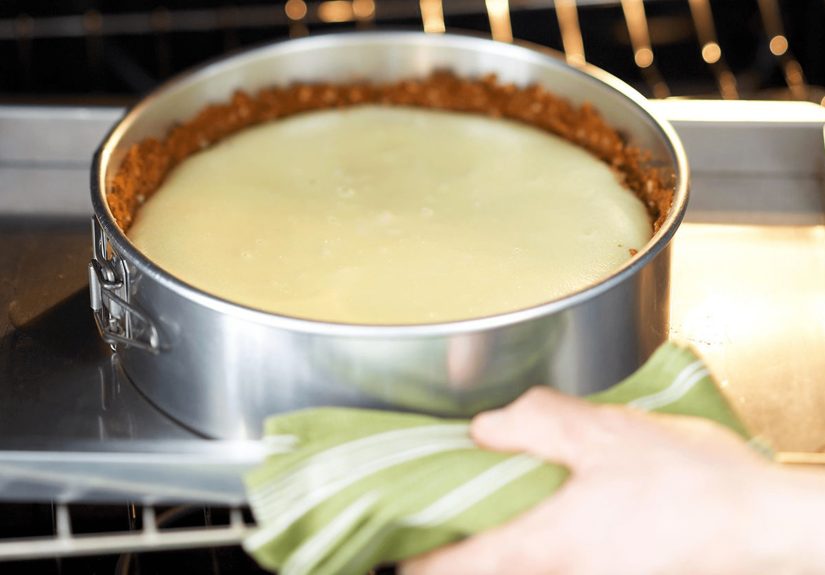
If you learn only one thing about baked cheesecake, make it this: the center should still jiggle slightly when the cheesecake is done. Not a full-body ripple. Not a slosh. Not a “somebody save this dessert” tremor. A slight jiggle.
When you gently nudge the pan, the outer edge should look set and stable. The middle should move a little, almost like Jell-O that has just finished setting. That tiny wobble is one of the clearest signs that your cheesecake is ready to come out of the oven.
What the jiggle should look like
The best way to picture it is this: the outer 2 to 3 inches should be set, while the center circle still has a soft bounce. If the entire surface moves in waves, it needs more time. If nothing moves at all and the middle looks completely firm, you may already be flirting with overbaking.
This small difference matters. Cheesecake keeps cooking from residual heat after it leaves the oven, and it keeps setting as it cools on the counter and later in the refrigerator. That is why the center should not be fully firm when you pull it out.
Three Reliable Ways to Tell if Cheesecake Is Done
1. Use the jiggle test
The jiggle test is the classic method because it is quick, simple, and surprisingly accurate. Open the oven, gently tap the side of the pan with a wooden spoon or oven-mitted hand, and watch the center. You want a slight wobble in the middle with set edges around it.
This is especially helpful if you do not want to poke or pierce the top of your cheesecake. After all, you worked hard for that smooth, creamy surface. No one wants to stab it like a potato just to answer one question.
2. Try the touch test
If you feel comfortable getting a little closer, lightly touch the center of the cheesecake. It should feel mostly set with a bit of softness or spring. It should not feel liquid beneath the surface. This test works best when you are already near the end of the baking time and simply want confirmation.
Be gentle here. You are testing the surface, not trying to leave a fingerprint for future archaeologists.
3. Check the internal temperature
If you want the most precise answer, an instant-read thermometer is your best friend. For many baked cheesecakes, the center is done at about 150°F. Insert the thermometer carefully into the center or just slightly off-center, depending on your recipe and pan shape.
This method is especially useful for nervous bakers, first-time cheesecake makers, or anyone whose oven runs hotter than it claims. Oven personalities are real. Some ovens whisper, some ovens lie, and some ovens act like every dessert insulted their family.
Visual Clues That Support the Test
Besides the center jiggle, your cheesecake will give you a few other clues when it is close to done. The edges often look slightly puffed and dull rather than wet and glossy. The top may lose some of its shine. The perimeter should look settled, not soupy. These are small signs, but together they help confirm that the filling has baked enough.
If the top begins browning aggressively or puffing dramatically, that is a signal to pay close attention. While a little color is fine in some cheesecakes, too much browning can mean the oven is running hot or the cheesecake is staying in too long.
What an Underdone Cheesecake Looks Like
An underbaked cheesecake usually has a center that sloshes rather than jiggles. The surface may still look shiny and wet, and the filling may shift too much when the pan is moved. If you see broad ripples across the whole cheesecake, give it a few more minutes.
Another clue shows up after cooling. If the cheesecake refuses to set even after chilling for hours, it may have come out too early. Texture matters here: creamy is correct, but loose and pudding-like is not.
What an Overbaked Cheesecake Looks Like
An overbaked cheesecake often tells on itself. The top may crack, the edges may pull away too sharply from the pan, and the texture can turn dry or slightly crumbly instead of rich and smooth. Sometimes the center rises too much in the oven and then collapses dramatically during cooling.
Overbaking is one of the biggest reasons cheesecakes crack. That is because the eggs tighten too much and squeeze out moisture as they overcook. The result is less “luxurious bakery dessert” and more “I have been through a lot.”
Why Cooling Matters Almost as Much as Baking
Even a perfectly timed cheesecake can run into trouble if it cools too quickly. Sudden temperature changes can cause the surface to crack. That is why many bakers let cheesecake rest in the turned-off oven with the door slightly ajar for a short period before moving it to a rack.
This gentle cooling step allows the center to finish setting gradually. It also reduces the dramatic oven-to-counter shock that can make the top split. After that, the cheesecake should cool at room temperature before going into the refrigerator for several hours or overnight.
The chill is not optional
Cheesecake is one of those desserts that rewards patience. Once it is out of the oven, the texture is not final. It needs time to become dense, creamy, and sliceable. Cutting into a cheesecake too soon is like opening a gift before it is wrapped. Technically possible, but deeply unhelpful.
How a Water Bath Helps Cheesecake Bake More Evenly
If you want a cheesecake with a silky texture and fewer cracks, a water bath can help. By placing the springform pan inside a larger pan filled with hot water, you create a moist baking environment and soften the oven’s heat. That helps the cheesecake cook more evenly from edge to center.
Does every cheesecake require a water bath? No. Some recipes are designed to bake low and slow without one. But for many classic baked cheesecakes, the water bath is a useful insurance policy against tough edges, overbrowning, and cracking.
Tips for using a water bath
Wrap the outside of your springform pan carefully with heavy-duty foil to reduce leaks. Use hot water, not cold, so the bath starts working immediately. Place the roasting pan on the oven rack before adding water if you want to avoid carrying a pan of near-boiling regret across the kitchen.
Does Doneness Change for Different Types of Cheesecake?
Yes, a little. A classic New York-style cheesecake is dense and rich, so the center may still look slightly underbaked when it is actually ready. Cheesecake bars and mini cheesecakes usually bake faster and may have less visible wobble simply because they are smaller. Basque cheesecake is its own glorious rebel, often darker on top with a custardy center by design.
The core principle still holds: do not wait for a baked cheesecake to become completely firm in the oven. Watch the edges, the center movement, and the overall texture. Recipe timing is useful, but your eyes and thermometer are even better.
Common Cheesecake Mistakes That Affect Doneness
Opening the oven too often
Every time the oven door opens, the temperature drops. One quick check near the end is fine, but repeated peeking can interfere with even baking.
Relying only on time
A recipe may say 60 minutes, but your oven, pan, batter depth, and ingredient temperature can shift that timeline. Use bake time as a guide, not a law carved into stone tablets.
Skipping the chill time
A cheesecake that seems too soft right after baking may be perfectly fine after chilling overnight. Resist the temptation to judge it too early.
Baking until the center is completely firm
This is the classic cheesecake trap. If the center looks fully set in the oven, you may already be headed toward overbaking.
A Simple Doneness Checklist
Before you remove your cheesecake from the oven, ask these questions:
Are the edges set? Does the center jiggle slightly instead of sloshing? Does the top look mostly matte rather than wet? If using a thermometer, is it around 150°F? If the answer is yes, your cheesecake is probably done.
And remember: “done” does not mean “ready to eat immediately.” It means ready to cool, ready to chill, and ready to become the creamy dessert you were promised.
So, When Is Cheesecake Actually Done?
The best answer is this: cheesecake is done when the edges are set, the center still has a gentle wobble, and the cake will finish setting as it cools. For bakers who want a number, around 150°F in the center is a strong benchmark for many recipes. Once you know that, the mystery fades and the magic gets a lot more repeatable.
The next time you bake one, do not wait for a firm middle or a toothpick to come out clean like it is a birthday cake. Cheesecake plays by different rules. Thankfully, they are delicious rules.
Test Kitchen Notes: Real-Life Cheesecake Experiences
The funniest thing about cheesecake is that almost everyone thinks they ruined it at least once before realizing they were actually just being impatient. One of our first test batches looked too soft in the middle, and there was a full two-minute debate in the kitchen about whether to leave it in for ten more minutes. Fortunately, cooler heads and a thermometer won. The cheesecake came out, cooled slowly, chilled overnight, and sliced like a dream the next day. Had we left it in longer, it would have gone from creamy to dry in a hurry.
Another memorable lesson came from a cheesecake that looked perfect at first glance but cracked like a dramatic movie plot twist the minute it hit the cooler room air. That batch taught us that doneness is not only about the bake; it is also about the landing. Since then, the slow-cool method has become routine. Turn the oven off, crack the door, let the cheesecake relax, then move it gradually to room temperature. It sounds fussy until you compare the tops side by side. The calmer cooling method usually wins.
We have also learned that different bakers describe the correct center movement in wildly different ways. Some say “wobble,” some say “jiggle,” some say “tremble,” and one very committed baker once said it should move “like a satin pillow in a light breeze,” which was beautiful but not especially measurable. In practical terms, the best version is the one that looks like the center has structure but still moves as a soft mass. If it looks loose like batter, it is not done. If it sits there without the slightest motion, it may have stayed in too long.
The internal temperature method has saved more than one cheesecake during recipe testing, especially when ovens ran hotter than expected. It is not always necessary, but it is incredibly comforting when you are using a new pan, trying a deeper filling, or baking for guests you actually want to impress. There is something reassuring about seeing a number and knowing you are not relying entirely on vibes and wishful thinking.
Perhaps the most universal cheesecake experience, though, is discovering that the dessert improves with patience. Fresh from the oven, it is too warm, too soft, and frankly a little emotionally unavailable. After a full chill, it transforms. The flavor settles, the texture becomes smooth and rich, and the slices clean up beautifully. It is one of the rare desserts that usually tastes better tomorrow, which is excellent news for planners and terrible news for people who keep opening the fridge “just to check on it.”
If there is one takeaway we would hand to every nervous cheesecake baker, it is this: trust the slight jiggle. Not the dramatic wobble, not the rigid center, but that small, confident movement that signals the cheesecake still has a little setting left to do. Once you see it a few times, you stop second-guessing yourself. And once that happens, cheesecake goes from intimidating project to reliable show-off dessert. Which is exactly where it belongs.
Conclusion
Knowing how to tell if your cheesecake is done comes down to reading the right signals. Ignore the instinct to bake until the center is completely firm. Instead, look for set edges, a gentle jiggle in the middle, and a cheesecake that still has enough softness to finish setting during cooling and chilling. Add a water bath if your recipe calls for it, cool the cheesecake gradually, and let the refrigerator do its part.
Master those steps, and you will spend less time panicking at the oven door and more time serving smooth, creamy slices that actually look as good as they taste. That is a pretty nice trade.